
The Smartest Online Business Model for 2026 (And Why High-Ticket Wins)
By Lex, Founder of Dropship Circle
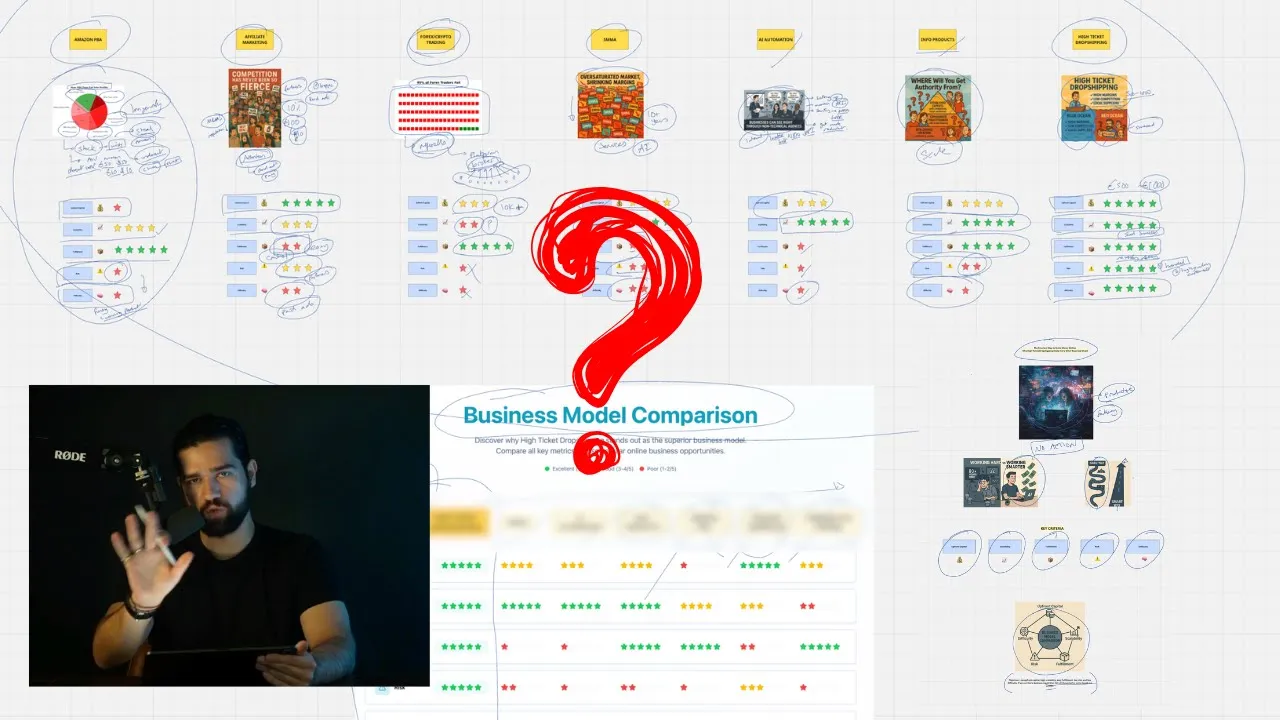
If you're trying to work out the smartest online business model for 2026, the best one to actually start, here's the short answer: score every model on the same five tests: upfront capital, scalability, fulfilment, risk and difficulty. And high-ticket dropshipping is the only one that passes all five. That's the argument I make in the video this article comes from, and below I'll walk through the same scorecard in writing, model by model, so you can check my working rather than take my word for it.
Prefer to watch instead? The full video is on this page, same comparison, same scorecard, delivered to camera.
One thing before we start. This is not a hate piece on any model. Amazon sellers, affiliates, agency owners: there are professionals doing genuinely well in every category on this list. What follows is my honest read, based on my own experience and the people I've worked with, of what each model demands from a beginner starting in 2026. Every model gets judged on the same criteria, in the same order, with no special treatment for the one I run.
The five tests that actually matter
Most "best business model" content online is someone flashing a car and telling you their thing is easiest. Ignore the car. Judge every model on five things:
Upfront capital: how much money you must put in before your first sale.
Scalability: how far the business grows without the wheels coming off.
Fulfilment: how hard it is to actually deliver what you sold.
Risk: financial risk, but also your reputation, legal exposure and platform dependence.
Difficulty: how realistic it is for a beginner to run this properly.
The winning profile is obvious when you write it down: low capital in, high ceiling, easy fulfilment, low risk, learnable by a serious beginner. Now hold each model against that profile.
The scorecard at a glance
Model | Upfront capital | Scalability | Fulfilment | Risk | Difficulty |
|---|---|---|---|---|---|
Amazon FBA | £10k+ in stock | Strong | Easy (FBA) | High | High |
Affiliate marketing | Low | Middling | Not in your control | Third-party | High without an audience |
Forex / crypto trading | Mid (5 figures to trade sensibly) | Poor | Trivial | Extreme | Extreme |
Service / SMMA agency | Modest | Good | Hard at quality | Reputational | High — skill-led |
AI automation agency | Modest | Big | Hard | GDPR + redundancy | High — technical |
Info products | Modest | Huge | Varies | Competitive | Harder than advertised |
High-ticket dropshipping | £500–£1,000, no stock | Strong | Minutes per order | Low — branded goods, no inventory | Low with proper education |
Read the rest for the working behind each row, starting with the model most people try first.
1. Amazon FBA: the platform takes the margin and holds the power
Amazon gives you an enormous pool of buyers, and people do make it work. But look at what the model asks of you. You buy stock upfront, often thousands of units, commonly £10,000 to £20,000 before you've sold anything. Then Amazon takes its cut at every stage: FBA fees, storage fees, shipping, and increasingly the advertising you must buy on the platform just to be seen.
Now the economics. The average order on Amazon sits around £50. At a 20% margin that's roughly £10 of profit per sale. Ten pounds, before returns, before ad spend, before the fee changes you don't control. To make that pay you need serious volume, which means more stock, which means more capital locked up in boxes sitting in a warehouse.
And the platform risk is real. Listings get hijacked. Accounts get suspended. Amazon's own brands watch what sells and move in on it. Chinese manufacturers increasingly sell direct on the platform and undercut the middleman entirely, and if you're reselling someone else's product, the middleman is you. Find a winning product and it might have a shelf life of two or three months before the copycats arrive, and you're back to hunting. That constant product churn is why I say the model is built on sand: it can pay, but it never gets stable.
Verdict: heavy capital, real scalability, easy fulfilment (Amazon handles it), high risk, high difficulty.
2. Affiliate marketing: a commission business without control
Affiliate marketing looks friendly because the barrier to entry is nearly zero, no stock, no product, just a referral link. That's exactly the problem. Everyone else can get the same link, so you're one voice in an enormous crowd competing for attention. A typical arrangement pays around 10% commission, so a £100 sale earns you £10, similar money to Amazon, with even less control.
The affiliates who genuinely do well fall into two camps: people who already have an audience, and specialists who deeply understand paid traffic and can buy attention at a profit. If you're neither, you're pushing links at your personal network. And the MLM-flavoured schemes waiting in this space will happily burn your reputation for you.
The deeper issue is control. You don't fulfil the product, which sounds like a benefit until the partner ships late, handles refunds badly or changes the commission terms. Their failures land on your name, and your income depends entirely on decisions made in someone else's boardroom.
Verdict: low capital, middling scalability, fulfilment out of your hands, meaningful third-party risk, difficult without an audience or paid-traffic skill.
3. Forex and crypto trading: a casino with better marketing
I'll be blunt because someone should be: around 95% of retail forex traders lose money, and the true figure is probably worse. The people selling you trading courses usually aren't making their money from trading. They're affiliates for brokers, earning fees when you sign up and a slice of the spread while you trade. Their business model is recruiting you, not beating the market.
Can you start small? Sort of, but if you're risking a sensible 1–5% of your account per trade, you need a five-figure balance before the wins are worth anything. There are no systems to build, no asset that compounds, no business to sell later. And the same speed that makes a good week feel incredible is what empties accounts: money made fast in leveraged markets leaves faster.
Verdict: middling capital, poor scalability, trivially easy fulfilment, extreme risk, extreme difficulty. It's the casino of this list.
4. Agencies, social media, content and the AI gold rush
Service agencies have been a legitimate route online for a decade: social media management, copywriting, video editing, design. The 2026 problem is that AI tooling has collapsed the price of exactly those deliverables. Logos, ad copy, edits. Clients can get a passable version from a tool for close to nothing, so agency margins are shrinking while the remaining work concentrates with genuine specialists.
The newer pitch is the AI automation agency: "implement AI for businesses with no tech skills needed." Be careful with this one. The tools are real, n8n, Vapi, Zapier, Lovable, Bolt, and sophisticated agencies are doing well with voice receptionists, automated ad pipelines and proper consulting. But a business buying automation can usually tell the difference between a developer-led team and someone reselling a template. You're taking on questions of API maintenance, security, GDPR compliance and the awkward truth that the platforms are improving so fast the system you build this year may be something your client can do in-house next year.
If you have genuine technical skill, agencies remain a real opportunity. If the pitch you heard was "no skills needed," the pitch was the product.
Verdict: modest capital, good scalability, hard fulfilment at quality, real reputational risk, genuinely difficult. Because you're competing with people who are world-class at the skill.
5. Info products: real business, brutal prerequisites
I run an education business, so I'll hold it to the same standard. Courses and mentoring are enormously scalable, knowledge travels worldwide at no marginal cost. But the prerequisite everyone skips over is that you need something true to teach: real experience, real credibility, and a way to get results for other people, kept up to date in a market that shifts every year.
"Package your passion into a course" is easy to say and easy to do badly. The making of the course was never the hard part, ebooks and video lessons take time, not genius. The hard part is being good enough at the thing that strangers pay you to learn it, and staying good enough that they keep getting value. If you already have a genuine skill (an instrument, a sport, a trade, one of these very business models), teaching it can be an excellent business. If you'd be learning the skill in order to sell it, you're building on the same sand as the Amazon product-hunters.
Verdict: modest capital, huge scalability, fulfilment ranges from trivial to heavy depending on how hands-on you are, competitive risk, harder than the gurus admit.
6. Why high-ticket dropshipping wins the scorecard
Now run high-ticket dropshipping, high-ticket e-commerce, through the same five tests. This is selling premium products, typically £500 to £5,000 each, from established brands, supplied by local UK or US distributors who hold the stock and ship it after you've made the sale.
Upfront capital. You never buy inventory. The customer pays you, you pay the supplier, the supplier ships. Realistically you want £500 to £1,000 to launch properly, the store, the tooling, early advertising, which is a fraction of the stock bill other e-commerce models demand on day one.
Scalability. The margin on a single sale is £500 to £1,000 on the higher-end products. That changes the arithmetic of scale completely: a store doing ten, twenty, thirty orders a month is still a small, calm operation, no warehouse, no packing bench, no staff, yet those are meaningful numbers precisely because each order carries real margin. Compare that with needing hundreds of £10-profit orders on Amazon to clear the same ground.
Fulfilment. An order takes minutes to process: pass it to the supplier, pay them, add the tracking. Local suppliers with next-day delivery handle the physical work, and because they're established distributors, they handle it well.
Risk. Two structural things keep risk low. First, you're selling branded goods. In a coffee niche that means names like Nespresso, Sage and Breville, so the product quality and the trust already exist; you're not gambling on an unbranded gadget surviving contact with customers. Second, there's no inventory risk: nothing bought upfront, nothing sitting unsold. Add customers who are, frankly, pleasant to deal with, people spending £2,000 on a considered purchase behave differently from bargain-hunters. And the risk profile is the lowest on this list.
Difficulty. Here's the honest caveat: this is one of the easiest models on the list if you know what you're doing, and a mess if you don't. Supplier approval, niche selection, store build, advertising, done with proper education or mentoring, it's a clear path. Attempted on a whim from free YouTube clips alone, it goes the way of every other model attempted on a whim. The difficulty isn't the model; it's whether you take learning it seriously.
Five tests, five passes. No other model on the list manages more than three.
Blue ocean, red ocean
There's a strategy book worth stealing one idea from: most sellers are in a red ocean, thousands of people fighting over the same low-ticket products, discounting against each other until nobody makes anything. High-ticket operates in the blue ocean: fewer competitors, premium products, local supply chains and margins that survive contact with reality. Most people won't do it, partly because they've never heard of it and partly because it asks for more seriousness than flipping £10 gadgets. That's precisely why it keeps working.
The time, energy and money triangle
One last filter for whichever direction you choose. Every business trades between your time, your energy and your money. Plenty of time but little capital? Skill-based routes and organic growth suit you. Capital but no time? Speculating in leveraged markets is the expensive way to learn this lesson; structured, delegated models exist instead. The reason I keep landing on high-ticket is that it balances the triangle: modest money in, sensible hours, and systems, not your personal grind, carrying the scale.
Whatever you pick, pick and act. Endless research feels productive and moves nothing. A year from now the people who chose a sound model and worked it seriously will be somewhere; the people still comparing options will be exactly where they are today.
Register to watch the free training →
Related reading
High Ticket Dropshipping With AI: The Five Systems You Actually Need
Dropshipping Mentor Proof: What Should You Actually Demand Before You Pay?
Frequently asked questions
What is the best online business model for 2026?
Judged on upfront capital, scalability, fulfilment, risk and difficulty together, high-ticket dropshipping comes out on top: no inventory purchase, £500 to £1,000 of margin per sale, local branded suppliers handling delivery, and a risk profile the other models can't match. The catch is that it rewards proper education. It's the easiest model on the list only for people who learn it before they launch.
How much money do I need to start high-ticket dropshipping?
Around £500 to £1,000 covers a proper launch, store, tools and initial advertising, because you never buy stock. You can start leaner without paid ads; it simply grows more slowly. Compare that with Amazon FBA, where £10,000+ of upfront inventory is normal before your first sale.
Is Amazon FBA still worth starting in 2026?
It can work, but the deck is stacked: fees at every layer, roughly £50 average orders leaving about £10 per sale at typical margins, capital locked in stock, and platform risk from hijacked listings, suspensions and manufacturers selling direct. Winning products also age fast, so you're forever hunting the next one. It's a volume treadmill, not a compounding asset.
Why not forex or crypto trading?
Because the maths is against you, around 95% of retail forex traders lose money, and the incentives behind the industry are worse: most people promoting trading earn broker referral fees from recruiting new traders, not from trading itself. There's no system to build and no business to own at the end.
Are AI automation agencies a good opportunity?
For genuinely technical people, yes. Voice agents, automation pipelines and consulting are real and growing. For everyone being sold "no skills needed," no. Clients can spot a reseller, the maintenance and security obligations are real, and the platforms improve so quickly that yesterday's build gets replaced in-house. Skill first, agency second.
Ready to Build Your Ecommerce Business?
Get started with our free training and discover the exact framework we use to build sustainable high-ticket stores.
Related articles

High-Ticket Dropshipping 101
High-Ticket vs Low-Ticket Dropshipping: An Honest Comparison
High ticket vs low ticket dropshipping compared honestly: margins, risk, timeline and who each model actually suits.

High-Ticket Dropshipping 101
High-Ticket Dropshipping Statistics 2026: Success Rates
See 2026 dropshipping statistics for the UK and US, including survival rates, buyer trust and source-linked data.

High-Ticket Dropshipping 101
High-Ticket Dropshipping: The Real Numbers Behind the Model
What high-ticket dropshipping actually costs, earns and breaks on — real margins, niches and a worked example, not