Best Dropshipping Products: What Actually Works for High-Ticket Stores
By Lex, Founder of Dropship Circle
The best dropshipping products are priced £300 and up, sofas, e-bikes, saunas, kayaks, pizza ovens, because that price band leaves enough gross margin per order to cover ads, delivery and support. Below £300, margin per order rarely survives contact with real costs.
Most "best dropshipping products" lists are the same recycled catalogue of £15 phone cases and LED strips, high order volume, thin margins, constant saturation. I run high-ticket stores and mentor operators through Dropship Circle, and the pattern across £8.25M in tracked sales spanning our own, student and client stores is consistent: the product itself matters less than whether the price band can absorb the real cost of winning and serving an order.
This isn't a trend list. It's the pricing and category logic that decides whether a product is worth building a store around.
What Makes a Dropshipping Product 'Best' Right Now?
A best dropshipping product clears roughly £300 in retail price, carries 30%+ gross margin, and isn't so fragile or bulky it eats that margin in delivery damage or returns.
Low-ticket dropshipping needs 125–1,000 orders to hit £10,000 revenue at £10–£80 a sale. High-ticket needs just 2–20 orders at £500–£5,000+ a sale to hit the same number. That's the entire case for high-ticket: same operational effort, sourcing, listing, fulfilling, handling a support ticket, applied to a transaction worth ten to fifty times more.
But price alone isn't the qualifier. A £1,800 item at 20% gross margin can perform worse than a £900 item at 38% margin with cleaner supplier terms and simpler delivery. Margin percentage and delivery complexity decide the winner more often than sticker price.
Best Dropshipping Products to Sell Right Now
The strongest current categories are outdoor and garden (saunas, hot tubs, kayaks), home comfort (sofas, recliners, fire pits) and functional kitchen appliances (pizza ovens, ranges), all commonly £300–£4,000.
A fast way to find them: go into Amazon departments, pick a broad vertical (Home & Kitchen, Sports & Outdoors, Garden), then sort price high to low. That single filter surfaces coffee makers, ovens, pizza ovens, tents, kayaks and car racks that people are already paying serious money for, proof of price tolerance before you build anything.
Best Dropshipping Products 2026
For 2026, outdoor living and home wellness are holding up best: infrared saunas, plunge pools, garden furniture sets and e-bikes. These sit comfortably in the £500–£3,000 range DSC treats as the practical high-ticket band, enough per order to justify a proper ad budget and real customer service.
Generic trend lists (like the 150+ product roundups circulating for 2026) mostly recycle kitchen and baby-product categories that are technically "trending" but priced £15–£60, fine for volume plays, wrong fit for a lean, high-margin operation.
Best Dropshipping Products for Summer
Summer favours outdoor and cooling categories: hot tubs, garden kitchens, patio heaters bought early, kayaks, paddleboards and portable AC units. Furniture and outdoor living niches often peak in spring/early summer, so building in the winter trough lets a new store age and start ranking before demand arrives.
Check both the 12-month Google Trends window and the 5-year view before committing, the 12-month view shows the seasonal dip-and-recovery rhythm, the 5-year view exposes one-off spikes (like a lockdown surge) that look like sustained demand but aren't.
How Do You Actually Calculate If a Product Is Worth Selling?
Calculate contribution, not gross margin: retail minus supplier cost minus payment fees, delivery, acquisition cost, returns and support. What's left after everything is the number that matters.
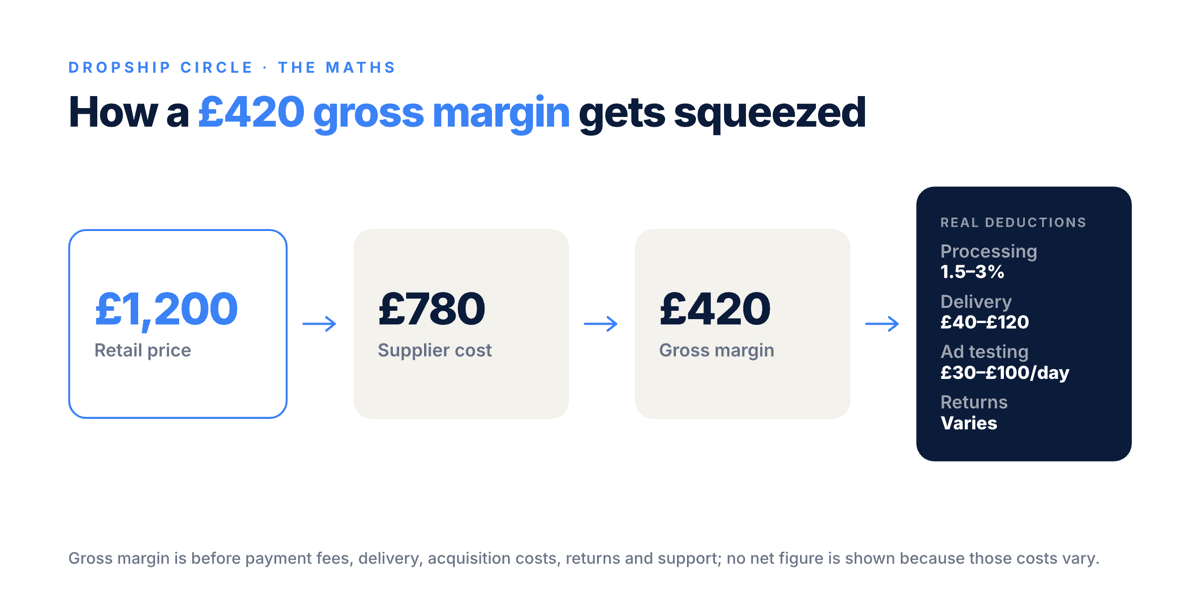
On a £1,200 product with an £780 supplier cost, gross margin looks like £420. But payment processing (1.5–3%), delivery surcharges (£40–£120) and daily ad testing spend (£30–£100) all come out of that £420 before you've banked anything. Run the full deduction stack before you commit stock time to a niche, not after the first order ships.
Price band | Orders needed for £10k revenue | Typical gross margin | Room for error |
|---|---|---|---|
£10–£80 (low-ticket) | 125–1,000 | 10–20% | Almost none — one bad week of ad spend wipes it |
£300–£800 (entry high-ticket) | 13–33 | 25–35% | Tight — one damaged delivery hurts |
£1,000–£3,000+ (core high-ticket) | 2–10 | 30–40%+ | Real buffer for ads, returns, support |
A Worked Example: When a 'Good' Product Quietly Loses Money
Say you list a £1,000 fire pit table with a £120 gross margin. That £120 gets wiped out by a single £60 delivery issue, leaving £60 before ads, returns or support time are even counted.
That's the realistic failure mode with high-ticket bulky goods: the product sells, the customer's happy on the surface, and the store still loses money on the order because one leg came through cracked and you're covering a replacement panel and a courier claim. It's not a bad product. It's a margin that was never thick enough to survive one operational hiccup. This is exactly why DSC pushes operators to model contribution margin before launch, not to chase the highest-priced item they can find.
eBay Dropshipping Best Selling Products, Is eBay a Fit for High-Ticket?
eBay's best sellers skew low-ticket, phone accessories, small electronics, apparel, because eBay's fee structure and buyer expectations reward volume over margin.
High-ticket dropshipping generally performs better on a self-hosted store (Shopify or similar) where you control checkout, warranty messaging and post-sale support. All of which matter more when a customer is spending £800 rather than £18. eBay can work for testing demand on a specific SKU, but it's a poor long-term home for a £300+ catalogue because you're competing on price against sellers with thinner overheads.
What Are the Best Websites for Dropshipping Products?
For high-ticket sourcing, real UK/US distributors and manufacturers with direct-to-customer shipping beat general marketplaces like AliExpress, which is built for low-cost, high-volume goods.
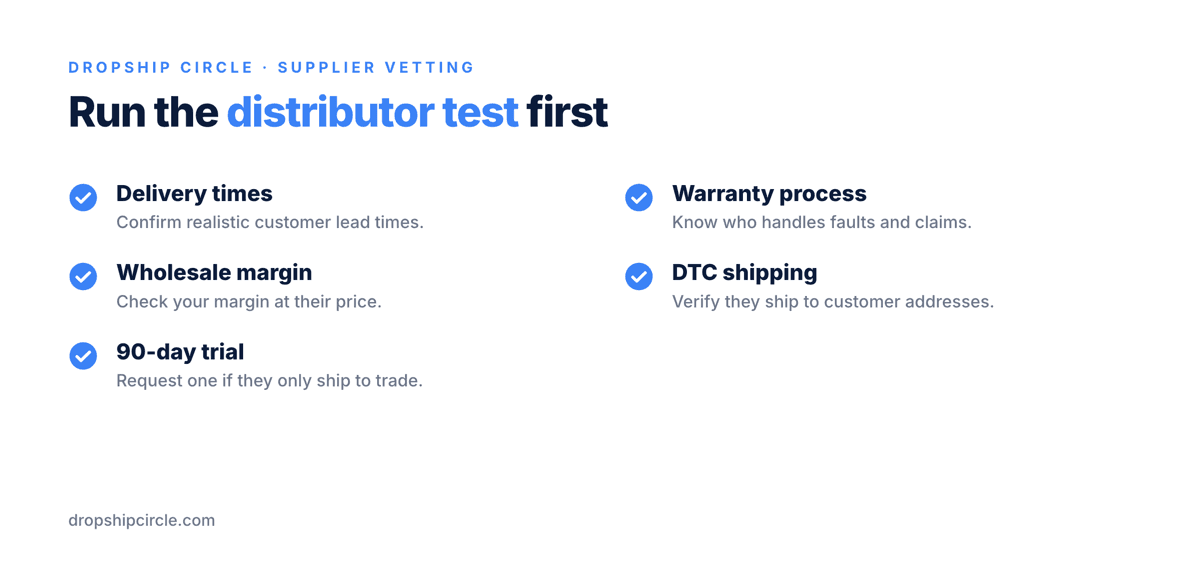
Before committing to any supplier site, run the distributor test: ask about delivery times, warranty process, your margin at their wholesale price, and whether they'll ship direct to customer addresses. If they only ship to trade/business addresses, ask for a 90-day DTC trial before you build a store around them. A supplier list is not a business. The terms behind it are what decide if the model works.
Best Dropshipping Products for Pakistan-Based Sellers
Sellers operating from Pakistan into UK/US markets should apply the same £300+ contribution logic, but weight suppliers and niches toward those offering reliable international DTC shipping and clear warranty handling across borders.
The product categories don't change, furniture, outdoor living, appliances still work, but supplier vetting matters more when you're managing cross-border logistics and currency conversion on top of delivery risk. The distributor test above becomes non-negotiable rather than optional.
Why Does Site Speed Affect Which Products Actually Sell?
A one-second page load beats a five-second load by roughly 3x on conversion rate, according to Portent's research, and Core Web Vitals are a confirmed Google ranking signal.
This matters more on high-ticket stores, not less, when each visitor represents a potential £500–£3,000 sale rather than a £15 impulse buy, a slow product page isn't a minor annoyance, it's a five-figure-a-year leak. Product choice and site performance aren't separate problems; a great product on a slow store still underperforms.
Should You Worry About Consumer Confidence Right Now?
Furniture and flooring purchases get delayed, not cancelled, when household budgets tighten, making these categories more volatile month-to-month than essentials, even though long-term demand holds.
That's not a reason to avoid furniture as a niche, sofas ranging up to £4,000 remain a solid high-ticket category. It's a reason to build cash buffer and realistic sales forecasts rather than assuming linear month-on-month growth. Know what you're actually betting on: a furniture store isn't betting on the product being good, it's betting on discretionary spend holding up, which is a different risk to manage.
Key takeaways
Best dropshipping products sit at £300+ retail with 30%+ gross margin: below that, delivery, ads and fees erode margin fast.
High-ticket needs 2–20 orders for £10k revenue versus 125–1,000 for low-ticket at the same target.
Calculate contribution (all real costs), not gross margin. A £420 gross margin can shrink to almost nothing after fees, delivery and ad testing.
Use Amazon departments sorted price-high-to-low to find real high-ticket product ideas fast.
Run the distributor test before building around any supplier: delivery, warranty, margin, and a DTC trial if needed.
One damaged delivery or return can wipe out the entire margin on a bulky high-ticket item, model that risk before launch.
Related reading
Trending Dropshipping Products: What to Ignore and What to Take Seriously
High Ticket Products: What They Are and How to Find Ones Worth Selling
The Smartest Online Business Model for 2026 (And Why High-Ticket Wins)
Frequently asked questions
What dropshipping product is most successful?
There's no single winner, the most successful products consistently sit above £300 with 30%+ gross margin and manageable delivery risk, categories like outdoor living, furniture and appliances tend to hold up best because price tolerance is already proven.
Is drop shipping dead in 2026?
No. The low-ticket, saturated-AliExpress version is struggling, but high-ticket dropshipping with real suppliers and proper margin math remains a viable model. The structural pattern hasn't gone anywhere; it's the thin-margin execution that's dying.
Is $1000 enough to start dropshipping?
It's enough to start testing, but tight for high-ticket, between a store build, initial ad testing (£30–£100/day) and a buffer for the first few order issues, £1,000 leaves very little margin for error. More capital gives you room to survive the first mistakes.
How many dropshippers fail?
Most fail, largely because they chase saturated low-ticket products with thin margins that can't absorb ad costs, returns or platform changes. The failure rate drops considerably when the price band and contribution margin are calculated properly before launch, not after.
Who is the richest dropshipper?
There's no verified, universally agreed answer. Most claimed figures in this space are unverifiable marketing rather than audited numbers. Treat any single named 'richest dropshipper' claim with scepticism unless it comes with real, traceable proof.
If you want the full system behind picking a £300+ niche, vetting suppliers with the distributor test, and calculating real contribution margin before you spend a penny on ads, Dropship Circle runs free training that walks through it properly, no rented Lambos, just the workings.
Ready to Build Your Ecommerce Business?
Get started with our free training and discover the exact framework we use to build sustainable high-ticket stores.
Related articles

Products
Trending Dropshipping Products: What to Ignore and What to Take Seriously
Trending dropshipping products: what to ignore, what to take seriously, and how to find ones with real margin left.

Products
High Ticket Products: What They Are and How to Find Ones Worth Selling
What are high ticket products, real examples, and how to find profitable high-ticket dropshipping and affiliate items