Yes. Dropship Circle is a UK-registered training and mentoring business for high-ticket dropshipping, based in London and run by a named founder rather than a brand account. Independent reviews sit on Trustpilot, where the profile has been claimed since January 2023 and scores 4.4 from 81 reviews as at 8 October 2026. The programme itself is education and mentoring: supplier sourcing and approval, niche and product selection, store build, and paid traffic. Training is priced by tier and mentoring is scoped individually.
What it is not. It is not a franchise: there is no territory, no licence and no fee to trade under our name. It is not a get-rich scheme, and nobody here can promise you an outcome. And it is not affiliated with dropship-circle.com or dropship-circle.co.uk, which are separate and unconnected businesses that we do not own or operate. Our only site is dropshipcircle.com.
I'm Lex, I run it. Everything below this point is either something you can check without asking me, or something a sales page would never print.
Why you're even asking
You searched this because the online business education industry earned its reputation, and scepticism is the correct starting posture.
Rented Lamborghinis, screenshot income claims, courses that are a rehashed YouTube playlist behind a paywall. I would think less of you for skipping the check. The problem is that scepticism alone tells you very little, because every company in this space, good and bad, has a slick site and a testimonial page. So here is how to actually check one.
What is Dropship Circle?
Dropship Circle is a UK training and mentoring programme that teaches people to sell premium products online, typically in the £500 to £5,000 band, supplied by established brands and distributors who hold the stock and ship after the sale is made.
You own the storefront, the marketing and the customer relationship. The supplier owns the warehouse. Members get a structured programme covering supplier sourcing and approval, niche and product selection, store build and paid traffic, plus direct access to me and my team for the parts that are genuinely hard, which are usually supplier relationships and ad economics.
It is education and mentoring. It is not a done-for-you promise and it is not a software product.
Where is Dropship Circle based, and who runs it?
It is a UK company based in London, and I run it under my own name. I am on YouTube weekly, on this blog, and on calls with members.
That matters in an industry where the standard failure mode is a logo, a rented lifestyle and a disappearing act. If you cannot identify a named human with a traceable history behind a course, walk away, from us or from anyone.
Green flags and red flags at a glance
Here is the checklist I would use to assess a company in this space from the outside. Apply it to us and to everyone else on your shortlist.
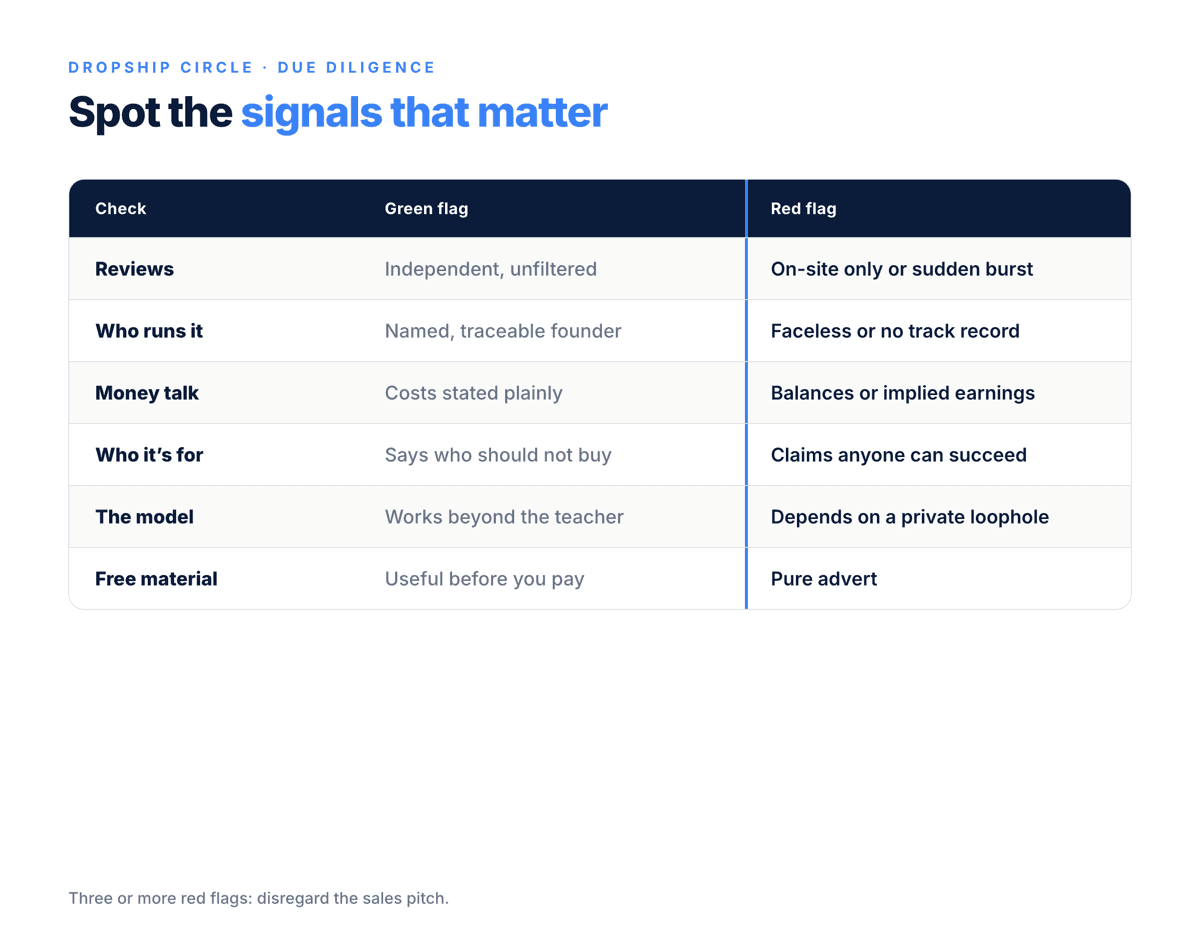
What to check | Green flag | Red flag |
|---|---|---|
Reviews | Independent profile you can read unfiltered, including criticism | Only on-site testimonials, or a burst of reviews all posted the same week |
Who runs it | A named person with a verifiable track record, visible regularly | Faceless brand, or a "founder" with no history in what they teach |
Money talk | Costs stated plainly; no outcome implied | Screenshots of balances, "typical" earnings, countdown timers |
Who it's for | Openly tells you who should not buy | "Anyone can do this, no experience or capital needed" |
The model | Works independently of the teacher, verifiable in the real market | Only works via their private system, method or loophole |
Free material | Substantial and genuinely useful before you pay | Free content is a pure advert with nothing usable in it |
If a company fails three or more of those, it does not matter how good the sales call is.
How do you verify a dropshipping course, including this one?
Run five checks. They take about ten minutes, and they work on us and on every competitor you are considering.
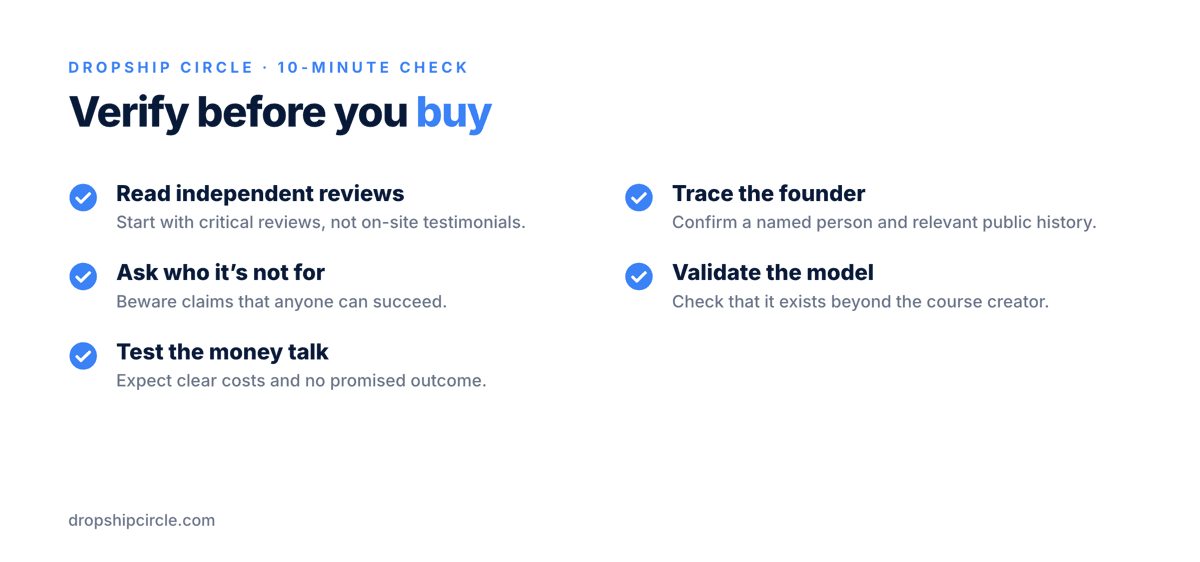
1. Find an independent review profile, not just on-site testimonials.
Anyone can put praise on their own website. Read our Trustpilot profile and sort by lowest rating first. As at 8 October 2026 it shows 4.4 from 81 reviews, and the critical ones are on there with our replies underneath. If a company has no third-party profile anywhere, or only reviews that all appeared in the same week, that tells you something.
2. Find out who actually runs it.
You should be able to see a real person, with a real track record, who puts their name on the business. If the founder has no verifiable history in the thing they teach, walk away.
3. Check whether they will tell you who it is not for.
Every legitimate operator has a customer they turn away. If the pitch is "anyone can do this, no experience, no capital", you are being sold to rather than taught. Our version of that answer is two sections down, and it is deliberately plain-spoken.
4. Check the model before you assess the teacher.
High-ticket dropshipping means selling premium products, typically £500 to £5,000, supplied by established UK or US distributors who hold the stock and ship after you make the sale. You can verify that this model exists independently of me: look at any established online retailer of hot tubs, saunas, garden offices or commercial equipment. Many operate on exactly this structure. The business model is not the part you have to take on faith.
5. Watch how they handle money questions.
A legitimate operator states what you are responsible for and never implies a specific outcome. If someone shows you a bank balance and implies it is typical, that is a regulatory problem for them and a warning sign for you.
What Dropship Circle is not
It is not a franchise, not a get-rich scheme, and not related to the hyphenated domains that appear in search results for our name.
Not a franchise or licence. You are not buying a territory, a licence, or the right to trade under our brand. You build your own store, under your own company, with your own supplier accounts, and you keep them.
Not a get-rich scheme. There is no guaranteed outcome and no promised timeline. What happens next depends on your market, your budget and the work you do, and that is true of any business.
Not affiliated with dropship-circle.com or dropship-circle.co.uk. Those are separate and unconnected businesses. Our only website is dropshipcircle.com, and our Trustpilot profile is the one for dropshipcircle.com.
Not done-for-you, by default. The core programme is education and mentoring. You run the business.
Who Dropship Circle is genuinely not for
The honest review of any programme is the list of people it does not fit, so here is ours.
If you want something hands-off, this is not it. It is a real business with customers, suppliers, refunds and admin. Lighter than holding stock, still needs running. Anyone describing ecommerce as effortless is describing something they have not done.
If you need it to cost nothing, plan first. You never buy stock, because the customer pays you before you pay the supplier for that order. What you do need is £1,000 or more to get started: the site, registration and your first advertising. If you are not there yet, work through the free training while you put it aside, and you will start with a plan rather than a guess.
If you want results in weeks, give it longer. Supplier approvals take time, because you are applying to real distributors who assess you as a stockist. Start those conversations early and the wait runs alongside your store build.
If you do not want to talk to suppliers or customers, this is the wrong model. High-ticket buyers ask questions before spending four figures. Someone answers the phone, and early on that is you.
None of those are about talent or background. They are about expectations, and every one of them is easy to get right if you go in knowing what the job is.
What are the three questions worth asking on any sales call?
Ask who they have turned down, what goes wrong most often, and what you own at the end. The answers separate an operator from a closer.
"Who have you turned down recently, and why?" Any operator running a genuine programme has declined people and can tell you the pattern instantly: wrong budget, wrong expectations, wrong timing. "We can help anyone" means they are optimising for volume.
"What goes wrong most often for people who start this?" The honest answers are unglamorous. People stall at supplier approval because they approach distributors like hobbyists, or they misjudge unit economics and spend into a product that cannot absorb the ad cost. If someone tells you nothing much goes wrong, they have not watched many people attempt it.
"What do I own at the end?" You should own a store, supplier relationships and skills that survive you leaving. If the answer is access to a group that disappears when you stop paying, you are renting rather than building.
What does "UK-registered" actually prove?
Very little on its own. Registration is a floor, not a credential, and it cuts against my interest to say so.
Anyone can incorporate a limited company in the UK in an afternoon for a few pounds. A scam can be registered too. It is worth checking that a company exists and files what it should, and it proves far less than people assume. Any company waving its registration around as its main proof of legitimacy is overselling a very low bar.
The same goes for a professional-looking website, a large following, or media logos. All of those can be bought. The checks that resist faking are the ones involving other people's verdicts: independent reviews you can read unfiltered, a founder with a traceable history, and free material substantial enough to be judged before money changes hands.
That is the standard I would want you holding us to.
How much does Dropship Circle cost?
Training is priced by tier, and mentoring beyond that is scoped individually.
The more useful number is what it takes you to start: realistically £1,000 or more before you have a store live, a supplier approved and a product properly tested. That covers the store and tools, registration and advertising while you learn. You do not need a stock budget or a float to pay suppliers: the customer pays you first, you pay the supplier per order, and if a card payout takes a few days to land, suppliers will usually give you a few days' credit or you set a 2-3 day dispatch window. Keep a good share of that £1,000 for advertising, because that is what puts the store in front of buyers.
The honest summary
Dropship Circle is a real business, run by a named person, with an independent review profile you can read without asking us, teaching a model you can verify exists on your own. That is what "legit" means, and it is the floor, not the ceiling.
The better question is the one I would ask in your position: is this model right for me, and is this the person I want teaching it? Read the critical reviews. Watch a few videos and see whether the way I explain things works for you. Ask hard questions on the call. If any part of it feels off, do not buy. The people who do well here are the ones who chose it with their eyes open.
You can judge all of it before speaking to anyone: this blog, the video library and the YouTube channel are free and substantial by design. If the free material is not useful, do not buy anything.
Register to watch the free training →
Related reading
Frequently asked questions
Is Dropship Circle a scam?
No. It is a UK-registered training and mentoring business based in London, with a named founder, an independent Trustpilot profile (4.4 from 81 reviews as at 8 October 2026) that you can read unfiltered, and a large library of free material published under my own name. Do not take that on trust. The five verification steps above take about ten minutes, and I would run them on any company asking for your money, including this one.
Is Dropship Circle a franchise?
No. There is no territory, no licence and no right to trade under our brand. You build your own store, under your own company, with your own supplier accounts, and you keep all three if you leave.
Does Dropship Circle guarantee I'll make money?
No, and be wary of anyone in this industry who implies otherwise. We teach a business model and support you in implementing it. What happens next depends on your market, your budget, the work you put in, and factors none of us control. Any company promising a specific financial outcome is making a claim it cannot stand behind.
Is dropship-circle.com the same company?
No. dropship-circle.com and dropship-circle.co.uk are separate and unconnected businesses. Our only website is dropshipcircle.com, and our Trustpilot profile is the one for dropshipcircle.com. If you are reading a review or a listing about a hyphenated domain, it is not about us.
Where can I read independent reviews of Dropship Circle?
Our Trustpilot profile is the main independent source. As at 8 October 2026 it holds 81 reviews at 4.4. Sort by lowest rating first. Reading how a company responds to criticism tells you more than any five-star review does. There is a fuller breakdown of what those reviews actually say, positive and negative, on our Dropship Circle reviews page.
How is this different from free YouTube content?
Honestly, the information overlaps. I publish a lot of the model on YouTube for free and you should watch it before spending anything. What you pay for is sequence, feedback and access: knowing what to do in what order, having someone review your niche and supplier choices before you commit money to them, and getting a direct answer when something breaks. If you are disciplined enough to self-teach from free material, do that first.
What does high-ticket dropshipping actually involve?
Selling premium products, usually £500 to £5,000, from established brands and distributors who hold stock and ship directly to your customer after you make the sale. You handle marketing, the storefront and customer support. The supplier handles inventory and fulfilment. Fewer orders, larger margins per order, no stock bought upfront, and it demands real customer service and proper unit-economics discipline.
Is dropshipping legal and legitimate?
Yes, dropshipping is legal and legitimate when the retailer follows the same rules as any other online shop. In the UK, that includes accurate advertising, product safety, tax obligations, data protection and consumer rights covering delivery, cancellations, returns and refunds; using a supplier for fulfilment does not remove the retailer’s responsibility.
What is a dropshipping scam?
A dropshipping scam is dishonest conduct carried out through a dropshipping store, not the fulfilment model itself. Examples include taking payment without supplying the product, selling counterfeits, using fake tracking details, hiding unrealistic delivery times or refusing valid refunds and returns.
Ready to Build Your Ecommerce Business?
Get started with our free training and discover the exact framework we use to build sustainable high-ticket stores.
Related articles

Mentorship & Courses
Dropshipping Mentor Cost: What the Market Charges in 2026
What does a dropshipping mentor cost? Published 2026 prices by format, what to get in writing and what the fee omits.

Mentorship & Courses
Dropshipping Mentor vs Course: Which Do You Need First?
Dropshipping mentor vs course compared on feedback, cost and stage, with a table and a checklist to choose.

Mentorship & Courses
Dropshipping Mentor Proof: What Should You Actually Demand Before You Pay?
Dropshipping mentor proof means checkable evidence, not screenshots.