High-ticket dropshipping is selling premium products, typically priced above £300, through supplier partnerships without holding stock, profit per order usually runs £150 to £800+, because the model earns from fewer, bigger sales rather than volume.
I run high-ticket stores and mentor operators through Dropship Circle. Most people land on this term after getting burned by low-ticket dropshipping, thin margins, saturated products, ad accounts bleeding money on £19 items. High-ticket is a different business: fewer customers, bigger tickets, and margins that can actually absorb a mistake.
This isn't a hype post. It's what the model costs, where it breaks, and how to check it fits before you build anything.
What Is High-Ticket Dropshipping?
High-ticket dropshipping is a supplier-fulfilled retail model built around premium products, usually priced above £300, sold in lower volume but at far higher profit per order than standard dropshipping.
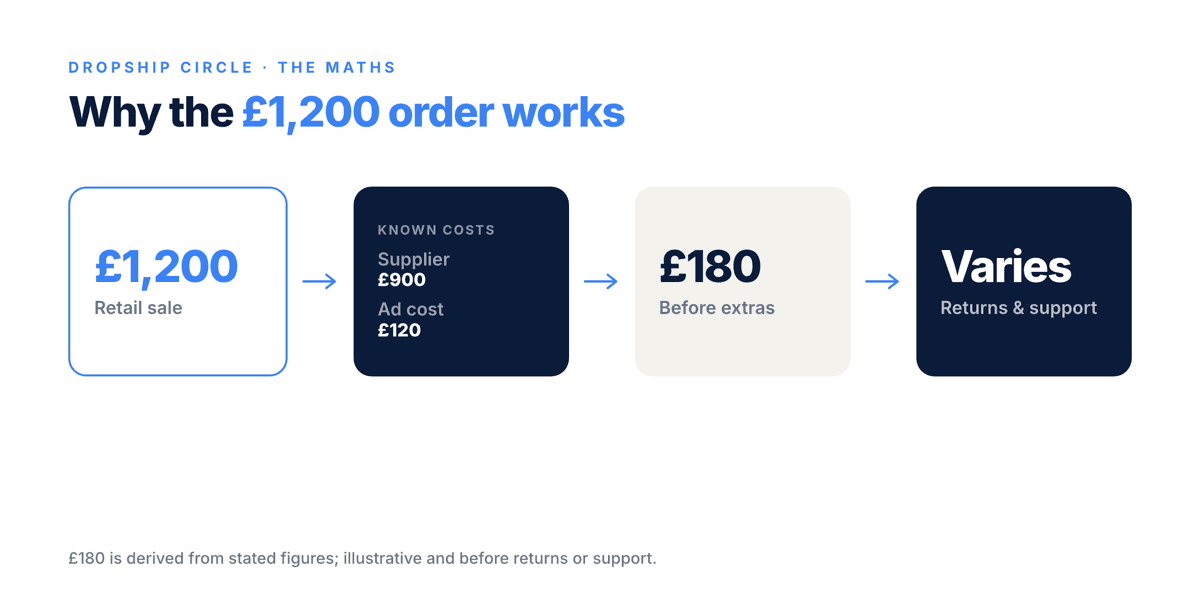
You don't hold stock. A supplier ships direct to the customer, and your job is finding buyers, running the store, and handling the sale. The difference from low-ticket dropshipping isn't the mechanics. It's the maths. A £19 item might clear £5-£30 gross profit. A £1,200 sauna can clear £300. That gap changes everything downstream: how much you can spend on ads, how many mistakes you can absorb, whether a single refund wipes out a week's work.
Take a £1,200 sauna sold for £900 from the supplier, £300 gross margin. If it costs £120 to acquire that customer through ads, the order is still comfortably viable. Compare that to a £19 product with a £14 margin and an £18 ad cost. You're paying to be busy, not to build a business.
Is High-Ticket Dropshipping Worth It?
Yes, if the margin can absorb real-world costs, ads, returns, delivery damage, and still leave profit; if it can't, the model isn't worth building around.
The honest answer depends on whether you run the numbers before you build, not after. Traditional low-ticket ecommerce typically runs 10-25% margins, with customer acquisition costs eating 15-30% of revenue. There's almost no room left when something goes wrong. High-ticket products carry enough margin to survive a bad week. That's the entire case for the model.
But worth it doesn't mean easy. Conversion rates on high-ticket items sit lower than general ecommerce. The industry average for high-ticket is around 1.5%, though a student running luxury kitchen appliances hit 3.2% through strong product pages and follow-up. You need fewer buyers, but you need to work harder to convert the ones who show up.
Here's where thin margins get exposed fast: say a £1,000 product carries £120 gross margin. A single delivery issue costing £60 in replacement or compensation leaves £60 before you've spent a penny on ads, refunds or support time. That's the gap between a margin that looks healthy on a spreadsheet and one that survives contact with a real order.
How Do You Find High-Ticket Dropshipping Products?
Validate a niche against three numbers before building: 8,000-10,000+ monthly searches for primary keywords, 40%+ gross margin after costs, and £500+ potential profit per sale.
Most people start by browsing supplier catalogues for expensive-looking items. That's backwards. Start with demand. Is anyone actually searching for this, at volume, with buying intent? Then check the margin math actually clears the bar, not just looks impressive on paper.
Build a per-product gross margin sheet before you commit to anything: retail price, supplier cost, payment processing fees (2-3%), your ad cost target, and a delivery surcharge risk line. On a £1,200 product with £900 supplier cost, that's £300 gross margin before fees, minus 2-3% payment processing, minus an £80-£180 ad cost target, minus £0-£100 for delivery surcharge risk. If what's left doesn't clear £500 profit per sale, the niche fails the test regardless of how good the products look.
Supplier catalogues are often messy. It's common to get a spreadsheet of 2,000+ products with RRPs set at double the real market price. The instinct is to stop and check every SKU before launching, don't. Launch the range together, then price-match individual products against the market as you go. Waiting to perfect the catalogue costs more than launching with a few mispriced items.
Best High-Ticket Dropshipping Niches
The strongest niches combine genuine search demand, thin competition on specific SKUs, and margins that clear £500+ profit per sale, outdoor structures, home spas and saunas, premium furniture, and specialist fitness or garden equipment consistently qualify.
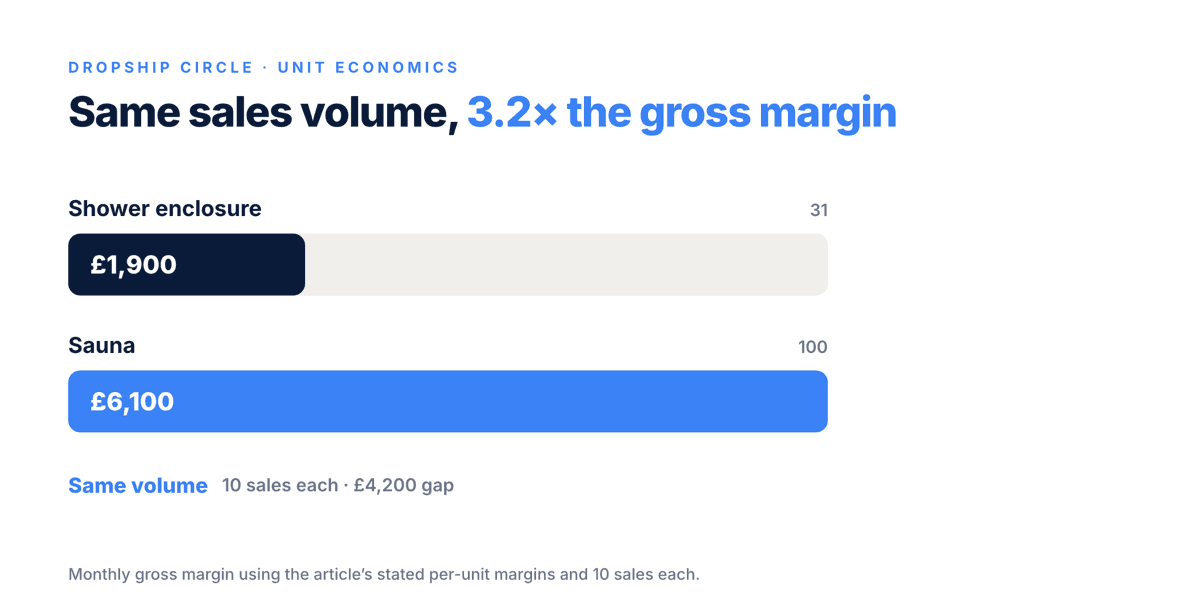
Running the sums matters more than the category. Say two products both sell 10 units a month: a £900 shower enclosure at £190 margin, and a £2,400 sauna at £610 margin. Ten sales of the sauna is £6,100 against £1,900 for the shower enclosure, same ad budget, same sales volume, three times the money. The niche isn't the winning factor; the per-unit economics are.
Is High-Ticket Dropshipping Worth It in the UK?
Yes. UK demand for premium home, garden and outdoor products is strong, but operators must register for VAT once taxable turnover passes £90,000 in a 12-month period.
High-ticket dropshipping UK operators tend to focus on categories with strong domestic demand and supplier proximity, garden structures, home improvement, outdoor leisure. The UK market rewards operators who can offer fast delivery and clear warranty terms, because buyers spending £1,000+ expect service that matches the price.
HMRC's VAT registration threshold is a real constraint to plan around, not an afterthought, once your taxable turnover crosses £90,000 in any rolling 12-month period, registration is mandatory. Build that into your pricing model early rather than discovering it mid-growth.
The model isn't UK-only, though, the same economics apply in the US and other English-speaking markets. What matters more than geography is whether you can actually service the country you're selling into: can a supplier authorise your territory, will they ship direct to customers, and can you answer a call when a £1,500 buyer has a question.
What's the Biggest Risk in High-Ticket Dropshipping?
Timing seasonal demand wrong is one of the most common ways operators lose money. Building for a season after the search demand has already peaked.
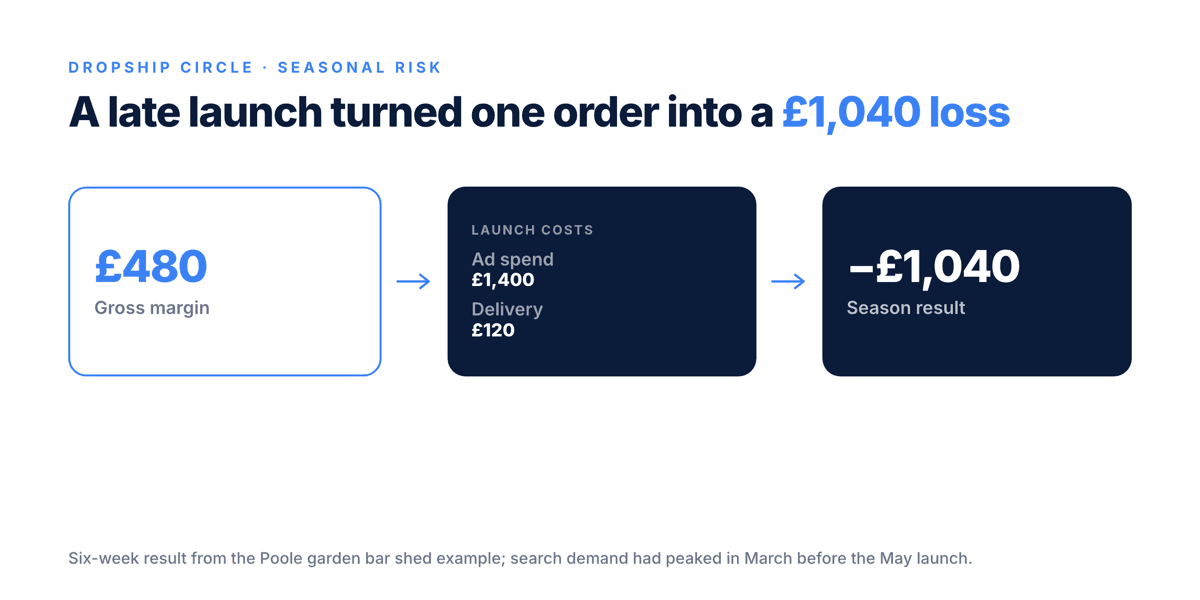
A seller in Poole spent the spring building a store around garden bar sheds, launching in the third week of May. He put £1,400 behind the launch and waited for the summer he'd built the whole thing for. The problem: searching for garden bar sheds had already peaked in March, weeks before the store went live. Six weeks brought in one order, carrying £480 gross margin. Subtract £1,400 in ad spend and £120 in delivery costs, and the season closed £1,040 down.
The store wasn't broken, the timing was. It worked the following March, almost by accident, when demand rose again and the store was simply still there. Seasonal demand isn't a curve you ride as it happens; it's a door that opens before the season starts. Build in the quarter before the one you're targeting, not during it.
High-Ticket vs Low-Ticket Dropshipping: What's the Real Difference?
The core difference is volume versus margin. Low-ticket needs constant, high-volume sales at thin margins; high-ticket needs fewer sales at margins that can absorb real costs.
Low-Ticket | High-Ticket | |
|---|---|---|
Typical price | £10-£50 | £300+ |
Typical gross margin | £5-£30 per order | £150-£800+ per order |
Margin as % | 10-25% | Often 40%+ |
Conversion rate | Higher volume, lower value | Lower (often under 3%), but higher value |
Room for error | Almost none | Meaningful, if margin is real |
Customer acquisition cost tolerance | Very low (£5-£15) | Higher (£80-£180+) |
Scale isn't the same as quality. Between 2020 and 2024, Ferrari sold fewer than 60,000 cars at an average price above $450,000, while Toyota sold over 52 million vehicles at roughly $32,000 each and GM sold nearly 30 million at around $51,000. Ferrari's unit volume is a rounding error against either, the business model doesn't need mass volume to work. That's the logic high-ticket dropshipping borrows: fewer transactions, better economics per transaction, a business that doesn't depend on outcompeting everyone on price.
Do You Need a Course for High-Ticket Dropshipping?
Not strictly, but a structured high-ticket dropshipping course shortens the path by teaching supplier outreach, niche validation and margin modelling that most beginners get wrong on their own.
Free content, blogs, YouTube, forums, can teach you the mechanics: what dropshipping is, how supplier relationships work, roughly what to sell. What it rarely teaches is the operating discipline: how to actually validate a niche against real search volume and margin thresholds, how to negotiate supplier terms, how to handle a return on a £2,000 item without eating the loss.
A good high-ticket dropshipping course should cover the full system, not just product selection: niche validation, supplier vetting, store build, pricing, traffic, fulfilment and customer service. That's the standard we hold Dropship Circle to: across £8.25M in tracked sales spanning our own, student and client stores, the pattern is consistent, margin discipline and supplier relationships decide who survives, not which product they picked. If a course only teaches you how to find products, it's teaching a third of the business.
Being sceptical of high-ticket dropshipping courses is fair, plenty oversell. Ask what specifically is taught, whether it covers supplier negotiation and after-sale service, and whether the instructor can show real numbers, not just screenshots.
Key takeaways
High-ticket products are typically priced above £300 and can generate £150-£800+ profit per order, versus £5-£30 on low-ticket items.
Validate any niche against three numbers before building: 8,000-10,000+ monthly searches, 40%+ gross margin, £500+ profit potential per sale.
Model your margin sheet against realistic costs, payment fees, ad spend and delivery surcharge risk, not optimistic best-case numbers.
Timing matters as much as product choice, build in the quarter before your target season, not during it.
Thin margins get wiped out fast by delivery issues and returns; the bank account tells the truth that dashboard analytics can hide.
Scale isn't the same as a good business. Fewer, higher-margin sales can outperform high-volume, thin-margin models.
Related reading
The Smartest Online Business Model for 2026 (And Why High-Ticket Wins)
High Ticket Dropshipping With AI: The Five Systems You Actually Need
Frequently asked questions
Is high-ticket dropshipping profitable?
It can be, when the margin genuinely clears real costs, ads, payment fees, delivery risk and returns, not just the retail-minus-supplier-cost figure on paper. Profit per order typically runs £150-£800+, which gives far more room to absorb mistakes than low-ticket margins of £5-£30.
Why do 90% of dropshippers fail?
Most fail on thin low-ticket margins that leave no room for ad costs, returns or market shocks. Customer acquisition costs alone often consume 15-30% of revenue in traditional ecommerce. Add poor niche validation and no real supplier relationship, and there's nothing left to survive a bad month.
What is the high-ticket dropshipping method?
It's selling premium products, usually priced above £300, through supplier partnerships without holding stock, earning larger profit per order (£150-£800+) from fewer sales rather than chasing volume on thin-margin items.
Is drop shipping dead in 2026?
No, but the low-ticket, race-to-the-bottom version of it is increasingly unworkable. High-ticket dropshipping remains viable because it's built on margin and service quality rather than out-competing everyone on price.
Why do so many dropshippers fail?
Weak margins, poor niche validation, and no plan for what happens when something goes wrong, a return, a delivery issue, a slow month. Low-ticket dropshipping in particular leaves almost no buffer for any of that.
Who is the richest dropshipper?
There's no verified, universally agreed answer, most viral claims about individual dropshippers' net worth are unverifiable or exaggerated. Rather than chasing a headline figure, judge the model on its actual mechanics: margin per order, market demand and service capacity.
If you want to see how the niche validation, margin modelling and supplier vetting actually work before you build anything, Dropship Circle runs a free training that walks through it properly, no pitch for a £27 course, just the system. Join the free training.
Register to watch the free training →
What is the most profitable thing to dropship?
There is no single most profitable product; profit depends on supplier pricing, demand, competition, delivery costs, returns and customer acquisition. In high-ticket dropshipping, products such as saunas, garden offices, premium furniture and specialist fitness equipment can support a healthy per-sale margin when suppliers are reliable and buyers actively search for them.
Is dropshipping still worth it?
Yes, dropshipping can still be worth it, but not as a shortcut or a copy-and-paste side hustle. It works best when you build a proper retail operation around dependable suppliers, sensible margins, strong product knowledge and customer support; thin-margin impulse products are far less forgiving.
What is the best product to dropship in 2026?
The best product to dropship in 2026 is one with steady search demand, limited local availability, reliable fulfilment and enough margin to absorb advertising, support and returns. Rather than chasing one trending item, look at considered purchases above £300, such as home wellness equipment, outdoor living products or specialist furniture, then validate each supplier and its delivery terms.
What sells the most in dropshipping?
Low-cost fashion, accessories, beauty items and home gadgets often sell in the highest unit volumes, but volume does not automatically mean a sound business. High-ticket dropshipping deliberately targets fewer sales of products such as saunas, pergolas, premium furniture and fitness equipment because each order has more room for acquisition and support costs.
What is the best niche for dropshipping in 2026?
There is no single best niche; the strongest options combine £300+ order values, stable demand, reliable UK suppliers and products that are awkward to compare purely on price. Home wellness, specialist furniture, garden buildings and premium outdoor equipment fit that brief, but only if the delivery, returns and warranty numbers hold up.
What are the best high-ticket dropshipping niches?
Strong high-ticket niches include saunas, pergolas, garden offices, mobility equipment, commercial catering kit, premium furniture and specialist fitness equipment. Avoid choosing from a generic trend list: check search demand, supplier margins, installation needs, return costs, seasonality and after-sales support before committing.
How do I find a supplier for dropshipping?
Search for UK manufacturers, distributors and authorised dealers in your niche, then contact their trade or wholesale team directly. Ask whether they offer blind fulfilment, stock feeds, trade pricing, delivery tracking, returns handling and warranty support, and place a test order before trusting them with customers.
What product is most in demand right now?
There is no dependable single ‘most in-demand’ product because demand changes by country, season and buying intent. Use Google Trends, Keyword Planner, Shopping results and marketplace sales data to find sustained demand, then favour products such as saunas, pergolas or mobility equipment where suppliers, margins and fulfilment are commercially workable.
Ready to Build Your Ecommerce Business?
Get started with our free training and discover the exact framework we use to build sustainable high-ticket stores.
Related articles

High-Ticket Dropshipping 101
High-Ticket Dropshipping vs Amazon FBA: Fees, Cash and Control
High ticket dropshipping vs Amazon FBA: Amazon's published fees, a worked £1,200 sale and who each suits.

High-Ticket Dropshipping 101
How to Start a Dropshipping Business in the UK: Step by Step
Start a dropshipping business in the UK: registration, HMRC, VAT, returns law and budget, sourced from GOV.UK.

High-Ticket Dropshipping 101
High-Ticket vs Low-Ticket Dropshipping: An Honest Comparison
High ticket vs low ticket dropshipping compared honestly: margins, risk, timeline and who each model actually suits.