A dropshipping mentor helps with decisions, not guarantees.
They should help you make better commercial calls: product selection, supplier approval, margins, ads, conversion and operations. If they cannot explain the £-by-£ economics of a real store, they are probably selling motivation, not mentorship.
I say that as someone who mentors people in this space. I founded Dropship Circle, I operate in high-ticket ecommerce, and I have seen the difference between someone buying a proper operating model versus someone buying screenshots, slogans and fake certainty.
The uncomfortable truth is this: most people do not need a guru. They need judgement. They need someone to look at a £1,200 product, a 35% supplier margin, a £60 delivery cost, a £90 ad spend test and say, “That works,” or “You are about to build a very expensive mess.” That is where a real dropshipping mentor earns their keep.
What does a dropshipping mentor actually do?
A dropshipping mentor helps you turn ecommerce theory into daily decisions on products, suppliers, ads and margins.
That sounds simple, but it is where most beginners fall apart. Anyone can tell you to “find winning products”. That phrase is usually useless. In high-ticket ecommerce, a mentor should be helping you understand whether a £900 garden room heater, a £1,500 massage chair or a £2,200 home sauna has enough margin, supplier support, search demand and delivery practicality to justify building around it.
A proper mentor is not there to clap when you open Shopify. They should challenge your decisions before the market does. In my world, that means looking at numbers like:
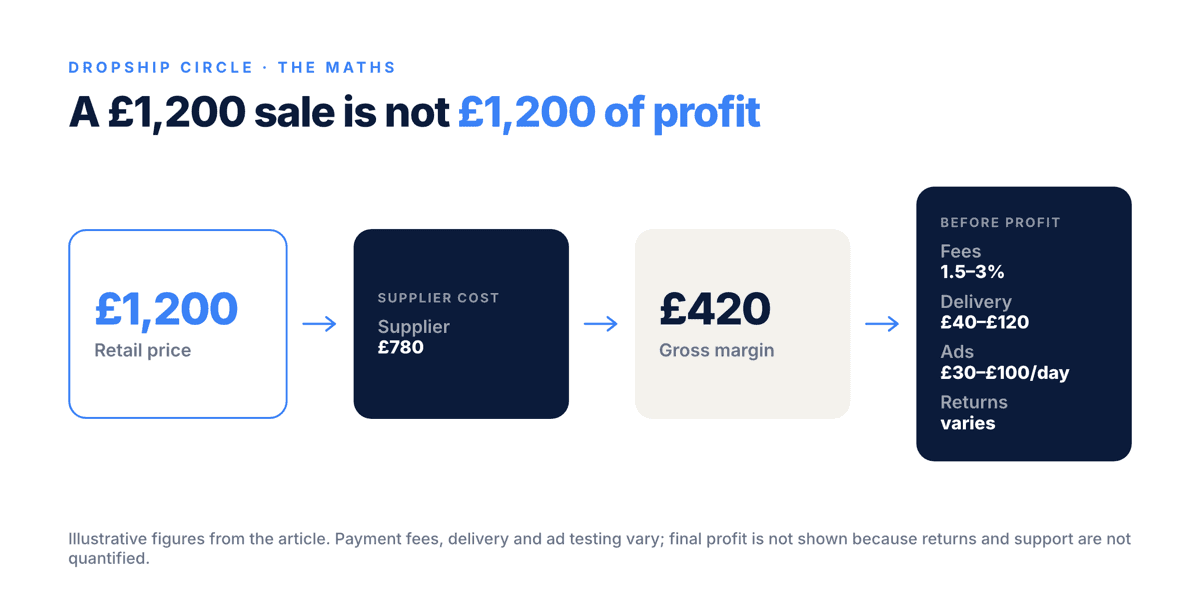
Product retail price: say £1,200
Supplier cost: say £780
Gross margin: £420 before payment fees, ads, returns and support
Card/payment fees: roughly 1.5% to 3% depending on provider and region
Delivery surcharge: say £40 to £120 depending on size and location
Initial Google Ads test: say £30 to £100 per day depending on category
Those are illustrative figures, not promises. But they show the point. Mentorship is not about vibes. It is about commercial judgement.
Dropship Circle has mentored hundreds of students through the high-ticket ecommerce model. That matters because the same patterns repeat: people overvalue logo design, undervalue supplier conversations, panic too early on ads, and ignore delivery realities until a customer in Scotland asks why shipping is £180.
A useful mentor shortens the feedback loop. They do not remove the work.
Do you really need a dropshipping mentor to start?
No, you do not need a mentor to start, but a good one can reduce avoidable commercial mistakes.
You can absolutely build a store alone. Shopify, WooCommerce, Google Merchant Center, Meta Ads, Klaviyo, ChatGPT, Ahrefs, Semrush and supplier directories give a determined person plenty to work with. The barrier to execution has dropped massively.
But execution is not the scarce skill anymore. Judgement is.
A beginner can now generate product descriptions in 30 seconds. They can build a passable homepage in a day. They can ask AI to write email flows, ad copy and supplier outreach scripts. Fine. But AI will not reliably tell you whether your chosen niche has a broken supply chain, brutal return risk or no serious UK supplier route.
That is the trap. People outsource thinking to tools and mistake activity for progress.
If you have more time than money, no mentor may be fine. Expect to spend months testing, reading, emailing suppliers, breaking things and correcting yourself. If you have more money than time, mentorship can make sense, but only if the mentor has real operating judgement.
I usually tell people to think in 3 layers:
Information: You can get this cheaply or free.
Implementation: This is where you build, test and get bruised.
Judgement: This is where experience becomes valuable.
Most course-sellers sell layer 1 and call it mentorship. That is the con.
What is the difference between a course and a dropshipping mentor?
A course gives information; a mentor gives feedback on your specific commercial decisions.
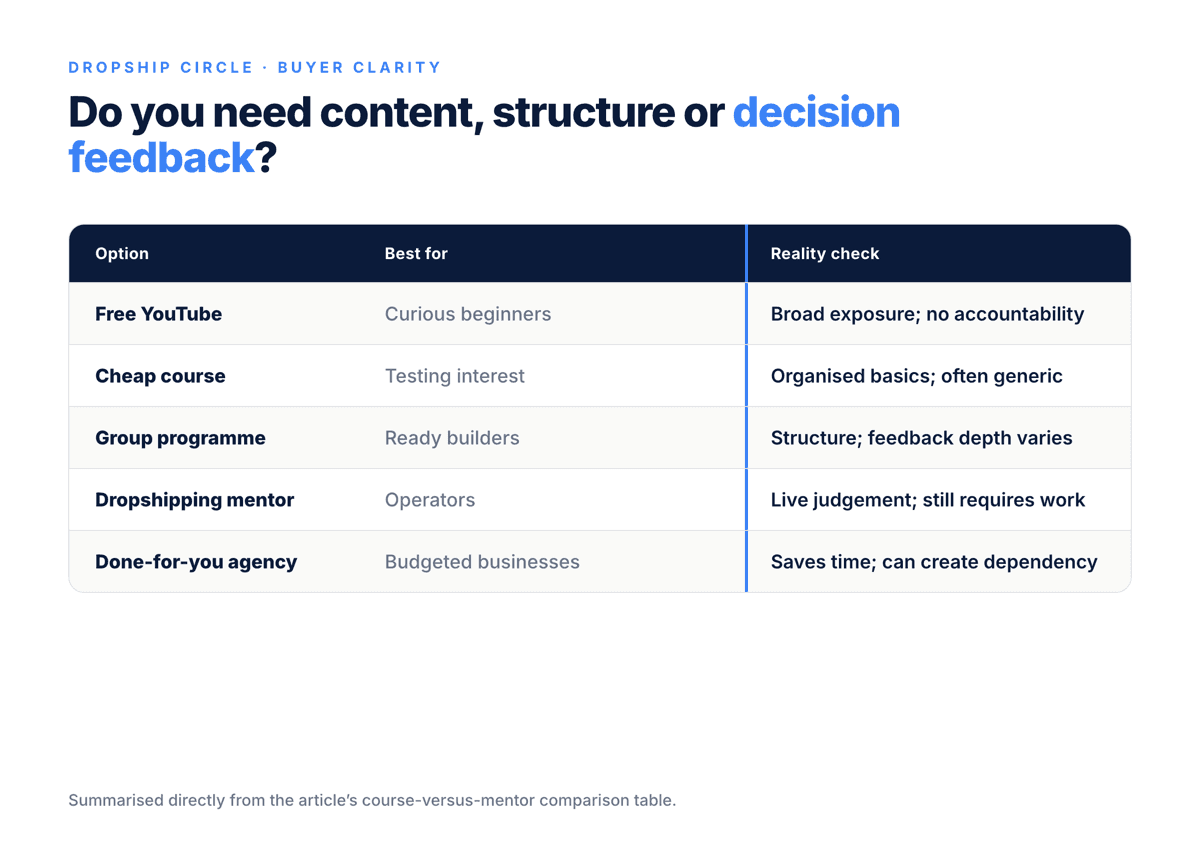
This is the part buyers need to be honest about. A £97 video course, a £1,000 group programme and a genuine mentor are not the same product. One is content. One is a system. One is judgement applied to your situation.
Here is the blunt comparison:
Which option is best for your stage?
The best option depends on whether you need information, structure or decision-level feedback.
Option | What you usually get | Typical strength | Typical weakness | Who it suits |
|---|---|---|---|---|
Free YouTube content | Videos, opinions, tactics | £0 cost and broad exposure | Contradictory advice and no accountability | Curious beginners with time |
Cheap course | Pre-recorded lessons | Organised basics | Often generic and outdated | People testing interest |
Group programme | Framework, community, some support | Better structure and momentum | Quality depends heavily on feedback depth | People ready to build seriously |
Dropshipping mentor | Personal or close feedback | Judgement on live decisions | More expensive and still requires work | Operators who want fewer blind spots |
Done-for-you agency | Build support or services | Saves execution time | Can create dependency and weak ownership | Businesses with budget and oversight |
A high ticket dropshipping mentor should not just say, “pick expensive products”. They should explain why a £1,800 item with a 20% gross margin might be worse than a £900 item with a 38% gross margin, better supplier terms and cleaner delivery.
That is the bit you cannot learn from a template alone.
What should a good high ticket dropshipping mentor teach?
A good mentor should teach product economics, supplier approval, paid traffic, conversion and operational control.
High-ticket ecommerce is not low-ticket impulse dropshipping with a bigger price tag. The customer behaves differently. The supplier relationship matters more. Delivery matters more. Phone calls and live chat can matter more. Finance options, warranties and lead times can make or break the sale.
If I were evaluating a mentor, I would want them to cover at least these areas:
Can they teach product and niche selection properly?
Product selection should start with margin, demand, supplier access and operational difficulty.
A weak mentor says, “sell hot products.” A strong mentor asks:
Is there existing search intent on Google?
Are customers already buying this category online?
Can a new retailer get approved by credible suppliers?
Is the product too fragile, regulated or return-heavy?
Can you make money after ads, delivery, payment fees and support?
For example, a £2,000 product looks exciting until you realise delivery is £250, the supplier gives you 18% margin, customers need installation advice, and the return process is a nightmare. I would rather see a boring £850 product with cleaner fulfilment and a supplier who answers emails within 24 hours.
Can they teach supplier outreach without sounding desperate?
Supplier approval depends on positioning your store like a serious retail partner, not a side hustle.
This is where beginners expose themselves. They send a vague email saying, “Hi, I’m starting a dropshipping store, can I sell your products?” Then they wonder why no one replies.
A mentor should help you approach suppliers with:
A proper domain and branded email
A clean store or credible holding page
A specific category plan
A reason you can represent their products well
Clear questions about margins, stock feeds, delivery and warranty handling
In high ticket, the supplier relationship is an asset. If you get a better margin by 5% on a £1,200 product, that is £60 extra gross profit per sale before other costs. Small negotiation details matter.
Can they teach traffic without pretending ads are magic?
Paid traffic works only when the offer, margin and conversion path can support the cost of testing.
Google Ads is not a cash machine. Meta Ads is not a cheat code. Shopping campaigns, Performance Max, search campaigns and retargeting all have a place, but the numbers must make sense.
If you are testing at £50 per day for 30 days, that is £1,500 of ad spend. You do not want to discover on day 31 that your product margin was too thin to survive normal customer acquisition costs.
A real mentor should talk about budgets without flinching. They should also tell you when not to spend. Sometimes the best advert is the one you do not run because the category economics are wrong.
What are the red flags when choosing a dropshipping mentor?
The biggest red flag is certainty: anyone making ecommerce sound easy is not operating in reality.
I have a simple rule. If someone’s marketing makes ecommerce sound clean, quick and painless, they are probably hiding the real work.
High-ticket ecommerce involves awkward bits:
Supplier rejections
Feed errors in Google Merchant Center
Delivery delays
Customers asking detailed pre-sale questions
Payment provider holds
Product pages that do not convert
Ads that spend £300 and teach you one painful lesson
Returns that wipe out the profit from a sale
A proper mentor will not pretend those things do not happen. They will show you how to reduce the risk and respond properly.
Watch out for these red flags:
They lead with rented cars, watches or lifestyle content.
They cannot explain their model in plain numbers.
They talk about hands-off ecommerce.
They show screenshots without context.
They guarantee outcomes or imply everyone wins quickly.
They dodge questions about suppliers, margins and operations.
They only teach AliExpress-style low-ticket tactics while claiming to be high-ticket experts.
Also, check third-party evidence. Dropship Circle has public Trustpilot reviews that buyers can inspect for themselves at trustpilot.com/review/dropshipcircle.com. Do your own due diligence. Do not rely only on my claims, or anyone else’s.
How much should you pay for a dropshipping mentor?
Pay only when the support, risk and workload make sense against the price.
I am deliberately not going to tell you a magic price. The market ranges from cheap courses under £100 to mentoring and business programmes costing several thousand pounds. Price alone tells you very little.
A £500 programme can be expensive if it gives you generic videos and no useful feedback. A £5,000 programme can be reasonable if it helps you stress-test niche choice, supplier access, margin structure and ad planning before you spend heavily.
But here is the key: you cannot judge value only by content volume. Ten hours of video is not automatically better than one direct review of your supplier list, product margins and ad structure.
Before paying anyone, ask:
What exact support do I get?
Is the model UK, US or both?
Do they understand high-ticket supplier relationships?
Can I inspect external reviews or proof sources?
Are expectations realistic around time, testing and risk?
Will I get feedback on my actual store and numbers?
Most operators should expect a learning curve. Timelines vary, but 3–6 months to first consistent signs of commercial traction is a more realistic planning window than 30 days of fantasy. Some take longer. Some never make it work. That is ecommerce.
Is a high ticket dropshipping mentor better than a low-ticket mentor?
A high-ticket mentor is better only if you want supplier-led ecommerce with higher order values and real operations.
Low-ticket and high-ticket dropshipping are different games. Low-ticket often relies on impulse buying, creative testing, trend speed and volume. High-ticket relies more on search intent, supplier access, trust, product depth and customer support.
Neither is automatically superior. But they require different judgement.
Area | Low-ticket dropshipping | High-ticket dropshipping |
|---|---|---|
Example product | £20 gadget | £1,200 sauna or furniture item |
Main channel | Often Meta/TikTok creative testing | Often Google search/shopping plus retargeting |
Supplier relationship | Often marketplace or agent-led | Often direct supplier or distributor-led |
Customer behaviour | Impulse purchase | Considered purchase with questions |
Margin risk | Product cost and shipping scale | Ads, delivery, returns and supplier terms |
Mentor skill needed | Creative testing and offer speed | Commercial judgement and supplier operations |
If someone only understands £25 impulse products, I would not trust them to advise on £1,500 orders with freight, warranties and supplier approvals. The mechanics are different.
A high ticket dropshipping mentor should be comfortable talking about lead times, landed margins, product feeds, phone conversion, category authority, Google Merchant Center, shipping zones and post-sale support. If they cannot, they are not a high-ticket mentor. They are just using a higher price point in their marketing.
What proof should you ask a dropshipping mentor for?
Ask for proof you can inspect, not just screenshots you are expected to believe.
The internet has trained people to accept weak evidence. A Stripe screenshot is not a business. A Shopify dashboard is not profit. A student testimonial without context is not due diligence.
Better proof includes:
Public third-party review sources
Clear explanation of the business model
Realistic discussion of costs and failure points
Evidence the mentor understands UK and US supplier routes
Transparent boundaries on what is and is not guaranteed
An operating philosophy that matches the market today
At Dropship Circle, buyers can inspect public Trustpilot reviews for themselves. DSC has also mentored hundreds of students through the high-ticket ecommerce model. Students are running live UK and US stores with real margins, but serious public proof must respect privacy and avoid exposing identities, private screenshots or unsupported income claims. Individual results, not typical.
That is the standard I think the industry should move towards: more proof, less theatre.
And when you are reviewing any mentor, ask them this simple question: “Can you walk me through a product’s economics from retail price to net margin after likely costs?”
If they cannot answer without changing the subject, keep your card in your pocket.
What will a dropshipping mentor not do for you?
A mentor will not make the decisions, take the risk or do the uncomfortable work for you.
This is where I lose some people, and I am fine with that. Mentorship is not a substitute for ownership.
A mentor can help you avoid bad niches. They can review your store. They can challenge your supplier outreach. They can explain why your Google Shopping feed is a mess. They can help you think through whether a £70 cost per lead is terrifying or acceptable in your category.
But they cannot care more than you do.
They cannot force you to email 30 suppliers. They cannot make you respond to customers properly. They cannot stop you from rebuilding your logo for the 14th time instead of fixing your product pages.
The best students and operators I see are not always the cleverest. They are the ones who can take feedback without sulking, test properly, and keep thinking when the first version does not work.
AI tools make this even more obvious. You can now build faster than ever, but building the wrong thing faster is still losing. The operator’s taste, judgement and willingness to iterate are the advantage.
So, should you hire a dropshipping mentor?
Hire a mentor for better judgement, not for certainty, shortcuts or guaranteed outcomes.
If you are casually curious, start with free content. Read, test, watch, build a basic understanding. You do not need to pay someone just to learn what Shopify is.
If you are serious about high-ticket ecommerce and want to build around UK or US suppliers, then mentorship can be worth considering. Not because it makes the business easy, but because the mistakes are expensive.
A wrong niche can cost you 2 months. A weak supplier approach can cost you approvals. A bad margin structure can cost you every sale. A poor ad setup can burn £1,000 before you understand what went wrong.
The right mentor should help you think like an operator. That means:
Choosing categories with commercial logic
Speaking to suppliers professionally
Building trust into the store before traffic arrives
Understanding margin before scaling spend
Reading early data without panicking
Fixing operational bottlenecks instead of chasing hacks
My honest view: most people do not need more motivation. They need fewer fantasy beliefs and better decisions.
That is what a dropshipping mentor should provide.
Key takeaways
A mentor can improve decisions, but they cannot guarantee outcomes or remove the work.
A dropshipping mentor is valuable only if they improve your real commercial decisions, not just give generic information.
High-ticket ecommerce depends on supplier access, margin control, paid traffic discipline and operational detail.
Do not trust screenshots alone; inspect third-party evidence such as public review platforms and ask for clear model explanations.
Expect timelines to vary; 3–6 months to early consistent traction is a more realistic planning window than instant results.
A mentor can shorten the feedback loop, but they cannot replace your effort, judgement or responsibility.
Related reading
Dropshipping Mentor Proof: What Should You Actually Demand Before You Pay?
Do You Need a Dropshipping Mentor? An Honest Operator Answer
Frequently asked questions
These are the common questions people ask before paying for dropshipping mentorship.
Do I need a dropshipping mentor as a beginner?
Not always. If you are only exploring, start with free content and learn the basics first. A mentor makes more sense when you are ready to choose a niche, approach suppliers, build a store and spend money testing traffic.
What makes a good high ticket dropshipping mentor?
A good high ticket dropshipping mentor understands supplier approval, product margins, Google Shopping, customer trust and delivery operations. They should be able to explain the economics of a £1,000+ product in plain numbers.
How long does dropshipping take with a mentor?
It varies. A realistic planning window for many operators is 3–6 months to see early consistent commercial traction, but there are no guarantees. Your niche, budget, execution speed and ability to take feedback all matter.
How do I know if a dropshipping mentor is legit?
Look for proof you can inspect, realistic claims, clear explanations and evidence they understand real operations. Be cautious with anyone using lifestyle content, vague screenshots or guaranteed outcomes as their main sales argument.
Is high-ticket dropshipping better than normal dropshipping?
It depends on your skills and model. High-ticket dropshipping can offer higher order values, but it also demands stronger supplier relationships, better trust signals, more customer support and tighter margin control.
If you want to understand how I think about high-ticket ecommerce before paying for anything, start with Dropship Circle’s free training. I walk through the model, the supplier-led approach and the commercial decisions that matter, without pretending the work disappears.
Register to watch the free training →
What is the law of 33% in mentorship?
The law of 33% says you should spend roughly a third of your time with people ahead of you, a third with peers and a third helping people behind you. It is a useful networking principle, not a proven rule or a reason to pay any self-styled dropshipping mentor.
Is $1,000 enough to start dropshipping?
$1,000 can be enough to test a lean dropshipping store, but it is not much of a buffer. Your budget must cover the platform, domain, samples, basic creative, advertising tests, refunds and supplier payments before customer funds clear; high-ticket products may require more working capital.
Why do 90% of dropshippers fail?
There is no reliable evidence that exactly 90% of dropshippers fail, but many stores close because their economics and execution are poor. Common causes include weak product demand, thin margins, expensive advertising, unreliable suppliers, slow fulfilment, poor conversion and too little cash reserved for returns or chargebacks.
Which platform is best for dropshipping in the UK?
Shopify is usually the best all-round dropshipping platform in the UK because it is quick to launch, easy to operate and integrates with major payment, advertising and supplier tools. WooCommerce can suit someone who wants more control and can handle hosting and maintenance, while marketplaces such as Amazon and eBay bring stricter policies and less ownership of the customer relationship.
How much should I pay for a dropshipping mentor?
Pay only what matches the mentor’s access, operating experience and depth of support. A few hundred pounds may cover a group programme, while one-to-one help can cost more, but the mentor should clearly show what is included and explain real store economics before taking payment. Avoid anyone charging thousands mainly for recorded videos, vague motivation or screenshots.
How many dropshippers fail?
There is no reliable, independently verified failure rate for dropshippers. The widely repeated figures claiming that 80%, 90% or 95% fail are usually unsupported and depend on what counts as failure. Many stores do close because of weak margins, poor suppliers, expensive advertising or inadequate customer support.
Which supplier is best for dropshipping in the UK?
There is no single best UK dropshipping supplier; the right one depends on your niche, margins, delivery requirements and returns process. Prioritise suppliers with UK stock, clear trade pricing, reliable fulfilment, proper product data and written terms for damage, cancellations and returns. Test communication and place a sample order before building a store around them.
Is dropshipping worth it in the UK?
Dropshipping can be worth operating in the UK when the product economics survive advertising, delivery, returns, payment fees and customer support. It is usually a poor fit for low-margin commodity products with slow overseas fulfilment and no meaningful differentiation. Treat it as an ecommerce operating model, not an easy shortcut.
Ready to Build Your Ecommerce Business?
Get started with our free training and discover the exact framework we use to build sustainable high-ticket stores.
Related articles

Mentorship & Courses
Dropshipping Mentor Proof: What Should You Actually Demand Before You Pay?
Dropshipping mentor proof means checkable evidence, not screenshots.

Mentorship & Courses
Do You Need a Dropshipping Mentor? An Honest Operator Answer
Do you need a dropshipping mentor? Not always, but the maths on wasted ad spend and rejected supplier applications.

Mentorship & Courses
Dropshipping Mentor UK: How to Choose the Right One
Comparing UK dropshipping mentors? What separates real operators from course sellers: costs, risks, proof to check.