Use a Udemy dropshipping course for cheap basics, not as your full ecommerce operating system.
A Udemy dropshipping course can teach Shopify, product research and store setup, usually in 5–10 hours of video, but it rarely gives you live supplier access, margin diagnosis or operator feedback.
I’m not anti-Udemy. I’m anti-confusing “I watched a course” with “I’m building a business”. High-ticket dropshipping is still ecommerce: acquiring customers, selling real products, handling suppliers, dealing with delivery issues, protecting margin and keeping customers alive after payment.
The problem with most beginner dropshipping education is that it teaches the visible bit: themes, apps, logos, product pages. The money is made or lost in the boring bit: gross margin, supplier terms, freight costs, returns, Google Shopping feed quality, tax treatment, payment holds and customer service when a £1,200 order goes sideways.
Is a Udemy dropshipping course worth it?
A Udemy course is worth it for basics, but not enough to build a serious high-ticket store.
If you are completely new, a cheap Udemy course can help you understand Shopify, domains, basic product pages, app installation and order flow. Some listed Udemy dropshipping courses run around 7–10 hours of video and cover store setup, theme editing and beginner product research.
That is useful if your starting point is zero. But once you move into high-ticket products, usually £1,000+ / $1,000+ items like saunas, home gym equipment, commercial furniture, outdoor structures or premium pet equipment: the course video is the easy part.
The real test is whether you can answer questions like:
Can this supplier actually ship to my customer’s postcode or ZIP code?
Is delivery kerbside/curbside, white glove, pallet freight or parcel?
What happens if the item arrives damaged?
Is your gross margin still viable after ad spend, merchant fees and returns?
Are you charging VAT/sales tax correctly for the UK or US context?
Can your Google Merchant Center survive policy review?
Across £8.25M in tracked sales spanning our own, student and client stores, the observed pattern is simple: operators do not usually fail because they cannot build a Shopify homepage; they fail because they choose weak suppliers, misread unit economics and underestimate operations.
What does Udemy usually teach well?
Udemy is decent for mechanical learning.
You can learn how to:
Open a Shopify account
Buy and connect a domain
Install a theme
Add products
Use basic apps
Understand order fulfilment flow
Write simple product descriptions
Run through beginner Meta or Google Ads settings
Those are real skills. But they are not a moat. A 16-year-old with a laptop can copy a Shopify theme in an afternoon. The business starts when you know which products are worth selling, which suppliers are worth trusting, and which numbers make the store worth keeping open.
Where does Udemy usually fall short?
Most Udemy courses are built for scale: one instructor, static videos, mass audience, low price.
That means they often struggle with the bits that need judgement:
Reviewing your actual niche before you waste £500/$500 on ads
Checking if a supplier agreement is workable
Diagnosing why your Google Shopping feed is rejected
Spotting a margin leak in shipping, tax or payment fees
Telling you when your product choice is weak
Helping you decide between UK and US market routes
A generic video can tell you to “find winning products”. It cannot look at your £1,400 pergola offer and say: your landed delivery cost is £170, your supplier only gives 18% margin, your Google CPCs are too high, and one damaged return wipes out the next 3 orders.
What should a good dropshipping course actually cover?
A good dropshipping course should teach ecommerce economics, not just Shopify setup.
Dropshipping is a fulfilment method. That means the supplier, brand or manufacturer ships directly to your customer after the order is placed. The underlying business is still ecommerce: traffic, conversion, product-market fit, supplier reliability and customer experience.
For high-ticket, I want to see a course go deep on the parts that affect cash and risk.
What should be inside a serious high-ticket training?
At minimum, I’d expect training on:
Niche validation: demand, competition, search volume, price depth and supplier availability
Supplier outreach: email scripts, call handling, trade account setup and rejection handling
Margin maths: gross margin, contribution margin, ad cost, refunds, payment fees and delivery costs
Store build: trust signals, category architecture, product pages and checkout flow
Google Shopping: product feeds, Merchant Center, conversion tracking and campaign structure
Customer operations: delivery updates, damaged goods, cancellations and returns
UK/US tax basics: VAT registration awareness in the UK; sales tax nexus awareness in the US
Cash-flow management: payment holds, supplier payment timing and refund reserves
Shopify’s own pricing page currently lists the Basic plan at $39/month when paid monthly in the US, before apps, themes, domains and payment fees. That is not the expensive part. The expensive part is building the wrong store for 6 weeks, spending £700 on traffic, then realising no decent supplier wants to work with you.
What should it not promise?
A serious course should not promise unusually easy outcomes, fixed results or some neat escape-from-work fantasy.
The better frame is boring but true: you learn how to control the inputs. You learn product selection, supplier use, conversion, paid acquisition, pricing and operations. You still have to execute, and timelines vary.
Most new operators should think in months, not days. For many people, 3–6 months is a more realistic window to build, test, diagnose and start seeing whether the model is becoming consistent. Some move quicker; some take longer; some should change niche.
How does Udemy compare with a high-ticket dropshipping programme?
Udemy is cheaper; a specialist high-ticket programme is deeper, more current and more operational.
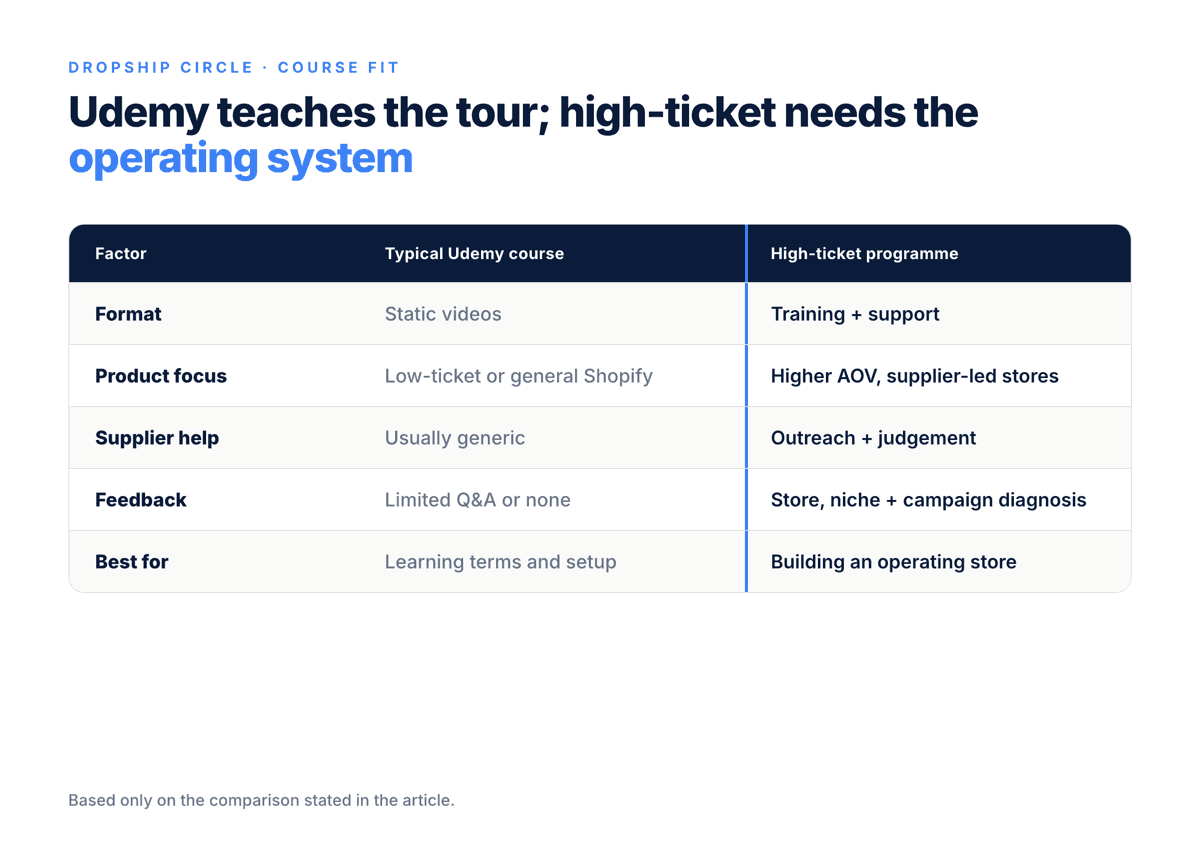
This is the practical difference. If you only need vocabulary and a tour of Shopify, Udemy can do the job. If you want to build around £1,000+ / $1,000+ products with real suppliers, paid ads and customer support, you need more than static lessons.
Factor | Typical Udemy dropshipping course | Specialist high-ticket programme |
|---|---|---|
Price | Usually low-cost | Higher investment |
Format | Static videos | Training plus support, feedback and updates |
Product focus | Often low-ticket or general Shopify | Higher AOV products and supplier-led stores |
Supplier help | Usually generic | Outreach, account setup and supplier judgement |
Market detail | Often broad/global | Can be UK-specific, US-specific or both |
Feedback | Limited Q&A or none | Store, niche and campaign diagnosis |
Risk | Low cash cost, high execution gap | Higher upfront cost, lower guesswork if used properly |
Best for | Learning terms and setup | Building a real operating store |
I run Dropship Circle because the gap between “course watched” and “store operating” is where most people get stuck. DSC has mentored 2,000+ students through the high-ticket ecommerce model, and the system is built around UK and US suppliers, higher order values and actual operating decisions, not just theory slides.
You should still do due diligence. Dropship Circle has public Trustpilot reviews at trustpilot.com/review/dropshipcircle.com, so inspect third-party evidence yourself before buying any business programme. Do that with us, and do it with anyone else asking for your money.
Can you build a high-ticket store after only taking a Udemy dropshipping course?
You can start after Udemy, but building profitably needs supplier, margin and traffic skills.
Here’s the mistake I see: someone watches a course, launches a general store, adds 30 products from random suppliers, then wonders why nobody buys. High-ticket does not work like a novelty gadget store. You are asking a stranger to spend £1,000, £2,000 or £5,000 online, often on an item that needs freight delivery.
That buyer needs trust. They want proper specifications, delivery clarity, warranty details, contact options and evidence that your store is not a temporary Shopify experiment.
A real high-ticket store normally needs:
A focused niche, not a random catalogue
Brands or suppliers with credible products
Clear delivery information by region
Proper product data and images
Phone/email support processes
Strong policy pages
Google Shopping-ready feeds
A margin model that survives imperfect orders
For UK operators, that may mean speaking to domestic suppliers, understanding VAT thresholds and working with couriers like DPD, DHL, Royal Mail, pallet networks or specialist freight firms. For US operators, it may mean suppliers using FedEx Freight, UPS, LTL carriers, regional warehouses and state-by-state sales tax considerations.
HMRC’s VAT registration threshold is £90,000 of taxable turnover for the 2024/25 period. In the US, sales tax is more fragmented; the 2018 South Dakota v. Wayfair Supreme Court decision allowed states to require out-of-state sellers to collect sales tax once economic nexus thresholds are met. You do not need to become a tax lawyer on day one, but you do need to know when to get proper advice.
What is a realistic high-ticket dropshipping margin example?
A £1,200 sale can look good, then collapse if freight, ads and returns are ignored.
Say you sell a £1,200 infrared sauna. The supplier gives you a 25% gross margin, so your cost is £900 and your gross profit is £300.
Now the real store maths begins:
Sale price: £1,200
Supplier cost: £900
Gross profit: £300
Card/merchant fee at roughly 2%: about £24
Google Ads cost to acquire the order: £90
Delivery surcharge to a remote postcode: £45
Net before overheads: £141
That is not bad. But it is not the £300 you thought you had.
Now add a failure mode. The sauna arrives with a damaged panel. The supplier agrees to send a replacement part, but it takes 10 days. The customer is annoyed and asks for a partial refund. You offer £80 to keep the order alive.
Your £141 drops to £61 before overheads. If you also had a Shopify app stack costing £80/month, a paid theme, bookkeeping and a virtual number, that order did not create much breathing room.
This is why high-ticket is not about blindly chasing expensive products. It is about controlled economics. A £1,200 order with weak margin can be worse than an £800 order with a reliable supplier, clean delivery and lower ad cost.
The upside is still strong when you do it properly. You need fewer orders to generate meaningful revenue, you can build a more defensible niche store, and you are not trying to make £4 profit selling plastic gadgets against thousands of copycats.
Should UK and US operators choose different dropshipping markets?
UK and US operators can both use high-ticket, but supplier routes and tax mechanics differ.
I write for both markets because both work, but they are not identical.
The UK is smaller, which can make supplier relationship-building more direct. You can often call brands, distributors or wholesalers and speak to someone who understands trade accounts. Delivery geography is tighter, but remote areas, islands and pallet access still matter.
The US is larger, with more states, more regional warehouses and a much deeper ecommerce market. The opportunity is big, but so are the operational details: LTL freight, state sales tax, longer delivery zones, manufacturer MAP policies and customer expectations around delivery updates.
International operators sometimes choose the UK or US because they want to operate in pounds or dollars and access ad and shopping infrastructure that may be weaker or unavailable in their home country. That can make sense, but it adds complexity: business registration, banking, payment processors, tax advice and customer support hours.
The main decision is not “UK good, US bad” or the other way around. The decision is: which market can you understand, serve and support properly?
How should you evaluate a Udemy dropshipping course before buying?
Check the curriculum, update date, instructor proof and whether it matches high-ticket economics.
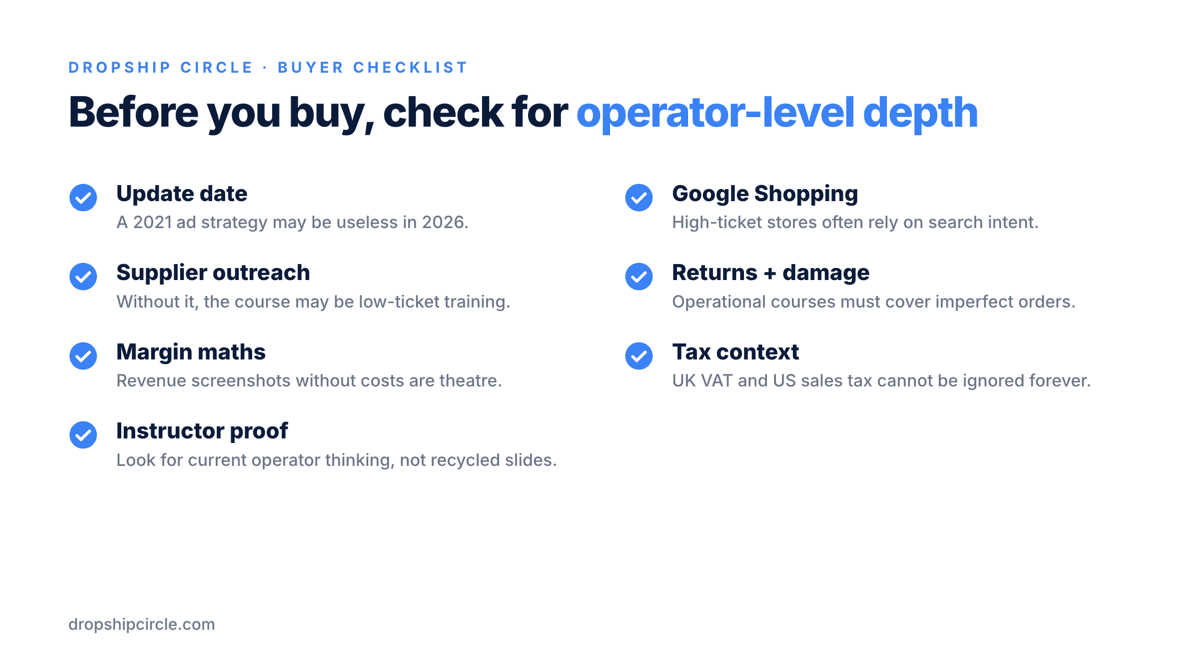
Before buying any Udemy dropshipping course, I’d look at 7 things:
When was it updated? A 2021 ad strategy can be useless in 2026.
Does it teach Google Shopping? High-ticket stores often rely heavily on search intent.
Does it explain supplier outreach? If not, it may be low-ticket AliExpress-style training.
Does it cover returns and damaged delivery? If not, it is not operational enough.
Does it show margin maths? Revenue screenshots without cost breakdowns are theatre.
Does it mention tax context? UK VAT and US sales tax cannot be ignored forever.
Does the instructor operate or only teach? You want current operator thinking, not recycled slides.
Udemy itself can be a good platform for learning software workflows. The issue is course selection. A title like “build a Shopify business in hours” may be fine as an introduction, but business economics do not appear just because the homepage is live.
If you buy one, treat it like a £10–£50 textbook. Take notes, learn the language, build a basic sandbox store, then move into proper operator training before you put serious money into ads or supplier commitments.
What would I do if I were starting from scratch today?
I would learn basics cheaply, then invest time in niche, supplier and margin validation.
If I had no experience and was starting again, I would not spend 4 weeks perfecting a logo. I would do this:
Spend 1–2 days learning Shopify basics through cheap training or free Shopify documentation
Pick 3 possible high-ticket niches with products above £1,000 / $1,000
Build a spreadsheet of 30–50 suppliers or brands
Check whether products have search demand on Google
Analyse competitor stores and Shopping ads
Call or email suppliers before building the full store
Model margins at 20%, 25% and 30%
Stress-test the model with one damaged delivery and one refund scenario
Build the store only after the numbers and supply route make sense
I would also avoid “perfect brand” syndrome. Customers do not remember flawless polish as much as they remember trust, clarity and a store that solves the buying problem. A slightly imperfect but useful store with phone support, clear delivery terms and credible products beats a beautiful store with no supplier relationships.
That is the operator route. Less dopamine. More use.
When is a Udemy dropshipping course the wrong choice?
Udemy is the wrong choice when you need live feedback, supplier help or market-specific execution.
Do not rely on Udemy alone if:
You are about to spend £500–£2,000 on ads
You want to sell £1,000+ / $1,000+ products
You need help choosing between UK and US markets
You have never spoken to a supplier
You do not understand gross margin versus net contribution
You need someone to challenge your niche before launch
You are trying to build a serious store, not just learn Shopify
This is where structured mentorship has a different job. The value is not “secret information”. Most information is somewhere online. The value is sequencing, judgement, diagnosis and being told the truth before you waste months.
That is also why I am careful with claims. Students are running live UK and US stores with real margins, but public content should not expose identities, private screenshots or unsupported income claims. Individual results, not typical. The point is not vanity screenshots; the point is whether the store economics stand up.
Key takeaways
A Udemy dropshipping course is useful for cheap Shopify basics, but it is not a full operating system for high-ticket ecommerce.
High-ticket dropshipping works best when treated as real ecommerce: supplier relationships, margin control, paid traffic, fulfilment and customer service.
A £1,200 order can shrink fast once ads, payment fees, freight surcharges and damaged delivery are included.
UK and US high-ticket stores can both work, but VAT, sales tax, delivery networks and supplier routes differ.
Before buying any business programme, inspect third-party proof, curriculum depth and whether the training includes real operational support.
Related reading
Dropshipping Mentor Proof: What Should You Actually Demand Before You Pay?
Do You Need a Dropshipping Mentor? An Honest Operator Answer
Frequently asked questions
What is the best Udemy dropshipping course?
The best Udemy dropshipping course for a beginner is one that is recently updated, teaches Shopify setup clearly, includes Google Shopping or paid traffic basics, and explains fulfilment. I would not choose based on hypey income claims. Choose based on whether it teaches the mechanics you actually need.
Can I learn dropshipping for free instead of buying a Udemy course?
Yes, you can learn the basics from Shopify documentation, YouTube and supplier research. The issue is not access to information; it is knowing what matters and in what order. Free learning is fine for foundations, but serious high-ticket execution usually needs better feedback.
Is high-ticket dropshipping better than low-ticket dropshipping?
For serious operators, I prefer high-ticket because the margins and order values give you more room to build a real business. Low-ticket often turns into a grind of tiny margins, copycat products and constant creative testing. High-ticket still has risk, but the model is more defensible when built properly.
How long does it take to make a high-ticket dropshipping store profitable?
Timelines vary, but many new operators should think in terms of 3–6 months to build, launch, test and diagnose properly. Some move faster, some take longer, and some need to change niche. Profit depends on supplier terms, traffic costs, conversion rate and operational discipline.
Do I need a UK or US company to start high-ticket dropshipping?
It depends on where you live, where you sell and which payment processors or suppliers you use. UK operators need to understand VAT obligations, while US operators need to understand sales tax nexus. If you are international and selling into the UK or US, get proper tax and legal advice before scaling.
If you want to learn the basics, a Udemy dropshipping course can be a sensible first step. If you want to build a proper high-ticket ecommerce store with UK or US supplier strategy, margin control and operator feedback, watch the free Dropship Circle training next. I’ll show you how the model actually works, what to avoid, and how serious operators approach it without the guru nonsense.
Ready to Build Your Ecommerce Business?
Get started with our free training and discover the exact framework we use to build sustainable high-ticket stores.
Related articles

Mentorship & Courses
Dropshipping Mentor Proof: What Should You Actually Demand Before You Pay?
Dropshipping mentor proof means checkable evidence, not screenshots.

Mentorship & Courses
Do You Need a Dropshipping Mentor? An Honest Operator Answer
Do you need a dropshipping mentor? Not always, but the maths on wasted ad spend and rejected supplier applications.

Mentorship & Courses
Dropshipping Mentor UK: How to Choose the Right One
Comparing UK dropshipping mentors? What separates real operators from course sellers: costs, risks, proof to check.