A good dropshipping mentor UK searchers should look for is someone running (or having run) a real store, who teaches supplier relationships, margin control and cashflow, not just ad clicks. Expect to pay anywhere from a few hundred pounds to a few thousand for structured mentoring, versus £0 for generic YouTube advice that skips the parts that actually break a business.
I run high-ticket ecommerce stores and mentor operators through Dropship Circle. Most people typing "dropshipping mentor UK" into Google aren't looking for a cheerleader. They've watched enough low-ticket AliExpress content to know the margins don't work, and they want to know if paying someone to teach them is worth it, or whether they'll just be funding someone else's rented Lamborghini.
This isn't a ranked "top 10 mentors" list. It's how to actually evaluate one, including the questions most comparison pages don't ask: cost, risk, legal setup, timeline to first sale, and what proof should actually look like.
What Does a Dropshipping Mentor Actually Do?
A mentor should teach the full operating system: niche selection, supplier relationships, store build, pricing, traffic, fulfilment and customer service, not just how to run ads.
Most of the free content circulating (Reddit threads, LinkedIn posts, Facebook groups) covers isolated tactics: a product idea here, an ad script there. A mentor's job is to connect those pieces into something that survives contact with a real supplier and a real customer complaint.
The distinction that matters most in the UK market right now is low-ticket versus high-ticket. Low-ticket dropshipping (phone cases, gadgets under £30) means chasing volume on wafer-thin margins against thousands of identical stores. High-ticket dropshipping means fewer, bigger orders on products people already spend serious money on: garden buildings, saunas, home gym equipment. At 30% margin, a £30 product nets about £9, a £300 product nets about £90. One high-ticket sale can equal ten low-ticket ones. A decent mentor should be steering you toward the model with better unit economics, not just more content volume.
It helps to separate what you're actually paying for into three layers:
Information: what to do. You can get this cheaply or free.
Implementation: building, testing and getting bruised. Nobody can do this part for you.
Judgement: someone looking at your product, your supplier terms and your numbers and telling you whether it works. This is where experience is worth paying for.
Plenty of course-sellers sell layer one and call it mentorship.
How Much Does It Cost to Hire a Dropshipping Mentor?
UK dropshipping mentoring typically runs from around £500 for a structured course to £1,500-£5,000+ for ongoing mentorship with community and support access.
Free routes exist: Reddit's r/dropship, Facebook groups, YouTube. They're useful for orientation but rarely go beyond generic product research tips. Paid mentors and programmes generally sit in two tiers: course-only products (often £500-£1,500, self-paced, limited support) and mentorship programmes with community, live support and structured curriculum (typically £1,500-£5,000+).
The fee is the smaller decision. Say a £20,000 house deposit sitting at 4% interest earns £800 a year. That money is doing exactly one job, and it cannot go down. The same £20,000 used as working capital in a store is doing a different job: it funds supplier deposits, ad tests and the buffer for the month a damaged return eats the whole margin on one order. That's the trade being made: savings can't fall, a store can and sometimes does. It's a trade worth making only with money you can genuinely afford to lose, and only once you understand why a store might underperform some months, whether that's a slow supplier, a failed ad test, or a product returned damaged.
The number that matters more than the mentor's fee is your working capital. A lean validation-stage software stack can run under £100 a month, but you also need cash for stock deposits, ad testing and delivery surcharges on large items, which can run £40-£120 per order. Budget for the total business, not just the course price.
Is Dropshipping Still Legal and Viable in the UK?
Yes, dropshipping is legal in the UK provided you register as a business, handle VAT correctly above the £90,000 threshold, and meet supplier and consumer protection obligations.
The legal side barely gets covered by comparison pages, but it's where beginners trip up. You need a registered company (sole trader or limited company) to open supplier accounts credibly. Most serious suppliers, especially in high-ticket categories like garden buildings or home gym, won't deal with an unregistered individual emailing from a personal Gmail address.
How you present yourself to suppliers matters more than most beginners realise. Position yourself as an online retailer, dealer or authorised reseller rather than leading with the word "dropshipping" itself. Suppliers care about sales and brand representation, not your fulfilment method. Many already ship direct to customers for their dealer network. An email that just asks for a catalogue and price list, with no plan behind it, tends to get ignored.
How Do You Compare Dropshipping Mentors and Courses in the UK?
Compare mentors on model taught (low vs high-ticket), supplier access, proof of real trading, ongoing support structure, and total cost including the course price and working capital.
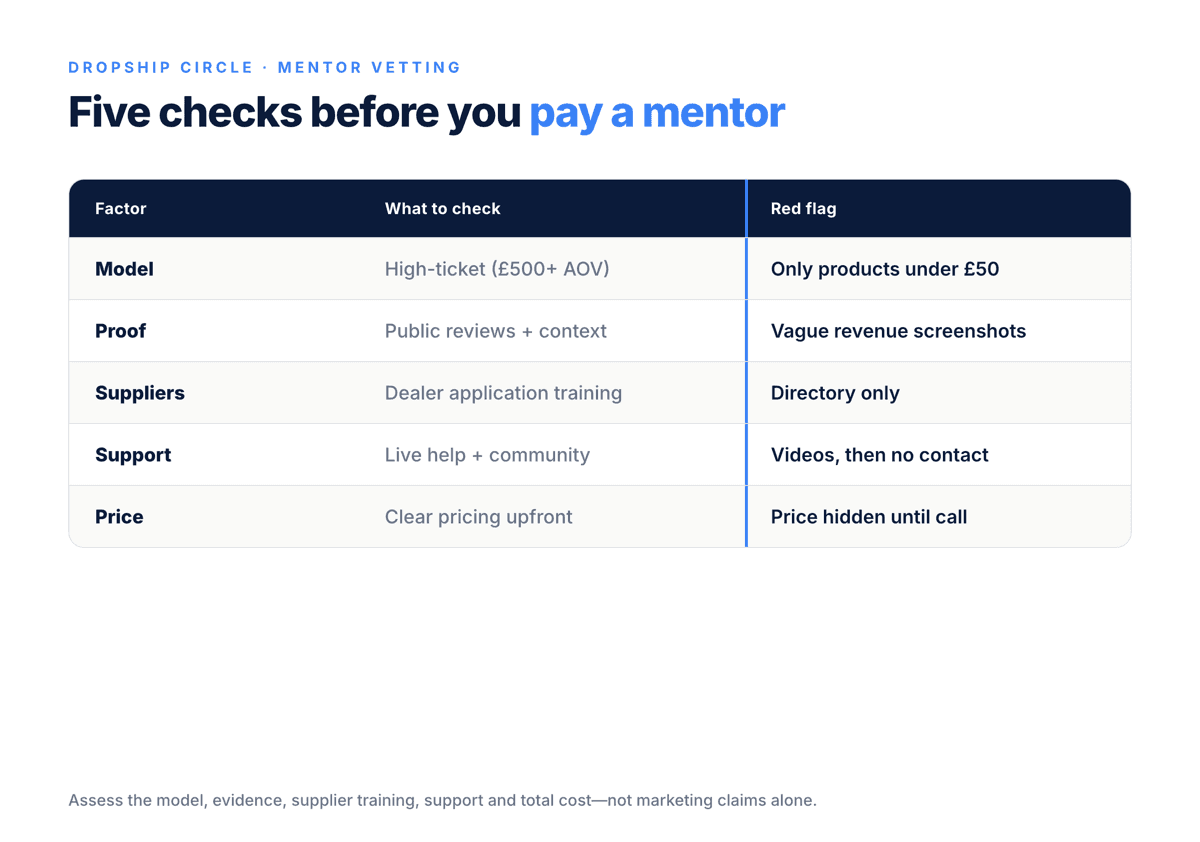
Here's a practical framework, not a ranking of named competitors:
Factor | What to check | Red flag |
|---|---|---|
Model taught | High-ticket (£500+ AOV) vs low-ticket | Focuses only on "winning products" under £50 |
Proof | Public reviews (e.g. Trustpilot), specific figures with context | Vague "6-figure months" screenshots with no breakdown |
Supplier training | Dealer/reseller applications, UK and US supplier routes | Just a supplier list or directory, no relationship-building |
Support | Live mentorship, community, ongoing access | One-off video course, no contact after purchase |
Cost transparency | Tells you exactly what's included and what you'll need to budget on top | Vague about what you get, or surprise costs after you've paid |
It also helps to be honest about which kind of help you're buying:
Option | What you usually get | Strength | Weakness | Who it suits |
|---|---|---|---|---|
Free YouTube content | Videos, opinions, tactics | No cost, broad exposure | Contradictory advice, no accountability | Curious beginners with time |
Cheap course | Pre-recorded lessons | Organised basics | Often generic and dated | People testing their interest |
Group programme | Framework, community, some support | Structure and momentum | Quality depends on how deep the feedback goes | People ready to build seriously |
One-to-one mentor | Personal feedback on live decisions | Judgement applied to your situation | Costs more, still needs your work | Operators who want fewer blind spots |
Done-for-you agency | Build support or services | Saves execution time | Can create dependency and weak ownership | Businesses with budget and oversight |
A paid supplier directory can save you research time, but it doesn't create margin on its own. A database of 5,000 unqualified supplier names is often worth less than five proper supplier conversations, especially once 500 other beginners are listing the exact same products from the exact same feed. That's the trap with cheap, tactic-only courses: they teach you to compete on identical inventory instead of building something defensible.
How Long Does It Take to Get Your First Sale?
In our experience a structured process usually produces a first sale somewhere between the fourth and eighth week, once supplier setup, store build and initial ad testing are done. Plenty of people take longer.
Any mentor promising instant results is selling a fantasy. A realistic timeline looks like: 1-2 weeks on niche and supplier outreach, 1-2 weeks on store build and catalogue setup, then 2-4 weeks of campaign testing before volume becomes meaningful. Initial order volume is often modest while campaigns get tested and refined. That's normal, not failure.
What Does a Real Dealer Application Look Like?
A strong supplier application looks like a functioning business: registered company, working contact number, and a clear statement of coverage area and existing stock, not a mass template email.
Say you're a first-time applicant with no sales, no company history and no stock, which is where every dealer application starts. You register a company, put a phone number on the contact page that actually rings, write three lines on which counties you'll cover and which two brands you already list, then send the application to the trade address rather than filling in a generic contact form.
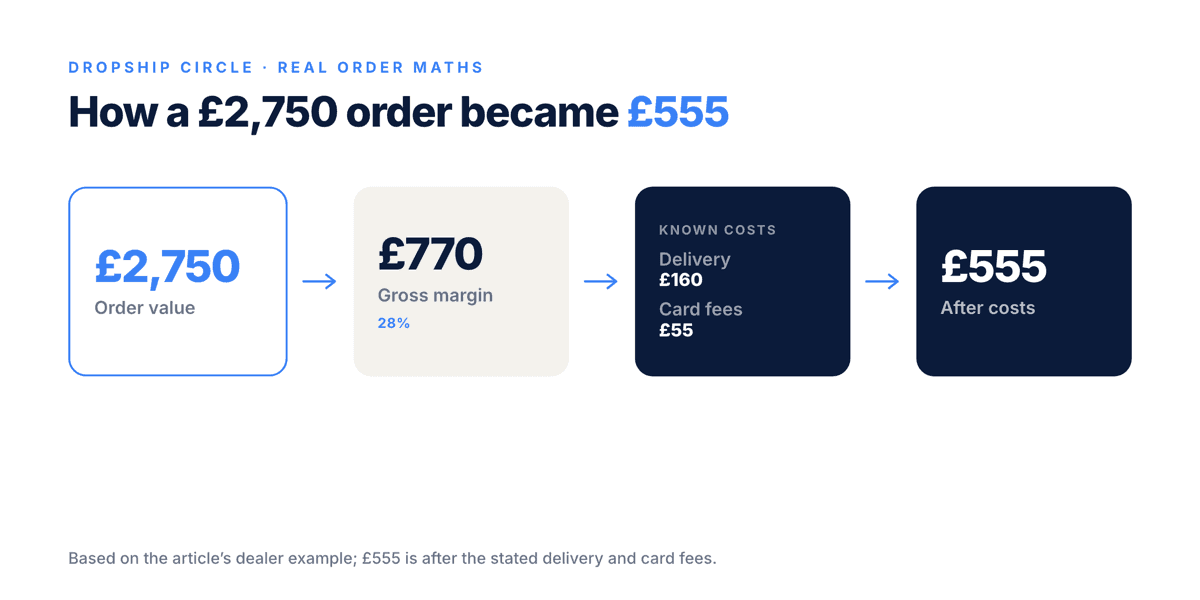
Say two of four brands approve you, and the first order through the better one is a £2,750 range cooker at 28% margin, which is £770 gross. After £160 delivery and £55 card fees, that leaves £555. A brand that says no at first may well come back once the site has been answering the phone for a few months.
A dealer application isn't judged on your size. It's judged on whether you look like a business that will pick up the phone when their product goes wrong.
What Are the Red Flags When Choosing a Mentor?
The biggest red flag is certainty. Anyone making ecommerce sound clean, quick and painless is leaving out the real work: supplier rejections, feed errors, delivery delays, detailed pre-sale questions, payment holds and returns that wipe out the profit on an order.
Be wary of a mentor who:
leads with rented cars, watches or lifestyle content;
can't explain their model in plain numbers;
talks about "hands-off" ecommerce;
shows screenshots with no context;
guarantees outcomes or implies everyone wins quickly;
dodges questions about suppliers, margins and operations;
teaches only low-ticket marketplace tactics while calling it high-ticket.
What Proof Should You Actually Ask a Mentor For?
Ask for public, checkable evidence such as third-party reviews and specific operating figures with context, not screenshots of a single good week.
Across £8.25M in tracked sales spanning our own, student and client stores, the pattern that holds up is consistent: operators who treat supplier relationships and margin control as the actual business outperform those chasing ad hacks. That's not a promise of what any individual reader earns, it's an observed pattern across a large tracked sample.
Check public review platforms like Trustpilot directly rather than trusting a founder's word. A mentor confident in their results won't mind you checking. Also ask what specific software stack they recommend and why. The right stack makes a good operation cleaner; the wrong stack makes a weak operation noisier. Plenty of operators spend £200-£500 a month on tools while unable to explain their own gross margin or delivery promise. That's a sign the mentor is teaching decoration, not fundamentals.
Before paying anyone, ask:
What exact support do I get, and who gives it?
Is the model UK, US or both?
Do they understand high-ticket supplier relationships?
Can I inspect external reviews or other proof myself?
Will I get feedback on my actual store and numbers?
Then ask one more: "Can you walk me through a product's economics, from retail price to net margin after likely costs?" If they can't answer without changing the subject, keep your card in your pocket.
What Won't a Mentor Do for You?
A mentor won't make the decisions, take the risk or do the uncomfortable work for you. They can steer you away from a bad niche, review your store, challenge your supplier outreach and explain why your product feed is a mess. They can't email thirty suppliers for you, answer your customers, or stop you redesigning your logo for the fourteenth time instead of fixing your product pages.
The operators who do well aren't always the cleverest. They're the ones who take feedback without sulking, test properly, and keep thinking when the first version doesn't work.
UK vs US: Does the Market Matter for Choosing a Mentor?
A good mentor should teach both UK and US supplier routes, since high-ticket categories like home gym and garden buildings have viable dealer networks in both markets.
Most UK-focused mentor pages (LinkedIn posts, UK-only course pages) frame the model as UK-only, which limits the addressable market unnecessarily. The mechanics of supplier applications, VAT handling and delivery logistics differ (US sales tax varies by state and nexus, UK VAT kicks in at the £90,000 threshold), but the underlying skill, positioning yourself credibly to a supplier, is identical. If a mentor only teaches one market, ask why.
Key takeaways
A real UK dropshipping mentor teaches suppliers, margin and fulfilment, not just ad tactics; expect to pay £500-£5,000+ depending on support level.
High-ticket categories (£500+ AOV) beat low-ticket on margin: a £300 product at 30% nets £90, ten times a £30 product's £9.
Position supplier applications as a retailer or dealer, not as "a dropshipper", and use a real company and phone number.
A first sale typically lands somewhere in weeks four to eight, often later; treat modest early volume as normal, not failure.
Check public proof (Trustpilot, specific figures with context) rather than screenshots; a confident mentor won't mind you checking.
UK and US supplier routes both work for high-ticket categories; a mentor limiting you to one market is limiting your options.
Related reading
Frequently asked questions
Will Amazon ban you for dropshipping?
Amazon's policies restrict dropshipping where the customer receives packaging or invoices showing a different seller than the one they purchased from. Selling as the seller of record with your own branding is generally permitted, but Amazon has tightened enforcement, so most high-ticket dropshippers operate through their own Shopify store instead, where they control the entire customer experience.
What is the best dropshipping platform in the UK?
Shopify remains the dominant platform for UK dropshippers, particularly for high-ticket stores, due to its checkout reliability, app ecosystem and payment processing. It isn't the cheapest option, but for a serious retail business the stability and conversion tooling generally justify the monthly cost.
How much does it cost to hire a mentor?
UK dropshipping mentoring typically ranges from around £500 for a self-paced course to £1,500-£5,000+ for structured mentorship with community and ongoing support. Factor in separate working capital for stock deposits, ad testing and delivery costs on top of any course fee.
Which dropshipping company is the best in the UK?
There's no single "best" dropshipping company; it depends on your product category. For high-ticket goods (saunas, garden buildings, home gym), the better approach is applying directly to UK brand distributors as a dealer or reseller rather than relying on a generic supplier marketplace.
What is the most profitable product to dropship?
Products in categories where buyers already spend serious money and local delivery matters tend to be most profitable, think garden buildings, saunas and home gym equipment, with a target average order value of £500 or more. Trending low-ticket items usually get saturated fast because thousands of stores list the same feed.
How do I know if a dropshipping mentor is legit?
Look for proof you can inspect yourself, such as third-party reviews, realistic claims, and clear explanations of how a real store makes or loses money. Be cautious with anyone whose main sales argument is lifestyle content, vague screenshots or guaranteed outcomes.
Where can I find dropshipping mentors?
Specialist ecommerce communities, industry events, LinkedIn and established training programmes. Before paying, ask who actually gives the support, how often they review your store, and whether you can start with a single audit or short trial rather than a long contract.
Is dropshipping profitable in the UK?
Yes, dropshipping can be profitable in the UK, but only when the unit economics work after VAT, advertising, delivery surcharges, returns and payment fees. High-ticket products generally offer more workable margins than generic low-ticket imports, although one damaged return can wipe out the margin from an order. Profitability depends on supplier terms, pricing discipline, customer acquisition costs and demand, not simply launching a Shopify store.
Is dropshipping a good side hustle in the UK?
It can be a sensible side business, but it is not a hands-off evening gig. You need time during supplier and customer working hours to handle quotes, delivery problems, refunds and complaints, plus working capital you can afford to lose. It suits someone willing to build a proper retail operation alongside their job, not someone looking for quick or effortless income.
If you want to see how the high-ticket model actually works before spending anything on a mentor or course, our free training walks through supplier positioning, product selection and the real numbers behind a working store. No pitch to sit through first, just the mechanics laid out plainly. You can find it at dropshipcircle.com.
Ready to Build Your Ecommerce Business?
Get started with our free training and discover the exact framework we use to build sustainable high-ticket stores.
Related articles

Mentorship & Courses
Dropshipping Mentor Cost: What the Market Charges in 2026
What does a dropshipping mentor cost? Published 2026 prices by format, what to get in writing and what the fee omits.

Mentorship & Courses
Dropshipping Mentor vs Course: Which Do You Need First?
Dropshipping mentor vs course compared on feedback, cost and stage, with a table and a checklist to choose.

Mentorship & Courses
Dropshipping Mentor Proof: What Should You Actually Demand Before You Pay?
Dropshipping mentor proof means checkable evidence, not screenshots.