No, you don't strictly need a dropshipping mentor to launch a store. But most beginners who skip one spend far more on avoidable mistakes, wasted ad tests and rejected supplier applications than a mentor would have cost them.
I run high-ticket ecommerce stores and I mentor operators through Dropship Circle, so I'm not a neutral voice here. But I'm also not going to tell you a mentor is mandatory, because it isn't. What actually matters is whether you can afford the tuition of learning it alone, in time and in money, and whether you're disciplined enough to read your own data when it comes in.
What Does a Dropshipping Mentor Actually Do?
A mentor shortens the gap between an idea and a working store by flagging mistakes before you pay for them, not after.
The useful version of mentorship isn't motivational chat. It's someone reviewing your niche choice against real margin thresholds, checking your supplier outreach before you send it, and reading your ad data with you when a campaign underperforms. A good mentor should be able to look at a product page and tell you, in one sentence, why it won't convert.
The useless version is a Discord server and a PDF. If the offer doesn't include direct review of your specific store, niche or supplier applications, it isn't mentorship, it's a course with a chat function attached.
Do You Need a Mentor, or Do You Need to Do the Maths First?
You need a mentor most when your own testing budget is small enough that one bad month can end the project.

Say the first £1,000 of ads on a new store. It buys about 380 clicks on a considered product, one sale at £540 of margin, and a list of every search term that wasted money. The month closes £460 down.
That £460 is tuition, and it's cheaper than most courses, on one condition: that somebody reads the search terms. Spend the same £1,000 without opening the report and you've bought nothing at all. This is the actual decision point. If you know how to read a search-term report, isolate the wasted 60%, and rebuild the campaign around what converted, you don't strictly need someone else in the room. If you don't know what you're looking at, a mentor's real value is sitting next to you the first time you lose money, so the second £1,000 doesn't repeat the same mistake.
Running to Dropship's own breakdown of mentorship makes a similar point with a five-question checklist: have you already spent money and got nowhere, do you have a plan you can't test alone, are you making the same mistake repeatedly. The more "yes" answers, the stronger the case for paying someone to shorten the loop.
What's the Risk of Learning Dropshipping Alone?
The main risk of going solo isn't losing money on one bad campaign, it's not knowing why the campaign failed, so you repeat it.
High-ticket dropshipping rewards patience because per-sale profit is higher, but that same higher price point means fewer orders to learn from. A low-ticket seller gets a hundred data points a week. A high-ticket seller selling a £1,000 item might get three sales a week, so every mistake carries more weight and takes longer to correct through trial and error alone.
The other solo risk is supplier rejection, which doesn't show up in most "is dropshipping dead" content because most of that content is written by people who've never applied to a real UK or US distributor. Beginners who email a supplier asking for "catalogues and prices" with no company behind them get ignored, because the request signals no plan and no value to the brand. Positioning yourself as an online retailer, dealer or authorised reseller, rather than leading with the word "dropshipping", changes the outcome, but almost nobody learns this without being told.
What Does the Application Process Look Like Without Guidance?
A first-time applicant with no sales history, no company and no stock is where every dealer application legitimately starts, so rejection at that stage is normal, not fatal.
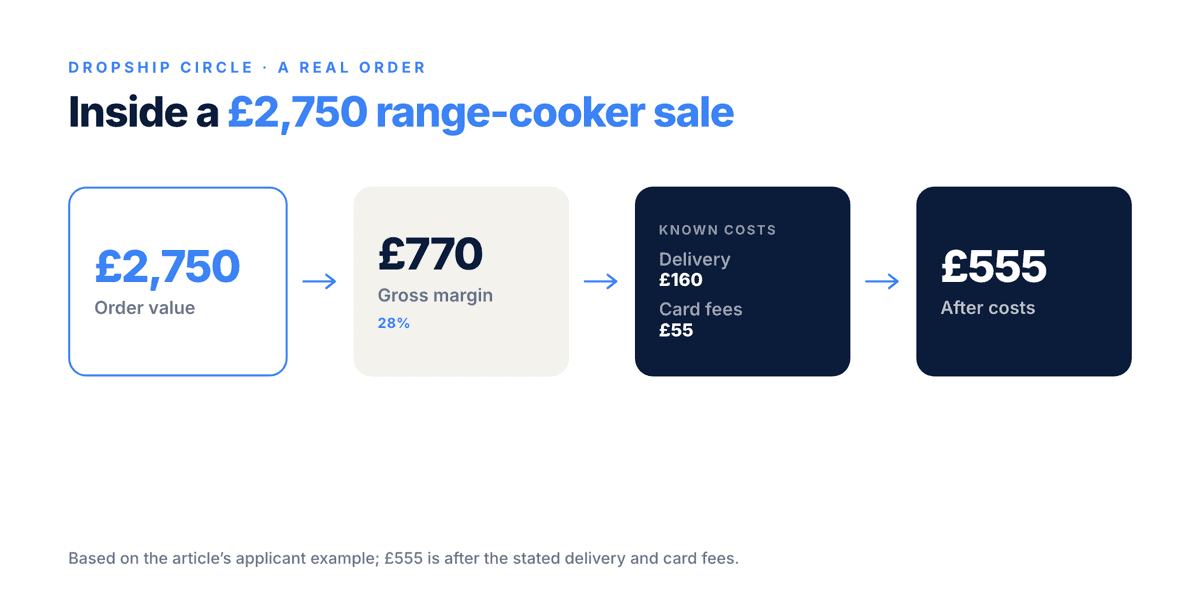
A first-time applicant in Carlisle had no sales, no company history and no stock, which is where every dealer application starts. He registered a company, put a number on the contact page that actually rang, wrote three lines on which counties he'd cover and which two brands he already stocked, and sent it to the trade address rather than the contact form.
Two of the four brands approved him inside a week. The first order through the better of them was a £2,750 range cooker at 28%, which is £770 gross, and after £160 of delivery and £55 in card fees that leaves £555. The brand that said no came back in the spring, after the site had been answering its phone for four months.
A dealer application isn't judged on your size. It's judged on whether you look like a business that will answer the phone when their product goes wrong. That's a lesson most people only learn after two or three rejections, which is exactly where a mentor's checklist saves time rather than money.
Mentor vs Free Content vs Paid Course: What's the Actual Difference?
The difference between these three routes is depth of review, not access to information, since most of the raw information is publicly available either way.
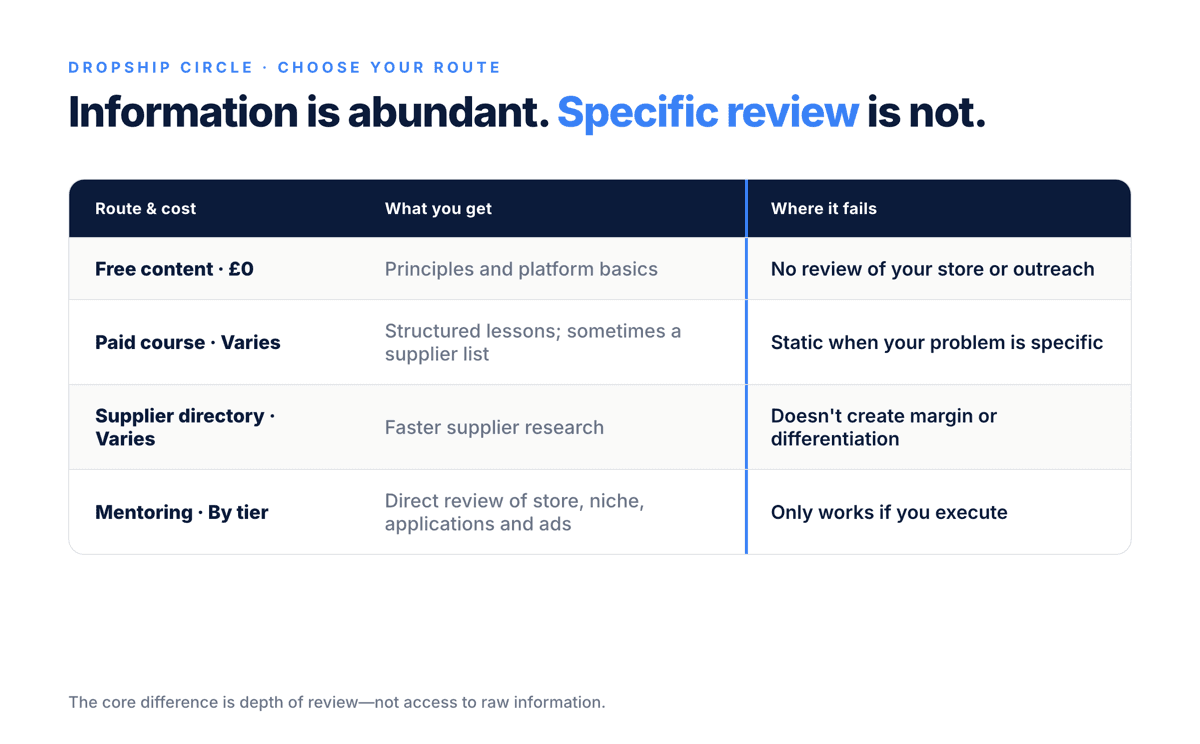
Route | Cost | What you get | Where it fails |
|---|---|---|---|
Free content (YouTube, blogs, Reddit) | £0 | General principles, platform basics, some real operator posts | No review of your specific store, niche or supplier emails |
Paid course, no mentoring | Varies, often low-cost | Structured lessons, sometimes a supplier list | Static; can't respond to your specific rejection or margin problem |
Paid supplier directory | Varies | Time saved on research | Doesn't create margin or differentiation on its own; if hundreds of sellers buy the same list, the same products get commoditised fast |
Mentor / mentoring programme | Priced by tier | Direct review of your store, niche, applications and ad data | Only works if you show up and do the outreach yourself |
A paid supplier directory can save research time, but a database of 5,000 unqualified names is often worth less than five proper supplier conversations, especially once 500 other beginners are listing the same products from the same feed. The tool doesn't replace the judgement.
Software has the same limit. The right stack makes a good operation cleaner. The wrong stack makes a weak operation noisier. I've seen operators spending £200 to £500 a month on tools who couldn't tell me their gross margin, their delivery promise or their returns process. No mentor and no software fixes that gap, only doing the unglamorous accounting does.
What Does a Mentor Cost, and Is It Worth It?
Mentor cost varies enormously by depth of access, from a one-off paid call to an ongoing scoped programme, so "is it worth it" depends entirely on what you're comparing it against.
Running the reader-maths again: one poorly-read £1,000 ad test costs you £460 in a single month and teaches you nothing if you don't open the report. A mentor's job, done properly, is to make sure that report gets read and acted on the first time, not the fourth. Across our own, student and client stores tracking £8.25M in sales, the pattern that shows up repeatedly isn't a secret product or a secret supplier, it's operators who read their own data early versus operators who kept spending on autopilot for months before checking.
Dropship Circle doesn't publish training pricing. Training is priced by tier and mentoring is scoped individually, because the right level of support depends on where you're starting from. What I will say plainly is that starting the model itself, supplier deposits, a basic Shopify setup, initial ad testing, generally needs £1,000 or more to get started, separate from anything you spend on education.
UK Specifics: Legal, Tax and Risk Considerations
Dropshipping is legal in the UK, but you're still liable for consumer protection law, VAT registration once you cross the threshold, and product safety regardless of who ships the item.
A UK operator needs the entity, tax and banking setup finished before serious supplier applications go anywhere, because later applications depend on identifiers created earlier. A distributor asking for a VAT number or company registration document mid-onboarding, when you haven't got one ready, reads as unprepared and costs you the account. This is the kind of gap a mentor catches in one conversation and a beginner discovers by being told no.
Margin risk is the other UK-specific pressure point right now. Higher household costs can push customers to delay replacing serviceable big-ticket items, which means the status quo, not a competitor, is often what you're actually selling against. A thin margin on a £1,000 product, say £120 gross, leaves almost no room once a single delivery issue costs you £60 in replacement or return handling. That's the arithmetic a mentor should be running with you before you commit to a niche, not after the first damaged delivery.
Key takeaways
A mentor isn't mandatory, but the cost of learning alone shows up as repeated mistakes, not one bad month.
A £1,000 ad test with unread data can close £460 down and teach you nothing; the report has to be read to count as tuition.
Supplier applications go better when you position as a retailer or dealer, not as "a dropshipper," and when your contact details actually work.
Paid supplier directories and software tools don't create margin on their own; they make a good operation cleaner or a weak one noisier.
UK operators need entity, tax and banking setup finished before supplier applications, since gaps there cause avoidable rejection.
Mentor pricing varies by depth; compare it against the real cost of your own unread mistakes, not against a course's sticker price.
Related reading
Frequently asked questions
Is drop shipping dead in 2026?
No. High-ticket dropshipping is still viable because the model targets fewer, bigger orders with better per-sale margins rather than competing on saturated low-ticket products. What's dying is the low-margin, race-to-the-bottom version most people picture when they hear the word.
Is drop shipping illegal in the UK?
No, dropshipping is legal in the UK. You're still responsible for consumer protection law, accurate product information, VAT once you cross the registration threshold, and product safety, regardless of who fulfils the order.
Why do so many dropshippers fail?
Most failures come from thin margins that can't absorb a single delivery problem, unread ad data, and supplier applications sent with no company or plan behind them. The model itself isn't the failure point; unmanaged basics are.
How much does it cost to hire a mentor?
It varies widely by depth of access, from a single paid consultation to an ongoing scoped programme. Dropship Circle prices training by tier and scopes mentoring individually rather than publishing a flat rate, since the right level of support depends on where the operator is starting from.
How much does a mentor get paid in the UK?
This varies enormously by niche, experience and format, from a one-off call fee to an ongoing programme fee, and there's no single published UK average for ecommerce mentoring specifically. Treat any figure quoted publicly as a general guide, not a fixed market rate.
How to get a mentor for free?
Free routes include genuine operator content on YouTube and blogs, Reddit threads from people actually running stores, and reading public reviews on sites like Trustpilot to see how paid programmes perform before committing. Free content can give you the map, but it won't review your specific store, niche or supplier applications the way paid mentoring does.
If you want to see how the model works before spending anything, Dropship Circle runs free training that walks through niche selection, supplier positioning and the real economics behind high-ticket stores. No pitch, no pressure, just the mechanics laid out honestly so you can decide for yourself whether this is worth building.
Ready to Build Your Ecommerce Business?
Get started with our free training and discover the exact framework we use to build sustainable high-ticket stores.
Related articles

Mentorship & Courses
Dropshipping Mentor Cost: What the Market Charges in 2026
What does a dropshipping mentor cost? Published 2026 prices by format, what to get in writing and what the fee omits.

Mentorship & Courses
Dropshipping Mentor vs Course: Which Do You Need First?
Dropshipping mentor vs course compared on feedback, cost and stage, with a table and a checklist to choose.

Mentorship & Courses
Dropshipping Mentor Proof: What Should You Actually Demand Before You Pay?
Dropshipping mentor proof means checkable evidence, not screenshots.