Most Dropship Circle reviews are written by strangers. This one is written by us, the company, which means you should treat every word with suspicion. So here is the deal: everything below is either independently checkable or the kind of thing a sales page would never print, including prices, costs and who we turn away.
I'm Lex, I run Dropship Circle, and I know exactly what you are doing right now. You have watched some videos, the idea holds up, and before you go any further you are checking whether we are real. Good. That instinct is the single best predictor of the people who do well at this. We answered the legitimacy question in full detail in our honest legit page. This page does the other half of the job: the review itself, with the numbers a review should contain.
Why we reviewed our own company
Because hundreds of people search for reviews of us every month before they trust us with a penny, and we would rather answer the awkward questions in public than leave that page to chance. A review from the company is worthless unless it holds itself to rules, so here are ours for this page: every figure is one we can evidence, stated in its exact approved wording or left out. Every cost is itemised, including the ones that make us look expensive. And the section on who should not join is real, because turning the wrong people away is cheaper than refunding them later.
You should still read the independent reviews. In fact that is most of the point: by the end of this page you will know exactly where to find them and what to check.
What Dropship Circle actually is
Dropship Circle is a UK-registered training and mentoring business that teaches high-ticket dropshipping: selling premium products, typically £500 to £5,000, supplied by established UK and US brands and distributors who hold the stock and ship it after you make the sale. You own the storefront, the marketing and the customer relationship. The supplier owns the warehouse.
It is run by a named person, me, not a faceless brand. My face is on the YouTube channel weekly, my name is on this blog, and I am on calls with members. That matters in an industry where the standard failure mode is a logo, a rented lifestyle and a disappearing act. If you cannot find a real human with a traceable history behind a course, walk away, from us or anyone.
What does Dropship Circle cost?
Training is sold in tiers, depending on how much feedback and direct access comes with it, and mentoring beyond that is scoped person by person against the level of support involved. The more useful number for anyone weighing this up is what it takes to actually start: realistically £1,000 or more before you have a store live, a supplier approved and a product properly tested.
The course fee is also the smallest number in this business, and a review that stops at the course fee is lying to you by omission. Here is the full picture:
Cost | Realistic range | Notes |
|---|---|---|
Training | Priced by tier | depends on the level of feedback and access |
Store and tools | £50 to £150 a month | Shopify, apps, email |
Advertising while you learn | £450 to £750 a month | the number most courses never itemise |
Working capital buffer | £2,000 to £5,000 | what the people who do well tend to start with |
The number that decides whether this works for you is not the training fee, it is whether you have enough behind it to test properly. Someone who spends everything on training and nothing on advertising has bought a manual, not a business. Work out the whole figure before you commit to any part of it.
The numbers we can stand behind
Three figures, each in the exact wording we allow ourselves, because rounding up is how honest numbers rot. From my own store: £2.8M gross from one store. 1,315 orders. No stock held. 800%+ ROAS. That is one store's lifetime figure, and gross sales are not profit. Across the wider business: £8.25M in sales tracked across our own, student and client stores, at roughly £1,000 average order value and 15 to 30 percent margins. That is an aggregate across many stores, never one person's income. And one student figure: £100,070 in sales over 202 orders on one student store. Individual result, not typical, and sales, not profit.
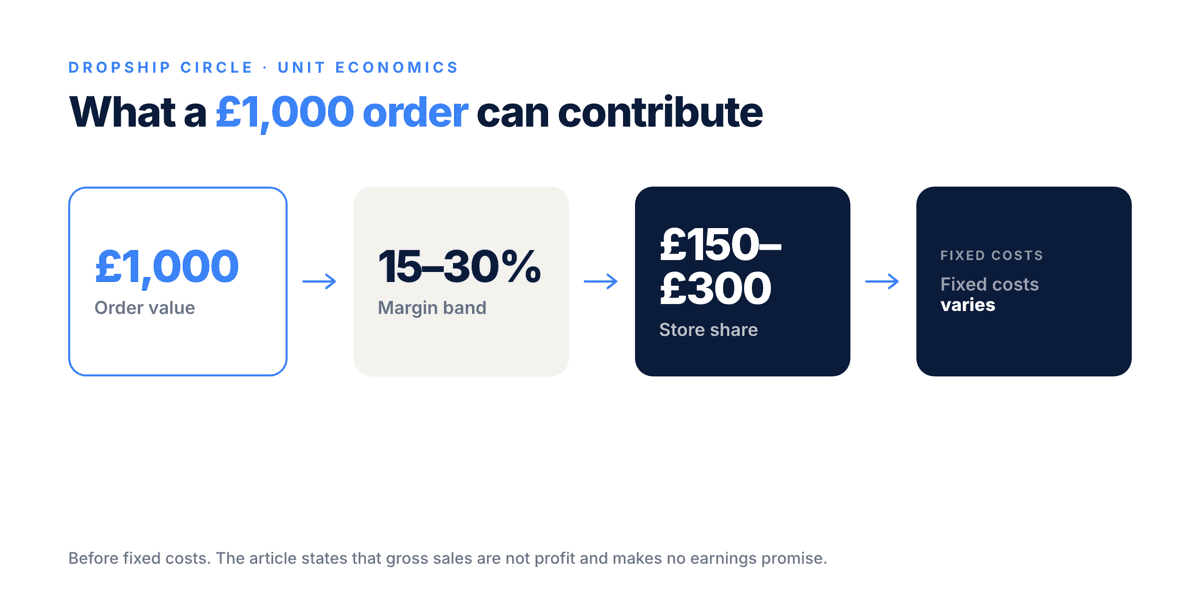
Notice what is missing: a promise about what you would earn. Nobody can make you one, and under UK advertising rules nobody should try. The sum worth running is yours, not ours. Take a £1,000 order at 15 to 30 percent margin: £150 to £300 stays with the store before fixed costs. Covering a £1,100 monthly mortgage payment therefore takes somewhere between four and eight orders a month, depending where in that band a store lands. Run that arithmetic against your own bills. If it does not work on paper with honest inputs, no course fixes it.
What this is not
This is a real business, not a shortcut, and it fails the daydream test on purpose. It is not hands-off: there are customers who phone before spending four figures, suppliers who expect professionalism, refunds, and admin. It is lighter than holding stock, and it can run around a full-time job, but it does not run itself, and anyone telling you an ecommerce business runs itself is describing something they have never operated.
It is not fast, either. Supplier approvals alone take weeks, because you are applying to real distributors who assess you as a stockist. Consistent sales take months. And it is not a way to start with nothing: advertising money leaves your account before sales money arrives, which is exactly why the working capital line sits in the cost table above.
Who we would tell not to join
The honest review of any programme is the list of people it does not fit, so here is ours. If you have less than about £1,000 spare beyond the course fee, do not join yet. Save first. That is not a sales tactic in reverse, it is the pattern we see over and over: the people who do well typically start with £2,000 to £5,000 of working capital they can commit without touching rent money. Starting underfunded means starting stressed, and stressed decisions are bad decisions.
If you need income inside sixty days to survive, this cannot promise that and we will not pretend otherwise. If you would never pick up the phone to a supplier, this is the wrong model, because someone has to and early on it is you. And if the money you are thinking of using is your pension or your safety net, keep it. No business model is worth that risk, ours included.
What people actually ask us before joining
Four questions come up on almost every call, so here are the answers in writing.
How many hours a week does it take? Around five to ten in the early months, worked around a job. Most members build in the evenings and on days off. The hours are front-loaded: research, supplier outreach and store build take more time than running a store that works.
Will real brands actually deal with me? Yes, as an approved stockist, and no, not all of them. Expect rejections, especially early. Approval is won with professionalism and patience, not a warehouse. We teach the approach, but the phone calls are yours.
What about VAT? The UK registration threshold is £90,000 of taxable turnover at the time of writing, and a high-ticket store can cross it faster than a low-ticket one. That is a sign of a working business, not a trap. Price it in from day one and it does not eat the margin; ignore it and it will.
What do I tell my wife or husband? Show them this page. The costs are above, the time is above, the risks are below. A plan that cannot survive that conversation is not a plan yet, and the version of you that starts with your partner on side does better than the version that starts in secret.
How to check us without asking us
A company's own review only earns trust where you can verify it, so verify it. Read our Trustpilot profile and sort by lowest rating first; how a company answers criticism tells you more than its five-star reviews do. Look us up on the Companies House register, where any UK company's filing history is public. Registration is a low bar, a scam can be registered too, but the record should exist and match what we claim.
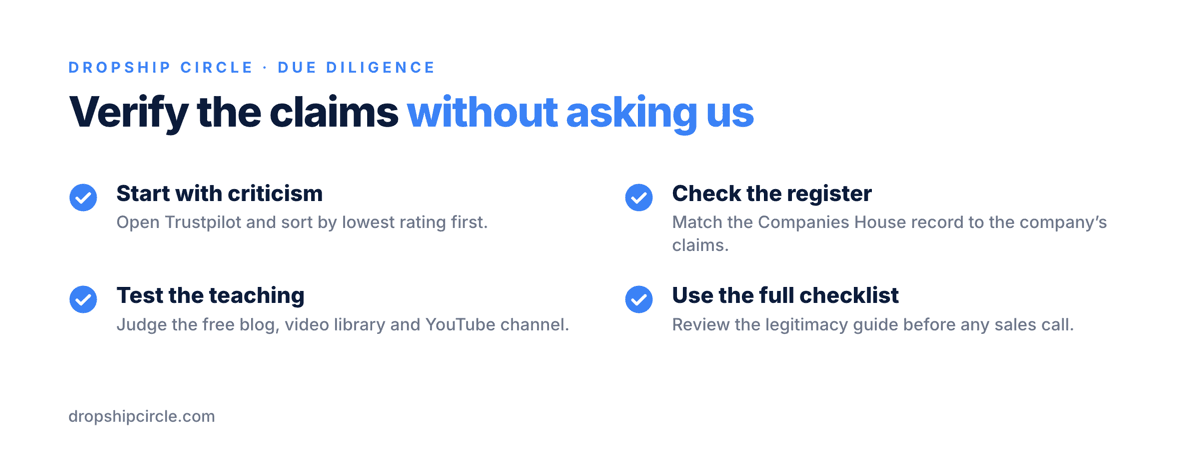
Then judge the teaching before paying for it. The blog you are reading, the video library and the YouTube channel are free and substantial by design: if the free material is not useful, do not buy anything. And for the full due-diligence checklist, including the questions worth asking on any sales call, ours or a competitor's, read Is Dropship Circle legit?
What goes wrong, honestly
Things fail in this model, and a review from us that skipped them would deserve your distrust. The most common wall is a Google Merchant Center suspension: Google's automated systems flag new ecommerce accounts constantly, ours and everyone's. It is usually recoverable, but recovery costs days or weeks, and anyone claiming it never happens has not run many stores.
The other failures are quieter. Ad spend runs ahead of sales in the first months, which is survivable with a buffer and fatal without one. Supplier approvals stall when people approach distributors like hobbyists. And margins collapse when a product cannot absorb its own advertising cost, which is why unit economics come before product ideas in everything we teach. Results vary with market, budget and the work you put in; no outcome is guaranteed, here or anywhere. What training changes is how expensive your mistakes are while you learn, because you are borrowing the patience of people who have already made them.
Key takeaways
Dropship Circle is a UK-registered training and mentoring business with a named, visible founder. Training is priced by tier and mentoring is scoped individually.
The real cost of starting is bigger than any course fee: budget £450 to £750 a month for advertising while learning, plus £2,000 to £5,000 of working capital.
The only figures we state are approved, evidenced wordings, and none of them is a promise about what you would earn.
Under about £1,000 of spare capital beyond the fee, the honest advice is to wait and save; the people who do well typically start with £2,000 to £5,000.
Verify us independently: Trustpilot sorted by lowest rating first, the Companies House register, and the free material, judged before money changes hands.
Related reading
Dropshipping Mentor Proof: What Should You Actually Demand Before You Pay?
Do You Need a Dropshipping Mentor? An Honest Operator Answer
Frequently asked questions
How much does Dropship Circle cost?
Training is priced by tier and mentoring is scoped individually. Budget for the whole thing rather than the fee alone: realistically £1,000 or more to get started, then roughly £50 to £150 a month for store and tools, £450 to £750 a month for advertising while you learn, and a working capital buffer of £2,000 to £5,000.
Is Dropship Circle legit?
Yes: a UK-registered company with a named founder, an independent Trustpilot profile you can read unfiltered, and a large free library published under my own name. Do not take that on trust. We wrote a full page on how to verify us, and any competitor: Is Dropship Circle legit?
Can I do this alongside a full-time job?
Yes, and most members do exactly that, typically five to ten hours a week in the early months, worked in evenings and on days off. What you cannot compress is the calendar: supplier approvals take weeks and consistent sales take months, so it suits patient builders rather than anyone needing income next month.
Why would a company publish a review of itself?
Because people search for Dropship Circle reviews before trusting us, and we would rather put prices, costs and downsides in public than leave that question to chance. The test of this page is simple: check every claim against the independent sources it points you to, and see whether it holds.
If the numbers on this page read like a business you would actually want to run, and the honest costs did not scare you off, the next step is free: watch the training. It is long enough to judge the teaching on its merits before spending anything, and if it does not hold your attention, keep your money. Either way, read the independent reviews first. We linked them for a reason.
Ready to Build Your Ecommerce Business?
Get started with our free training and discover the exact framework we use to build sustainable high-ticket stores.
Related articles

Mentorship & Courses
Dropshipping Mentor Proof: What Should You Actually Demand Before You Pay?
Dropshipping mentor proof means checkable evidence, not screenshots.

Mentorship & Courses
Do You Need a Dropshipping Mentor? An Honest Operator Answer
Do you need a dropshipping mentor? Not always, but the maths on wasted ad spend and rejected supplier applications.

Mentorship & Courses
Dropshipping Mentor UK: How to Choose the Right One
Comparing UK dropshipping mentors? What separates real operators from course sellers: costs, risks, proof to check.