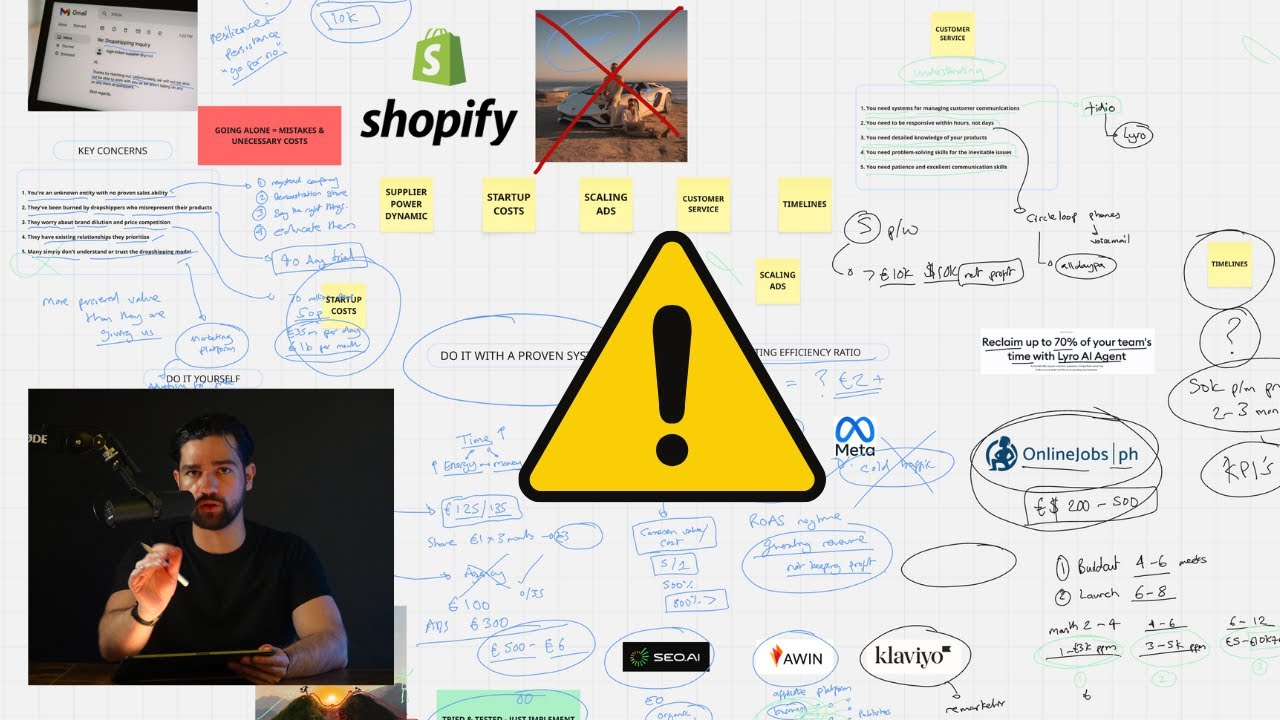
High ticket dropshipping risks include supplier rejection, cash-flow gaps, ad waste, refunds, delivery failures, and slow scaling.
Forget the Lamborghinis, revenue screenshots, and dreams sold through highlight reels.
This isn’t that.
This is the unfiltered reality of building a high-ticket dropshipping business.
Across £8.25M in tracked sales spanning own, student, and client stores, the same failure points show up repeatedly: supplier access, cash-flow timing, paid traffic discipline, margin control, and customer support.
After working with hundreds of entrepreneurs, I’ve seen both sides: operators who build durable businesses and those who burn out, stall, or lose thousands chasing an opportunity they never understood.
This article lays out five brutal truths about high-ticket dropshipping that most people leave out because they do not sell courses or clicks.
More importantly, it shows you how to navigate them.
Let’s get into it.
Quick Answer
The five biggest risks are weak suppliers, underfunding, ad dependence, poor support, and unrealistic timelines.
Supplier rejection is normal. Fix it with a credible store, clear positioning, and professional outreach.
Startup costs are real. Budget for setup, software, ads, operations, and refund timing.
Cash flow can break good orders. New stores need runway before payment processing feels smooth.
Paid ads can waste money fast. Use buyer-intent search, clean tracking, and margin-aware decisions.
Customer service is not optional. High-ticket buyers expect reassurance before and after purchase.
Scaling takes months. Supplier access, traffic data, SEO, affiliates, and systems compound over time.
The model punishes lazy execution. Operators win by diagnosing problems instead of panicking.
1. The Supplier Power Dynamic Is Real
Good suppliers reject weak stores to protect their margins, reputation, and existing dealer relationships.
Most gurus will tell you:
“Just build a store, email a few suppliers, and you’ll get approved.”
Wrong.
That advice worked better when the model was less visible. Serious suppliers have now seen every lazy pitch going. They recognise a copy-paste Shopify store. They know when someone has no plan, positioning, customer support, or clue how to represent a premium product.
Good suppliers are approached by dozens of dropshippers every week, and they reject nearly all of them.
Why?
You have no sales history
You’re an unknown business entity
They’ve been burned by dropshippers who misrepresented or undercut their brand
They don’t trust or understand the model
They already have dealer relationships
In my first business, 48 suppliers rejected me before one said yes. That supplier wasn’t even particularly good.
That is one of the biggest high ticket dropshipping risks: people assume the supplier is waiting for them. They’re not. You are entering their world. You need to look like an asset, not a liability.
Suppliers are asking themselves:
Will this person damage our brand?
Will they discount too aggressively?
Will they answer customer questions properly?
Will they create complaints we have to clean up?
Will they submit messy orders with missing information?
Will they disappear after two weeks?
That’s the real interview, not your “I’m passionate about e-commerce” email.
You need to prove that you can bring clean demand, handle customers professionally, and make the supplier’s life easier.
So how do you flip the script?
Position yourself as a credible marketing partner with a niche store, buyer-acquisition plan, and low-risk trial.
You don’t approach suppliers like a desperate beginner.
You show them you’re a professional marketing partner.
You offer value before asking for anything in return.
Here’s how we do it:
✅ Registered Company – Not self-employed. A real business.
✅ Demonstration Store – A professionally designed Shopify store that shows intent and credibility.
✅ 90-Day Trial Pitch – Let them test you without risk. No commitment. If it doesn’t work, they can remove you.
✅ Educate Them – Explain your marketing strategy, Google Shopping Ads plan, professionalism, and how you’ll expand their reach.
✅ NLP Language – Instead of saying “we’re dropshippers,” say:
“We’re a marketing platform that promotes your products at no cost to you.”
That line matters because language frames the relationship.
If you say “dropshipper,” many suppliers hear:
amateur
low margin
no control
brand risk
returns nightmare
If you say “marketing platform,” then prove it with a polished store, professional outreach, clear niche, and proper plan, the conversation changes.
You offer targeted exposure to buyers. You’re doing work marketing agencies charge thousands for, with performance aligned to actual orders.
That’s how you reframe the power dynamic.
A better supplier outreach process looks like this:
Build a niche-specific demonstration store first
Create proper category pages, product education, trust pages, delivery policy, returns policy, and contact details
Register the business so the supplier can verify it
Prepare a short pitch explaining who you serve and how you attract buyer-intent traffic
Lead with distribution value, not “can I list your products?”
Offer a 90-day test period
Confirm that you will respect pricing rules and brand guidelines
Ask about stock feeds, lead times, warranty ownership, returns, damage claims, and order submission
Follow up professionally without sounding desperate
Bad pitch:
“Hi, I run an online store and want to dropship your products. Can you send me your catalogue?”
Better pitch:
“Hi, we operate a specialist online store focused on premium garden wellness products in the UK. We’re expanding our supplier base and would like to discuss promoting your range through buyer-intent Google Shopping campaigns. We handle customer enquiries professionally, maintain brand presentation, and would be happy to start with a 90-day trial so you can assess fit.”
One sounds like someone trying to make money from them.
The other sounds like a business development conversation.
Once a supplier responds, qualify them as hard as they qualify you. Confirm:
How often stock data updates
Whether they provide accurate EAN or GTIN data
Their order cut-off times
Their normal and peak-season lead times
Who pays for redelivery, transit damage, and failed collections
Whether the warranty is handled by you, them, or the manufacturer
Whether they enforce advertised pricing
How quickly they issue refunds or replacement parts
Approval from a bad supplier is not a win. It is an operational liability wearing a catalogue.
2. Startup Costs Are Real, And They Vary
High-ticket dropshipping is capital-efficient, not free; setup, ads, software, fees, and refund timing all need cash.
This isn’t a zero-cost business.
You’ll need to invest in:
Company formation: £125–£200
Shopify store + theme: £500–£5,000, depending on whether you DIY or hire pros
Ads: £300+ just to launch
Software: £100/month for email, analytics, and product feeds
Optional: Virtual assistants, freelancers, and customer service tools
If you don’t know how to approach suppliers properly, they may ask for minimum order quantities, such as buying 5 units at £1,000 each upfront to “prove” you’re serious.
That’s £5,000 you didn’t plan for because you lacked a strategy.
People hear “no inventory” and assume “no cash required.”
Wrong again.
You may not be filling a warehouse, but you still need enough runway to build properly, test traffic, install basic systems, and handle friction.
The main cost buckets are:
Setup: company, domain, Shopify, theme, legal pages, and branding
Store build: design, product pages, collection structure, copy, images, speed, and mobile UX
Marketing: Google Shopping Ads, feed setup, tracking, and testing budget
Software: email, analytics, feed management, reviews, chat, and call handling
Operations: returns handling, customer service, and admin support
Contingency: refund timing, delayed supplier invoices, chargebacks, damaged goods, and delivery disputes
That final category is where beginners get caught.
A customer may buy a £2,000 product while the payment processor delays settlement or holds reserves on a new store. The supplier may require payment before dispatch. You now have a profitable order on paper but a cash squeeze in reality.
That does not mean the model is broken.
It means you need to operate like a grown-up.
Before touching Shopify, model every serious SKU. Record retail price, supplier cost, payment fees of 2–3%, target ad spend, and delivery surcharge risk. If the numbers have no oxygen in a spreadsheet, a better theme will not save them.
For example:
Retail price: £1,200
Supplier cost: £900
Gross margin: £300
Payment fee: roughly 2–3%
Target ad spend: £80–£180
Delivery risk: £0–£100
Net contribution: whatever remains before overhead, tax, refunds, and support
That exposes weak products immediately.
A £1,200 sale with £850 COGS, an £80 delivery contribution, and £120 ad spend leaves roughly £150 before fees and VAT. A £19.99 product acquired at a £30 CPA is immediately loss-making, and one refund can wipe out several orders.
Price alone does not make a product commercially attractive. A £900 item at 38% gross margin may outperform a £1,800 item at 20% gross margin when supplier terms and delivery are cleaner.
Typical Startup Costs
A lean launch can start at £1,000+, while poor outsourcing can create a £10,000+ detour.
Approach | Cost Range |
|---|---|
Lean setup, done properly | £1,000+ |
DIY, learning as you go | £1,000 – £1,500 |
Outsourced build | £10,000+ |
You can keep this lean, but only if you know where to focus.
We’ve invested over £100,000+ in agencies, mentors, and freelancers so you don’t have to reinvent the wheel.
Spend where it reduces risk, not where it feeds your ego.
Good spending:
A clean, fast Shopify theme
Proper product feed setup
Conversion-focused product pages
Call answering or live chat coverage
Email flows for abandoned carts and enquiries
Basic SEO foundations
Supplier-ready brand presentation
Bad spending:
Overdesigned logos
Custom code before you have sales data
Expensive branding decks
Random influencer posts
Trendy apps you don’t understand
Massive catalogues with no filtering or structure
Agency retainers before you can judge the work
Every paid Shopify app should do at least one of four things:
Save time on repeated tasks
Reduce costly errors
Improve buyer trust or conversion
Provide clearer numbers for decisions
If it does none of those, it is decoration. And decoration is expensive before the model is proven.
Your first objective is not to build the prettiest store on the internet.
Your first objective is to secure supplier approvals, launch credible products, test buyer-intent traffic, collect data, and avoid stupid cash leaks.
Illustrative lean setup:
Company formation: £150
Shopify store + theme: £600
Initial ads: £500
Software for first month: £100
Basic support tools: £50
That is £1,400 before major outsourcing.
Now compare it with a messy outsourced build:
Agency store build: £5,000
Branding package: £1,500
Unnecessary apps and setup: £600
Poor ad testing with no feed structure: £1,500
Freelancer fixes after launch: £1,400
That’s £10,000 gone before supplier quality, traffic economics, or conversion rate has been proven.
Same model. Completely different operator discipline.
3. Scaling Is Not Just About Ads
Scaling requires paid search, SEO, affiliates, email, supplier depth, margin control, and clean tracking together.
Everyone thinks success comes from running Facebook or TikTok ads.
The truth?
Cold traffic is a money pit, especially for high-ticket items.
We use Google Shopping Ads because they target buyers with real intent. Someone searching for “buy outdoor infrared sauna UK” is not passively scrolling. They’re actively comparing options.
But Google alone isn’t enough to scale long-term.
Paid ads are the ignition. They are not the whole engine.
If you rely only on ads, you create fragile growth. CPCs rise. Competitors enter. Campaigns get limited. Product feeds get disapproved. Suppliers change pricing. Suddenly, what worked last month stops behaving.
That is why your scaling system needs layers.
Our 3-Tiered Scaling System
Strong stores use paid ads for intent, SEO for compounding traffic, and affiliates for controlled reach.
1. Paid Ads (Google)
Google Shopping works when product data, tracking, search terms, bidding, and SKU margins are controlled.
Target ROAS: 800%+ (you break even at ~500%)
Focus on high-converting search terms
Track CVR (conversion value over cost) meticulously
The job is not just to “turn ads on.”
It is:
Clean product titles
Accurate product categories
Strong images
Competitive pricing where possible
Merchant Center health
Search-term pruning
Negative keywords
Product segmentation
Margin-aware bidding
Proper conversion tracking
Phone call and form lead tracking where relevant
High-ticket buyers often take longer to decide. They may click today, call tomorrow, compare three sites, then return through brand search.
If your tracking is lazy, you will cut good campaigns and keep bad ones.
Do not manage campaigns from revenue alone. Map supplier cost and delivery exposure at SKU level. A £1,200 product can show approximately £420 gross margin before deductions, then lose 1.5–3% to payment fees, £40–£120 to delivery surcharges, and £30–£100 per day during ad testing.
Shopify analytics can make that order look healthy. The bank account tells the truth.
A £1,000 product with only £120 gross margin is worse. One £60 delivery issue leaves £60 before ad spend, refunds, or support time. That is not margin. That is fragility.
2. Organic Traffic (SEO + AI)
Useful buying guides can support paid traffic and compound over 4–6 months; thin AI filler cannot.
AI-assisted blog content
Timeline: 4–6 months for results
Scales without equivalent additional ad spend
SEO has changed, but it is not dead. Thin AI spam is dead. Lazy “Top 10 garden furniture ideas” sludge is dead.
What works now is original, product-adjacent content that helps buyers make decisions.
Examples:
“Infrared sauna vs traditional sauna for UK homes”
“What size pergola do I need for a 4m patio?”
“Hot tub running costs in winter”
“Best outdoor kitchen layout for small gardens”
“Delivery access checklist for large garden buildings”
That content supports paid ads, improves conversion, answers objections, and builds topical authority.
Do not publish just to fill a blog. Publish to remove purchase friction.
Good articles should include:
Measurements or compatibility guidance
Installation and access constraints
Running-cost considerations
Delivery expectations
Product comparison criteria
Answers pulled from real pre-sale questions
Clear routes back to relevant products and collections
AI can help structure drafts and analyse recurring questions. It cannot invent operator experience, supplier policies, or product facts. Verify every claim against current supplier documentation.
3. Affiliate Marketing (Awin Platform)
Affiliates can add performance-based traffic at 3–5% commission when partners and brand bidding are controlled.
Hire affiliates to drive traffic for 3–5% commission
You get backlinks and traffic; they get paid on performance
Builds domain authority and brand trust
Most e-commerce sellers don’t even touch this. That’s why they stall.
Affiliates can include:
Review sites
Niche blogs
Buying-guide publishers
Home-improvement content sites
Voucher sites, used carefully
Product-comparison partners
The operator move is to control commission, approve partners manually, and protect margin. Do not let low-quality affiliates hijack brand searches or train customers to wait for discounts.
Scaling is not louder ads.
It is a better acquisition mix, stronger conversion, tighter follow-up, better supplier terms, and cleaner operations.
4. Customer Service Matters More Than You Think
High-ticket buyers need detailed reassurance before purchase and fast ownership of problems after purchase.
Yes, you’re selling fewer items. But each customer matters more.
You must:
Know your products
Be available during working hours
Respond quickly by live chat, phone, or email
Solve problems when things go wrong
Useful tools include:
Tidio for live chat, email, and AI-assisted responses
Lio for AI customer service integration
AllDayPA or CircleLoop for UK-based call handling
Klaviyo for email marketing automation
OnlineJobs.ph for hiring trained virtual assistants from £200–£500/month
If you ignore this, you’ll burn out managing leads, orders, questions, and logistics alone.
Even with a lean business, systems beat hustle.
High-ticket customer service means:
Confirming delivery access before dispatch
Explaining lead times clearly
Checking product dimensions with the buyer
Sending setup, warranty, and care information
Chasing suppliers for tracking updates
Handling missed delivery attempts
Managing damaged-item claims
Keeping customers calm when delays happen
Responding to pre-sale questions before competitors do
This is not selling £12 phone cases.
A customer buying a £2,000 item wants confidence. They may want to speak to someone. They may ask technical questions. They may need reassurance that the business is real.
If your website has no phone number, slow replies, vague policies, and generic copy, you lose the sale.
A simple service system looks like this:
Live chat during working hours
Phone number visible in the header
Email inbox checked multiple times per day
Saved replies for common product questions
Supplier escalation contacts documented
Delivery checklist sent before dispatch
Post-purchase email flow with next steps
Issue log for damaged, delayed, or disputed orders
The goal is not to answer everything yourself forever.
The goal is to build repeatable processes so support can be delegated without quality collapsing.
Illustrative example:
A customer orders a £1,800 garden building. The supplier says delivery is 7–10 working days. The customer has narrow side access and forgets to mention it. The delivery team arrives, cannot complete the drop, and the item returns to the depot.
Now you may face:
redelivery charges
an angry customer
supplier admin delays
refund pressure
a negative review
hours of back-and-forth
A proper pre-dispatch checklist could prevent the whole thing.
Ask:
Is access clear?
Are there steps, gravel, narrow gates, or height restrictions?
Is someone available to receive delivery?
Does the customer understand kerbside delivery if applicable?
Have they checked product dimensions?
Are there local delivery restrictions?
Then document the answer against the order. If a supplier requires photographs of access, collect them before releasing the order. If the item arrives damaged, ask for packaging and product photographs before it is assembled or discarded.
That evidence matters during claims.
This is the difference between an operator and a gambler.
5. Timelines Are Longer Than You’re Told
Most stores need months to build supplier access, traffic data, conversion systems, and dependable operations.
Can a store scale unusually quickly?
Yes, with strong resources, strong execution, and favourable conditions. It is not typical.
Here’s a practical roadmap based on hundreds of students:
Month | KPI Target | Notes |
|---|---|---|
0–2 | Build Store | Product research, store build, supplier outreach |
2–4 | First traction | Initial supplier approvals, first sales |
4–6 | Repeatable acquisition | Ads + email marketing working together |
6–12 | Multi-channel scaling | SEO, affiliates, stronger suppliers, cleaner systems |
Some stores move faster. Others take longer.
This is a realistic operating roadmap, not a promise.
The workload can become manageable at 5–10 hours per week once systems are in place, but that is not automatic. Product complexity, support volume, supplier quality, and delegation all change the workload.
The mistake is expecting a straight line.
It usually looks more like this:
Month 0–1: niche selection, competitor research, store architecture, supplier list
Month 1–2: outreach, rejections, follow-ups, demo-store improvements
Month 2–3: first approvals, product uploads, feed setup, tracking checks
Month 3–4: early sales, messy data, customer questions, supplier bottlenecks
Month 4–6: better campaigns, sharper product pages, email flows, stronger approvals
Month 6–12: organic traffic, affiliates, deeper supplier terms, operational use
You are not just launching a store.
You are building a distribution asset.
That takes time because every layer compounds:
Better suppliers improve product quality and margins
Better pages improve conversion
Better ads improve data
Better support improves trust
Better SEO reduces reliance on paid traffic
Better processes reduce owner workload
This is also why copying a store never works properly. You can copy the surface. You cannot copy supplier relationships, campaign data, operational processes, or trust.
The Real “Dark Side”, and How to Beat It
The real danger is quitting in the messy middle before supplier relationships, systems, and useful data compound.
Eventually, everyone hits what I call “the pit.”
You start climbing the mountain and everything looks good.
Then something breaks:
A supplier rejects you
Ads stop converting
A customer issue blindsides you
You second-guess your niche
Most people fall back down the hill.
If you’re working with the right system, team, or mentor, you plan for the pit and keep going.
You protect your time, money, and energy.
And you build something that lasts.
The pit is predictable. That means you can plan for it:
Keep a rejection tracker for supplier outreach
Follow up suppliers after 3–5 working days
Build a second supplier pipeline before you need it
Do not judge ads from one day of data
Separate product issues from traffic issues
Review search terms before increasing budgets
Document every customer issue so it does not repeat
Keep cash available for timing gaps and refunds
Avoid changing niche every time you feel uncomfortable
Most beginners make emotional decisions using incomplete data.
An operator asks better questions:
Is the product getting impressions?
Are clicks relevant?
Is the price competitive?
Are shipping terms clear?
Are there trust signals above the fold?
Are customers asking the same unanswered question?
Is the supplier reliable?
Is the campaign spending on junk terms?
Is the issue traffic, conversion, offer, margin, or operations?
Run that diagnosis in order.
If impressions are low, inspect feed eligibility, demand, bids, and product data. If clicks are relevant but nobody enquires or buys, inspect price, trust, delivery clarity, and page quality. If orders arrive but cash disappears, inspect COGS, fees, ad cost, surcharges, refunds, and support.
That level of diagnosis saves businesses.
Panic kills them.
Register to watch the free training →
FAQ
High-ticket dropshipping is viable, but supplier, margin, cash-flow, delivery, and execution risks must be controlled.
Is high-ticket dropshipping risky?
Yes; the main risks are supplier rejection, cash-flow gaps, ad waste, refunds, delivery problems, and slow scaling.
The risk is not just whether products sell.
The real risk is whether you can operate the business properly: supplier outreach, product data, paid traffic, support, tracking, margin control, and cash timing.
How much money do you need to start high-ticket dropshipping?
A lean setup can cost around £1,000 – £1,500, while poor outsourcing can push costs to £10,000+.
Typical cost areas include company formation, Shopify, theme, software, initial ads, basic tools, and contingency for refunds or cash-flow timing.
What is the biggest risk in high-ticket dropshipping?
The biggest risk is weak execution before the business has enough clean data to support good decisions.
That usually appears as bad supplier outreach, thin margins, messy product pages, poor tracking, emotional ad decisions, or no customer support process.
Can you lose money with high-ticket dropshipping?
Yes; setup, ads, refunds, chargebacks, delivery issues, supplier mistakes, and weak margins can all create losses.
That is why you need a budget, SKU-level contribution modelling, supplier checks, clear delivery policies, and a process for deciding what to fix before spending more.
How long does high-ticket dropshipping take to work?
Most stores need months, not days, to build supplier access, traffic data, conversion systems, and reliable operations.
A common build path is 0–2 months for setup and supplier outreach, 2–4 months for first traction, and 6–12 months for stronger systems. Individual results vary.
Final Words: Is This Business Right for You?
High-ticket dropshipping suits operators prepared to build a real retail business, not chase a shortcut dressed as e-commerce.
It may fit if you:
Want honest answers, not hype
Value structure and guidance
Are willing to invest time and effort in a real asset
Don’t want to chase viral TikTok products or play e-commerce roulette
But only if you’re ready to treat it like a real business.
The high ticket dropshipping risks are real:
Supplier rejection
Startup costs
Cash-flow timing
Ad waste
Thin SKU margins
Slow timelines
Customer service pressure
Delivery failures
Operational mistakes
Bad advice from people selling the laptop-lifestyle promise
None of that means the model does not work.
It means the model punishes tourists and rewards operators.
If you want hype, go elsewhere.
If you want the real process, build it properly.
And if you are ready:
📍 Watch the Free Training, no fluff, no pressure
📞 Book a Free 15-Minute Call to get clarity on whether this is your next move
✅ Join Dropship Circle, and let’s build your business together
Lex
Founder, Dropship Circle
Related reading
High-Ticket vs Low-Ticket Dropshipping: An Honest Comparison
The Smartest Online Business Model for 2026 (And Why High-Ticket Wins)
Ready to Build Your Ecommerce Business?
Get started with our free training and discover the exact framework we use to build sustainable high-ticket stores.
Related articles

High-Ticket Dropshipping 101
High-Ticket vs Low-Ticket Dropshipping: An Honest Comparison
High ticket vs low ticket dropshipping compared honestly: margins, risk, timeline and who each model actually suits.

High-Ticket Dropshipping 101
High-Ticket Dropshipping Statistics 2026: Success Rates
See 2026 dropshipping statistics for the UK and US, including survival rates, buyer trust and source-linked data.

High-Ticket Dropshipping 101
High-Ticket Dropshipping: The Real Numbers Behind the Model
What high-ticket dropshipping actually costs, earns and breaks on — real margins, niches and a worked example, not