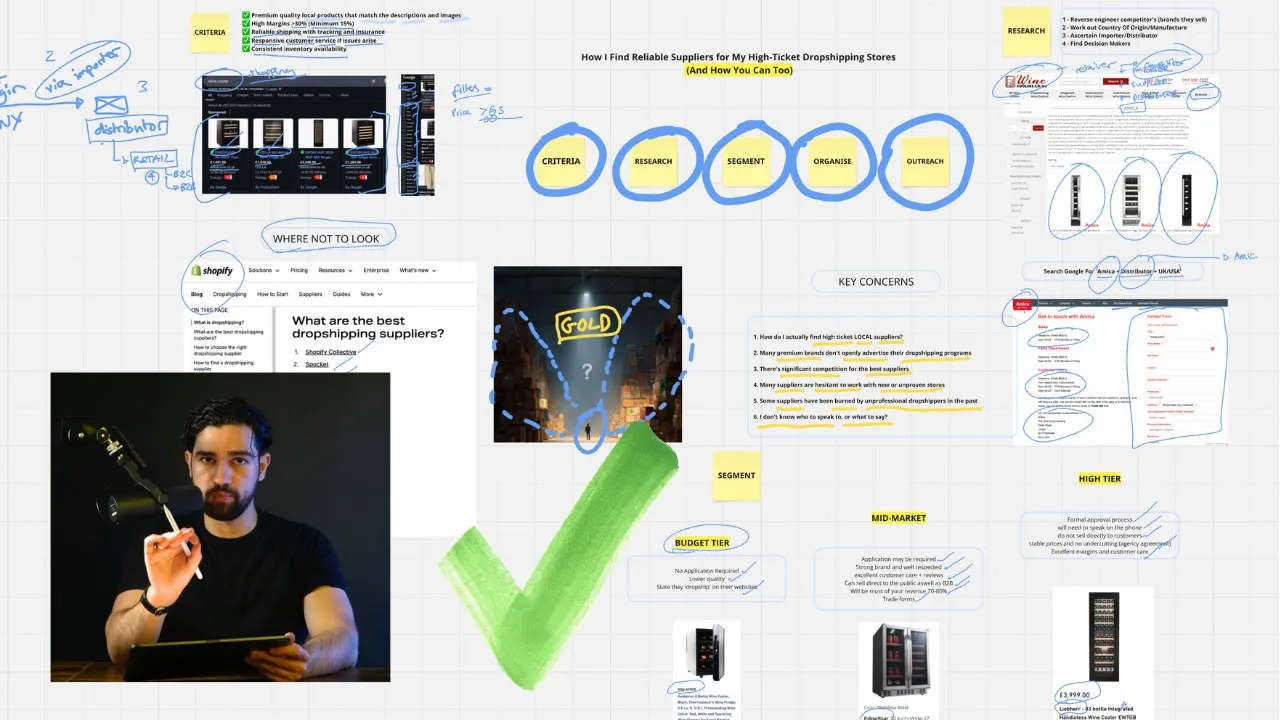
Find high-ticket dropshipping suppliers by researching real brands, tracing distributors, and applying as a retailer.
High-ticket dropshipping suppliers are established brands and authorised distributors that hold their own stock, drop-ship products priced £500 to £5,000+ direct to your customer, and approve retailers through a dealer-application process rather than an open marketplace.
Let’s get straight to it.
Your dropshipping business is only as strong as the suppliers behind it, and when you’re dealing with high-ticket products, the stakes are higher.
If you're tired of sifting through low-margin AliExpress listings or waiting weeks for AutoDS shipments, this article gives you a clear, repeatable system to find premium suppliers that:
Offer fast, local shipping
Stock real, branded products
Sell products where strong margins may be possible
Are open to working with serious online retailers
Whether you're just getting started or looking to upgrade your supplier base, this guide walks you through the process we teach inside the Dropship Circle Masterclass: find brands, trace the supply chain, qualify suppliers, organise your pipeline, and prepare for outreach.
This is not a supplier list. Supplier lists get stale fast. Markets move. Brands change distributors. Trade pages disappear. New competitors enter. Good suppliers are rarely sitting around waiting to be scraped from a directory.
So we’re not doing lazy research here.
We’re building a supplier-finding machine you can run in any premium niche: wine coolers, saunas, garden rooms, home gyms, commercial furniture, fireplaces, appliances, outdoor kitchens, mobility products, luxury pet equipment, specialist tools: anything where products are expensive enough to justify proper sales work and customer support.
Why Most Dropshippers Fail at Finding Quality Suppliers
Most dropshippers fail because they search for “dropshipping suppliers” instead of real brands and distributors.
Let’s address the confusion upfront.
You're probably surrounded by noise, YouTube videos shouting about “winning products,” lists of the “top 50 dropshipping suppliers,” and marketplaces like:
AliExpress
DHGate
CJDropshipping
AutoDS
Alibaba
Spocket
These platforms can work for low-ticket e-commerce, but they’re not designed for serious, scalable high-ticket brands.
Why?
Because high-ticket suppliers rarely advertise dropshipping partnerships. And the best ones? They often don’t need to.
They already work with trusted distributors, showrooms, installers, dealers, procurement teams, and established retailers. They’re not chasing TikTok trends: they’re running real businesses. But that’s exactly where your opportunity lies.
Most beginners go wrong in three places.
First, they search the wrong terms. They type “dropshipping supplier UK” and end up with directories, middlemen, or low-quality product feeds. Real brands usually use language like “trade account,” “become a retailer,” “dealer enquiry,” “distribution,” “stockist,” “partner,” or “wholesale.”
Second, they judge suppliers by convenience. If a supplier has an instant sign-up form, a product feed, and a big “dropship with us” banner, that can be useful. But it also means every other beginner can find them. Easy access usually means more competition.
Third, they confuse product price with supplier quality. A £1,000 product from a weak supplier can still be a nightmare if shipping is slow, tracking is poor, warranty support is vague, or the brand has no trust in the market.
High-ticket is different. You are not just listing random products and hoping the checkout fires. You’re positioning yourself as a professional retailer. That means the supplier has to trust you, and you have to qualify them properly.
Step 1: Understand What a High-Ticket Supplier Looks Like
A good high-ticket supplier has local stock, proper logistics, responsive support, and trade margins worth your time.
Before we go digging, we need to know what to look for.
The 5 Criteria of a Good Supplier:
Local stock & fast shipping
Products are already in your country or distributed from a local warehouse. No long wait times. If you’re selling in the UK, you want UK stock or a clear UK distribution route wherever possible.High margins
You want 30–50% margin. Never settle for less than 15%. If a supplier offers you 5–10%, move on. That does not mean every product will hit those numbers after ads, payment fees, returns, and support. It means the trade pricing needs enough room for the model to make sense.Tracking, courier integration & insurance
Legit suppliers offer reliable logistics, insurance, and proper tracking. These aren’t casual sellers. With large or fragile goods, ask how items are packed, which couriers are used, whether delivery is kerbside or room-of-choice, and what happens if an item arrives damaged.Responsive customer service
When something goes wrong, and it will, you need fast, professional support. Test this early. Send a basic trade enquiry. Call the number. Ask a product question. See if they reply like a proper operation or like someone checking emails once a week.Established branded products
You’re not private labelling. You’re partnering with existing, trusted brands, and positioning yourself as a premium online retailer.
A proper supplier should make your business stronger, not fragile.
Here’s a quick test: if a customer asks about warranty, lead time, installation, delivery access, spare parts, returns, or product compatibility, can your supplier help you answer clearly? If not, you are carrying too much risk.
Also look at whether the supplier protects its brand. RRP, MAP, dealer rules, territory rules, image guidelines, and warranty policies can be annoying, but they often signal a supplier that cares about long-term positioning. Chaos is bad for high-ticket. Race-to-the-bottom pricing is bad for everyone except the cheapest operator in the room.
Step 2: Find Suppliers Without Using AliExpress or AutoDS
Use Google Shopping to uncover brands and retailers already selling high-ticket products in your niche.
This is where most people overcomplicate things.
Forget Chrome extensions, supplier directories, and endless scrolling. Instead, use Google Shopping as your starting point.
Here’s how:
Search a high-ticket keyword in your niche, such as “wine cooler” or “infrared sauna”.
Click the Shopping tab.
Look at the listings and identify:
Brand names such as Swiss Cave, Liebherr, CDA
Retailers selling those brands
Product price points
Repeated models or product families
Retailers that appear again and again
Make a list of all brands you see.
You’ll be surprised how many new ones appear, even on page 5 or 6.
Pro tip:
Set filters on Google Shopping to only show products over £300. This weeds out low-end, budget items.
Do not stop after five minutes.
Open a spreadsheet and work the niche properly. Search broad keywords first, then narrower ones. If the niche is wine coolers, don’t just search “wine cooler.” Search “built in wine cooler,” “dual zone wine cooler,” “undercounter wine fridge,” “commercial wine cabinet,” “integrated wine cooler,” and “large wine fridge.”
You are looking for patterns.
If the same retailer keeps appearing, inspect their site. Which brands do they carry? Do they have brand category pages? Do they mention delivery partners? Do they have finance options? Do they sell premium add-ons? Are they a generalist store or a specialist retailer?
Then inspect the brands. Search the brand name directly. Check whether the brand has:
An official website
A UK domain or UK distributor page
A “where to buy” page
A stockist locator
Dealer or trade information
Warranty pages
Downloadable manuals
Product catalogues
Installation guides
Spare parts support
This is not glamorous work. Good. That means most people won’t do it properly.
Step 3: Reverse Engineer the Supply Chain
Reverse engineer suppliers by searching each brand with distributor, importer, trade, and retailer terms.
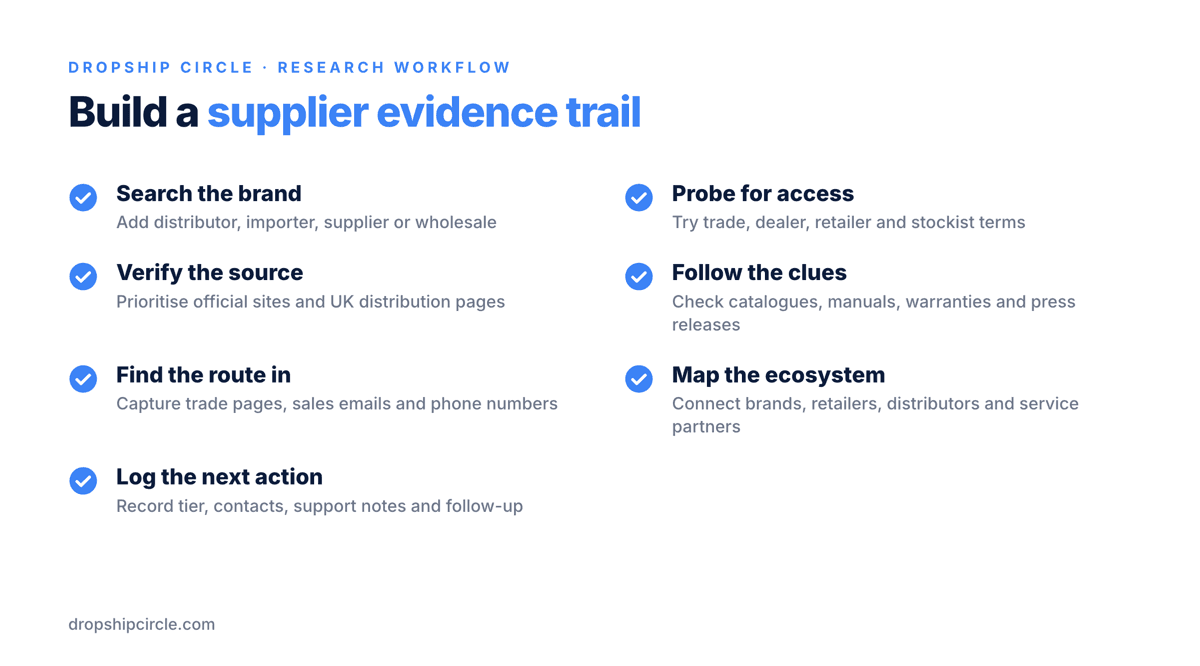
Now that you have a list of brand names, let’s find out where they come from.
For each brand:
Search: "Brand + distributor UK" or your country.
Example:Amica distributor UKUse variations like:
Brand + supplier UKBrand + importer UKBrand + trade applicationBrand + wholesaleBrand + dealer applicationBrand + become a retailerBrand + stockistBrand + warranty UK
Look for:
Official websites
“Trade” or “Become a retailer” pages
Contact forms or sales department emails
Spare parts or manuals, often a sign it's a manufacturer
Press releases naming distributors
PDF catalogues with contact details
Retailer locator pages
Installation or service partner pages
Add the data to a spreadsheet:
Brand name
Website
Do they retail direct to consumer? yes/no
Trade application available? yes/no
Supplier tier: budget / mid-market / high tier
Contact info: email, phone, address
Product category
Approximate product price range
Notes on warranty, delivery, and support
Next action
This is real research: not plug-and-play automation. You're building something real.
Here’s the important part: do not assume the first website you find is the supplier you need.
Sometimes the brand sells direct. Sometimes it has a separate distributor. Sometimes the distributor owns multiple brands. Sometimes the UK importer is buried in a PDF manual or warranty page. Sometimes the best contact is not “support@” but a trade sales phone number.
Work backwards.
If a retailer sells five brands in the same niche, those brands may share distributors. If a warranty document lists a service company, that service company may know the importer. If a “where to buy” page lists specialist retailers, those retailers reveal what serious operators are carrying.
Your job is to map the ecosystem.
Step 4: Segment Your Suppliers into Tiers
Segment suppliers into budget, mid-market, and high-tier so you know where to focus outreach.
Not all suppliers are equal. Here’s how to classify them:
Budget Tier
Products priced ~£200–£400
Easy to join, often with trade form on site
May advertise dropshipping openly
Lower quality components
Less exclusive, more competition
Example: Tron
Budget suppliers are not automatically bad. They can help you understand the niche, test demand, and build early operational confidence. But they are usually easier for competitors to access, and customer expectations can still be high even when the products are cheaper.
Watch the support burden here. A cheap product with constant delivery issues is not cheap. It just moves the cost from purchase price into customer service, refunds, reviews, and your time.
Mid-Market Tier
Strong brand reputation
£500–£2,000+ product range
Requires basic vetting or trade application
Often where much of your practical selling work happens
Example: EdgeStar
Mid-market suppliers are usually the sweet spot for many new high-ticket retailers. The products are expensive enough to justify real support, but not always so exclusive that you need years of trading history before they speak to you.
Expect some vetting. They may want to see your website, company details, route to market, advertising plan, customer service process, and how you’ll represent the brand. Good. That forces you to act like a retailer, not a chancer.
High-Tier
Premium pricing: £2,000–£15,000+
Formal approval process
You must speak with sales directors or managers
No direct-to-consumer sales
Often use RRP in the UK or MAP in the US enforcement to protect margins
Example: Liebherr
These high-tier suppliers are often importers, distributors, and manufacturers all in one. If you gain access, the credibility, product quality, and margin structure can be much stronger than commodity catalogue suppliers.
But don’t romanticise them.
High-tier suppliers may expect a polished site, brand-safe content, clear policies, strong customer support, product knowledge, and sometimes showroom presence or installation capability depending on the niche. Some will say no. Some will ignore you. Some will ask you to come back when your store is live or when you can show category focus.
That is normal.
Your goal is not to win every supplier. Your goal is to build a pipeline and keep improving your positioning.
Step 5: Organize Everything Like a Pro
Track suppliers in a simple spreadsheet or board so every lead has a status, contact, tier, and next action.
You now have:
Competitor brands
Supplier contacts
Product data
Tier classification
Notes on logistics
Notes on trade terms
Outreach status
Organize it in a Google Sheet or Trello board with columns like:
✅ Supplier Name
🌐 Website
📞 Contact Info
🎯 Tier: Budget / Mid / High
📝 Trade App Available?
📦 Products You Want to Sell
📍 Country of Distribution
🚚 Delivery Notes
🛠 Warranty / Support Notes
⏳ Last Contacted
📆 Follow-Up Needed
🔥 Priority Score
✅ Status: Researching / Contacted / Call Booked / Approved / Rejected / Follow Up Later
Stay consistent. Update your sheet after every outreach or call.
Inside Dropship Circle, we also give our students pre-built templates, supplier management boards, outreach trackers, and CRM systems, but you can start simple.
Here’s a basic scoring method if you don’t know what to prioritise:
Product price fit: 1–5
Brand reputation: 1–5
Margin potential: 1–5
Shipping quality: 1–5
Support quality: 1–5
Competition level: 1–5
Ease of contact: 1–5
Add the scores. Sort by the strongest opportunities. Then start outreach with suppliers that are good enough to matter but not so intimidating that you freeze.
Do not make your spreadsheet a hiding place. Research is only useful if it leads to action. If you have 80 supplier leads and zero conversations, you don’t have a supplier strategy. You have a procrastination file.
Step 6: Prepare for Outreach
Outreach works better when you present as a serious retailer, not someone asking for a product feed.
Outreach is where you turn this research into relationships.
And no, it’s not about begging suppliers to work with you.
It’s about presenting yourself as a professional online retailer with:
A clean, branded website
An understanding of their market
A clear plan to drive sales
Respect for their brand’s reputation
Proper customer service policies
Clear delivery, return, and warranty pages
A reason they should take your enquiry seriously
Before you contact anyone, get the basics in place.
Your website does not need to be perfect, but it cannot look unfinished. No broken links. No placeholder text. No random logo. No fake reviews. No copied product descriptions from three different competitors stitched together like a hostage note.
Build the minimum credible retailer presence:
Homepage explaining your niche focus
Category pages that make sense
About page with a real business angle
Contact page with email and phone if possible
Delivery policy
Returns policy
Privacy policy
Terms
Brand-safe design
Clear positioning
Then prepare your outreach.
You can start with a simple email:
Hi [Name],
I’m building a specialist online retailer focused on [category] for customers in [market]. I’ve been researching [brand/supplier] and think your range could be a strong fit.
Could you point me to the right person for trade or retailer account enquiries?
I’d be happy to share our website, category plan, and how we intend to represent the brand online.
Thanks,
[Name]
That is not magic. It is just professional.
If you call, keep it direct:
Ask for trade sales or retailer accounts
Say you’re interested in representing the brand online
Ask what they require from new retailers
Ask whether they work with online-only retailers
Ask whether products are held locally
Ask how delivery and warranty support work
Ask whether there is a trade application process
Take notes immediately after the call. Add the next action to your sheet. Follow up when you say you will.
In the next article and video, I’ll walk you through exactly how to do outreach, including:
What to say on the phone
How to write high-converting emails
What materials to include in your presentations
How to build credibility from day one, even if you're brand new
Comparison Table: Supplier Types
Use supplier type to judge access, competition, margins, logistics, and the level of professionalism required.
Supplier Type | Typical Access Level | Product Range | Margin Potential | Main Advantage | Main Risk | Best Use |
|---|---|---|---|---|---|---|
Marketplace supplier | Very easy | Low-ticket to mixed | Often thin | Fast to start researching | Heavy competition and weak control | Learning product research basics |
Open dropship supplier | Easy | Budget to mid-market | Variable | Simple onboarding | Many retailers selling the same catalogue | Early testing and operational practice |
Brand distributor | Medium | Mid-market to premium | Often stronger | Better products and support | Requires proper outreach and vetting | Building a credible high-ticket store |
Manufacturer / importer | Harder | Premium or specialist | Often strongest | Direct relationship and brand authority | Higher expectations and slower approval | Long-term supplier base |
High-tier protected brand | Hard | £2,000–£15,000+ | Depends on terms and policy | Trust, quality, and market positioning | Formal approval and brand rules | Serious category leadership |
Do not treat this table like a scoreboard where “harder” always means “better.”
A hard supplier with poor communication is not better than a mid-market supplier that ships fast and supports you properly. A premium brand with no margin is not better than a mid-tier brand with clean terms and strong demand.
Judge the full picture.
Final Thoughts
Supplier research is the foundation: find real brands, qualify the supply chain, organise leads, then do professional outreach.
This is real business-building.
Not quick wins. Not “winning product” roulette. Not hoping an app finds your next supplier.
If you're willing to put in the work, even just a few hours a week, this process can help you build a stronger supplier base over time.
Some Dropship Circle students have used this approach to build high-ticket supplier relationships and grow their stores, but results vary based on niche, execution, budget, market conditions, and consistency.
If you're ready to stop dabbling and start building:
💼 Build a business worth owning, not just another Shopify store
Lex
Founder, Dropship Circle
Register to watch the free training →
Related reading
Ready to Build Your Ecommerce Business?
Get started with our free training and discover the exact framework we use to build sustainable high-ticket stores.
Related articles

Suppliers & Sourcing
High-Ticket Dropshipping Suppliers in the USA: The Named List
A named list of high-ticket dropshipping suppliers in the USA, how to get approved, and the real economics behind

Suppliers & Sourcing
Free Dropshipping Suppliers
Free dropshipping suppliers can work, but only if margins, stock, delivery and support terms survive real trading

Suppliers & Sourcing
Spocket Dropshipping Suppliers
Searching for a sprocket supplier? If you mean Spocket, this blunt guide covers suppliers, margins and product fit.