A free dropshipping course should teach the full store system before ads: niche, suppliers, store, pricing, traffic, fulfilment, and service.
Most people searching for a free dropshipping course are not trying to become ecommerce experts today. They want to know if this is still a real business model, what it costs, and whether they can learn enough for free to avoid getting rinsed by a course seller with rented cars and fake screenshots.
Fair enough. I run high-ticket ecommerce stores, and I mentor operators through Dropship Circle. I am pro high-ticket dropshipping because the economics are better than the low-ticket grind, but I am not going to pretend a free course will magically build the business for you. Free content can give you the map. Execution, supplier calls, cash control, and customer handling are where the business gets real.
Free dropshipping course checklist | What it should cover | Why it matters |
|---|---|---|
Niche choice | Demand, product depth, competition, supplier fit | Stops you chasing random products |
Supplier sourcing | Dealer accounts, lead times, margins, support | The supplier can make or break the store |
Store setup | Shopify structure, trust assets, product pages | Buyers need clarity before spending |
Pricing | Freight, fees, discounts, tax exposure | Revenue is not profit |
Traffic | SEO, Google Shopping, Search, email | Traffic must match buyer intent |
Fulfilment | Dispatch, tracking, damages, returns | Operations decide customer trust |
Service | Enquiries, aftercare, warranty handling | High-ticket buyers expect support |
Free dropshipping course curriculum
Module | Lesson goal | Beginner output |
|---|---|---|
1. Business model | Compare low-ticket, high-ticket, and marketplace routes | One model selected |
2. Niche research | Test demand, product depth, competition, and supplier fit | 3 viable niches |
3. Supplier sourcing | Find and approach domestic or regional suppliers | 20-50 supplier prospects |
4. Store setup | Build the core Shopify structure and trust assets | A working storefront |
5. Pricing and operations | Calculate landed margin and define fulfilment rules | Margin sheet and operating checklist |
6. Traffic | Match SEO, Shopping, Search, and email to buyer intent | One focused traffic plan |
7. Service | Prepare for enquiries, damages, returns, and warranties | Customer-service process |
A free dropshipping course is a no-cost guide to the full store system: niche research, supplier sourcing, store setup, pricing, traffic, fulfilment and customer service. It should teach these foundations before advertising or chasing trendy products.
What should a free dropshipping course actually teach?
A good free course should teach the full store system, not just how to find a trendy product.
If a free dropshipping course is only “find winning products on TikTok” and “launch ads”, it is not a business education. It is a content funnel. Real dropshipping, especially high-ticket dropshipping, has more moving parts than that.
At minimum, I want a beginner to understand these 7 areas before they spend serious money:
Business model: low-ticket versus high-ticket, domestic versus international suppliers, marketplace versus Shopify.
Niche selection: demand, product depth, supplier availability, shipping constraints, and competition.
Supplier sourcing: authorised dealer routes, trade accounts, MAP pricing in the US, credit terms, lead times.
Store setup: Shopify structure, collection pages, product pages, trust assets, payment methods.
Pricing and margins: VAT or sales tax exposure, card fees, freight, returns, damages, and discounts.
Traffic: Google Shopping, Google Search, SEO, email, retargeting, and quote-led selling.
Operations: order confirmation, fulfilment, tracking, customer service, damaged goods, refunds.
The difference between a thin free course and a useful one is whether it shows you the boring bits. The boring bits are where the margin survives.
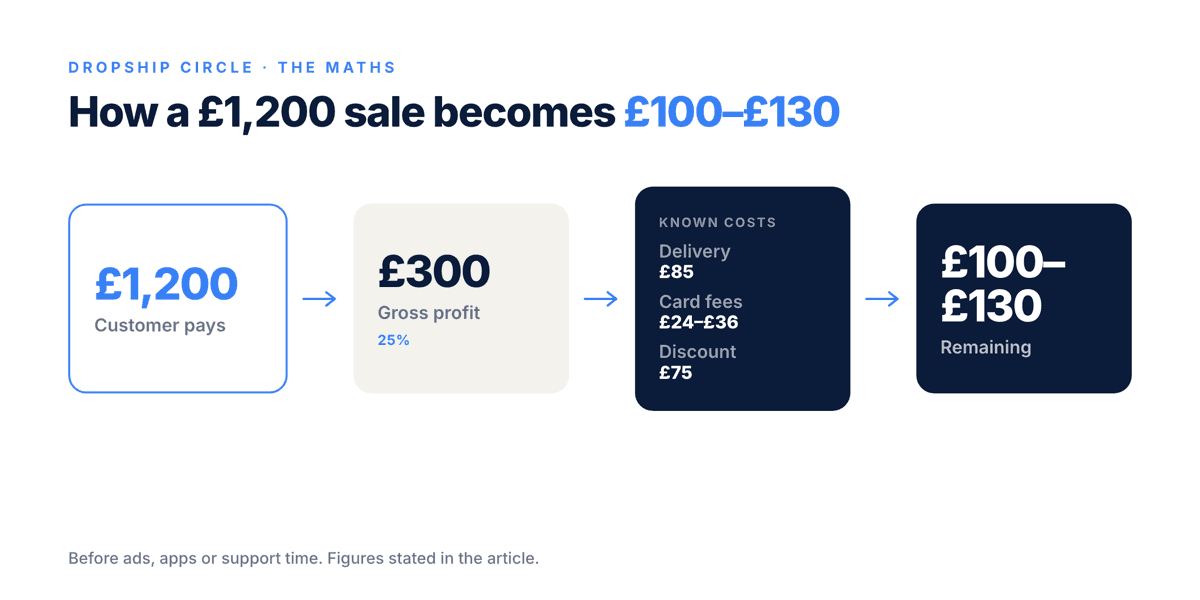
For example, selling a £1,200 item at a 25% gross margin looks like £300 gross profit. But if delivery is £85, card fees are roughly £24 to £36 depending on processor and region, and you offer a £75 discount to close the order, that margin is not £300 anymore. It can become £100 to £130 before you have paid for ads, apps, or support time.
That is the type of reality a free course needs to cover.
Do not build a conversion forecast around an unsupported universal benchmark. Use your own channel, device, product, and checkout data, then improve the pages causing leakage. Shopify’s conversion-rate guide explains why store context matters instead of giving every retailer one magic target.
The U.S. Census Bureau’s Quarterly Retail E-Commerce Sales release tracks ecommerce as a share of total US retail sales. The useful point is directional: ecommerce remains a material sales channel, but it is not an exemption from normal retail economics. You still need margin, service, fulfilment, and cash control.
Should a free course focus on low-ticket or high-ticket dropshipping?
A serious beginner should learn both, then choose high-ticket if they want better order economics.
Low-ticket dropshipping usually means £10 to £80 products, often imported, often impulse-led, and often dependent on paid social ads. High-ticket dropshipping usually means products around £1,000+ / $1,000+, sourced from domestic or regional suppliers, sold through a proper ecommerce storefront.
Here is the blunt comparison:
Model | Typical order value | Main traffic route | Operational pressure | Core risk |
|---|---|---|---|---|
Low-ticket dropshipping | £10-£80 / $10-$100 | TikTok, Meta, impulse ads | High order volume, lots of tickets | Thin margin and product saturation |
High-ticket dropshipping | £1,000+ / $1,000+ | Google, SEO, buying-intent traffic | Fewer orders, higher expectation | Supplier quality and margin control |
Amazon FBA | Varies | Amazon marketplace traffic | Inventory and platform rules | Platform dependency and cash tied in stock |
Local service ecommerce | £500-£5,000+ | Search, local SEO, referrals | Fulfilment coordination | Operational complexity |
I prefer the Shopify-based high-ticket route because you build an asset outside Amazon’s ecosystem. You own the website, the email list, the niche positioning, the supplier relationships, and the customer experience. That does not make it easy, but it makes it more defensible than trying to win a race to the bottom on a marketplace you do not control.
Can you really learn dropshipping for free?
Yes, you can learn the basics for free, but free content rarely gives you judgement under pressure.
There is no shortage of free information. Shopify Learn provides free education around store setup and ecommerce basics. YouTube has full 6-hour dropshipping videos. Blogs, Reddit threads, supplier directories, Google Merchant Center documentation, and tax authority websites are all public.
The issue is not access to information. The issue is sequencing and decision-making.
A beginner does not usually fail because they cannot find a video on building a product page. They fail because they choose a niche with weak suppliers, copy bad pricing, ignore freight costs, run ads before the store can convert, or panic when a £1,500 order arrives and the supplier says the item is out of stock.
That is why most free learning should be used to answer one question: “Do I understand the model well enough to begin properly?” Not “Can I avoid all mistakes forever?”
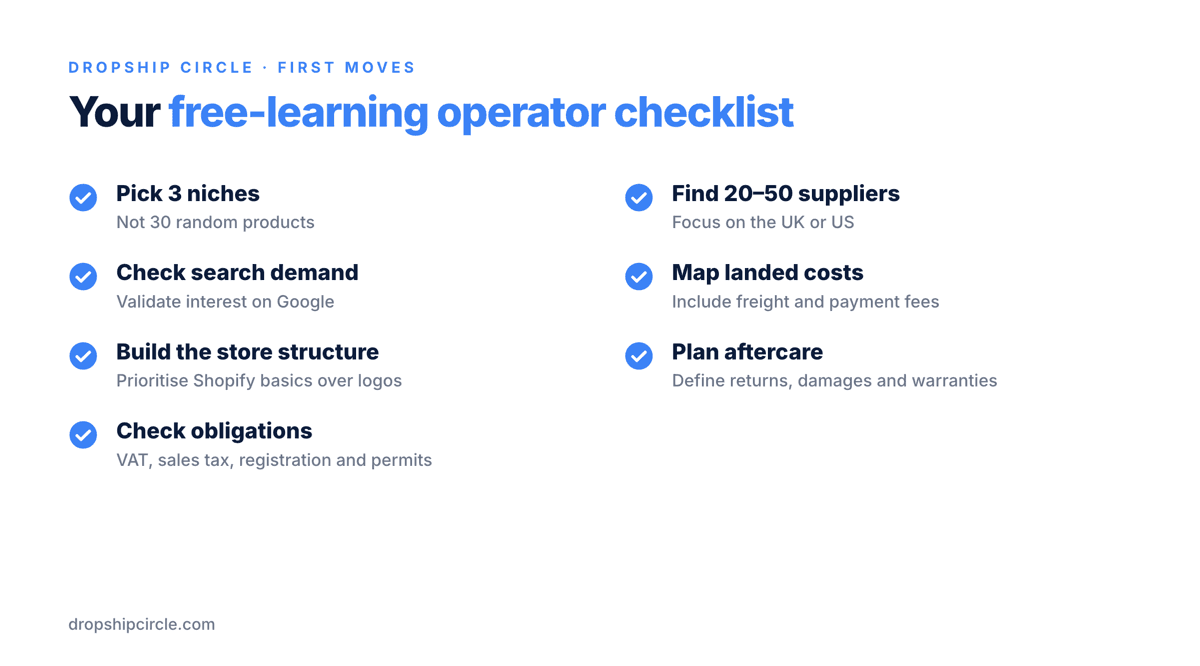
The best use of free training is to build a first operator checklist:
Pick 3 possible niches, not 30 random products.
Find 20 to 50 potential suppliers in the UK or US market.
Check whether the products have search demand on Google.
Map landed costs, including freight and payment fees.
Build a basic Shopify store structure before obsessing over logos.
Learn how returns, damages, and warranties are handled before taking orders.
Understand when VAT, sales tax, business registration, and reseller permits may matter.
In the UK, HMRC’s VAT registration guidance sets mandatory registration once taxable turnover goes over £90,000 in a 12-month period. Businesses remain responsible for checking the current rules because thresholds and details can change.
In the US, sales tax is state-based, and economic nexus rules vary by state. The Streamlined Sales Tax Governing Board’s state resources provide links to state-level remote-seller guidance. Serious operators usually speak to an accountant or use tools like Shopify Tax, TaxJar, or Avalara once volume justifies it.
Free content can get you to the edge of the pitch. It does not play the match for you.
What is the hidden downside of free dropshipping training?
Free training often teaches isolated tactics, not a commercial operating system.
The hidden cost is confusion. One creator tells you to sell viral gadgets. Another tells you to use AliExpress. Another says Amazon FBA is dead. Another says SEO takes too long. A beginner stitches 12 opinions together and ends up with no coherent model.
That is why I tell people to judge free content by consistency. If the course teaches high-ticket, the supplier strategy, traffic strategy, pricing strategy, and customer service strategy should all fit high-ticket. You cannot bolt a £1,500 furniture model onto a low-ticket TikTok ad playbook and expect it to behave.
What is the best free dropshipping course structure for beginners?
The best structure is a 30-day learning sprint followed by 60-90 days of focused execution.
I do not like the “watch a course for three months” approach. Watching is comfortable. Building is where you find the problems.
A practical free dropshipping course should move in this order:
Stage | Timeframe | Output | Common mistake |
|---|---|---|---|
Model selection | Days 1-3 | Choose low-ticket, high-ticket, or FBA-style route | Mixing models |
Niche research | Days 4-10 | Shortlist 3 niches with demand and suppliers | Picking products only because they look interesting |
Supplier research | Days 11-17 | Contact 20-50 suppliers | Sending weak copy-paste emails |
Store build | Days 18-25 | Shopify store with core pages and collections | Over-designing before validating |
Pricing and ops | Days 26-30 | Margin sheet, shipping rules, returns process | Ignoring freight and damages |
Traffic testing | Days 31-90 | Google Shopping/Search or SEO foundations | Spending before tracking is clean |
This is why I prefer high-ticket for serious beginners. With fewer but larger orders, you can afford to slow down and think like an operator. A £1,500 order can justify a phone call, a supplier check, and proper customer communication. A £17 impulse product usually cannot.
That does not mean high-ticket is simpler. It means the effort has more room to breathe.
Across £8.25M in tracked sales spanning our own, student and client stores, we have repeatedly seen margin problems surface before traffic problems. That is internal operational experience, not a prediction of what another store will achieve: freight, discounts, returns, stock issues, and supplier terms decide whether revenue becomes a viable business.
That is the bit most free courses skip because it is harder to package into a shiny screenshot.
What tools should a beginner use in a free dropshipping course?
Start with a small tool stack under £100-£200 per month before adding complexity.
You do not need 19 apps to validate a store. You need a clean stack and enough discipline to read the numbers.
A sensible beginner stack might include:
Shopify for the storefront.
Google Search Console for SEO visibility.
Google Merchant Center for product feeds.
Google Ads if you are testing Shopping or Search.
Klaviyo or Shopify Email for abandoned carts and post-enquiry follow-up.
Google Sheets for supplier, margin, and product tracking.
Canva for basic creative and trust assets.
A call tracking or business phone setup if you sell products where buyers ask questions.
Do not confuse tools with competence. A margin sheet in Google Sheets used properly beats a £300-per-month software stack used badly.
How does high-ticket dropshipping actually work?
High-ticket dropshipping sells higher-value products through suppliers who ship directly to the customer.

The basic flow is simple:
You build a niche ecommerce store.
You become an authorised dealer or retail partner for suppliers.
You list their products on your store.
A customer places an order with you.
You collect payment.
You place the order with the supplier.
The supplier ships to the customer.
You handle communication, tracking, service, and aftercare.
The money is made in the spread between the customer price and your landed cost, after fees, freight, discounts, and operating costs.
Say you sell a £1,200 outdoor sauna accessory bundle. The supplier gives you a 30% dealer margin, so your buy cost is £840. On paper, you have £360 gross margin.
Now the real store maths begins:
Customer pays: £1,200
Supplier cost: £840
Freight contribution you cover: £70
Payment processing: £25-£35 depending on processor and region
Promotional discount: £50
Google Ads cost to acquire the order: £90
Remaining contribution: roughly £115-£125
That is still workable if the store is improving, the niche has repeatable demand, and the supplier is reliable. But here is the failure mode: the product arrives with a damaged panel. The supplier says it will send a replacement part in 10 days, the customer is annoyed, and you spend two hours managing the issue. If your supplier agreement is vague, you may eat another £40-£100 in goodwill, replacement freight, or partial refund.
This is why “30% margin” is not the same as profit. In high-ticket, you win by controlling the chain: supplier quality, product pages, customer expectations, delivery terms, and post-sale handling.
That is also why I like the model. It rewards real business behaviour. Low-ticket often rewards whoever can make the loudest ad before the product dies.
What products work best for high-ticket dropshipping?
The best products are expensive, searchable, supplier-backed, and awkward for Amazon-style impulse buying.
Good high-ticket categories often have:
Order values above £1,000 / $1,000.
Domestic suppliers in the UK, US, or target region.
Buyers who research before purchasing.
Product variations that require explanation.
Freight or installation considerations.
Brands that want dealer representation.
Examples might include garden buildings, saunas, commercial equipment, specialist furniture, home improvement products, fitness machines, or outdoor living items.
Bad categories are usually too commoditised, too fragile without supplier support, too fashion-led, or too dependent on one viral product. If a buyer can compare 40 identical listings in 12 seconds, your only lever becomes price. That is a weak place to build from.
How long does dropshipping take to work?
A realistic planning window is 3-6 months for first traction and 12 months for meaningful competence.
Some people get early orders faster. Some take longer. Some never make it work because they quit, choose a poor niche, avoid supplier outreach, or spend money before the basics are fixed.
I would rather you plan like an adult than get sold a 30-day fantasy.
For high-ticket dropshipping, a realistic timeline often looks like this:
Period | What should happen | What usually feels hard |
|---|---|---|
Month 1 | Learn model, pick niche, start supplier outreach | Not knowing what is a good niche |
Months 2-3 | Build store, add products, refine supplier terms | Getting ignored by suppliers |
Months 3-6 | Launch traffic, collect enquiries, improve pages | Paying for data without panicking |
Months 6-12 | Improve conversion, expand suppliers, tighten ops | Staying consistent after slow weeks |
12 months+ | Build process, SEO depth, repeatable acquisition | Managing complexity like a real operator |
The Office for National Statistics’ internet-sales dataset tracks online sales as an established part of UK retail, not some secret loophole. That visible opportunity, combined with ordinary financial pressure, makes beginners vulnerable to shortcut marketing.
A proper free dropshipping course should reduce that pressure, not exploit it. It should show you what the work really looks like so you can make a clear decision.
Why do many people not launch after buying courses?
Many fail before the market even judges them because they never launch the store.
I have seen the same pattern repeatedly inside the course market: people consume training, collect notes, join communities, and still avoid the uncomfortable work of choosing a niche, contacting suppliers, and putting a real store in front of buyers.
That does not mean education is useless. It means information without accountability, sequencing, and execution standards does very little.
The launch gap is real. Supplier outreach feels uncomfortable. Store building exposes taste and judgement. Ads expose numbers. Customer service exposes whether you can stay calm. A free course should prepare you for that reality, not just entertain you.
What should you avoid in a free dropshipping course?
Avoid any course that sells certainty, hides costs, or teaches screenshots instead of operations.
There are good free resources out there. There is also a lot of nonsense.
Red flags:
Claims that beginners can build a serious store in 7 days with no trade-offs.
“Copy my winning product” content with no supplier strategy.
No discussion of returns, freight, tax, payment holds, or customer service.
Revenue screenshots with no margin context.
Advice that treats the UK, US, EU, and Australia as if tax and suppliers are identical.
No mention of cash flow timing.
No explanation of what happens when an order goes wrong.
Pressure to buy before you understand the model.
Payment holds are a good example. If you suddenly take a £2,000 order on a brand-new store, processors such as Shopify Payments, Stripe, or PayPal may review the transaction or hold funds depending on risk signals. That is not a conspiracy. It is part of ecommerce risk management.
If your supplier wants payment today and your processor releases funds later, you need working capital or a plan. Free courses that ignore this are not protecting you.
A serious operator asks boring questions early:
What is the supplier’s dispatch time?
Who pays for damaged delivery?
Are returns accepted on assembled or used items?
Is there MAP pricing in the US?
Are UK prices VAT-inclusive or VAT-exclusive?
Can the supplier provide stock feeds?
Who handles warranty claims?
Can I use brand images and product data?
These questions are not glamorous. They are the business.
Is dropshipping still worth learning today?
Yes, but only if you learn it as ecommerce, not as a loophole.
The arbitrage era of throwing random products on a messy store and hoping ads save you is weak. Customers are more sceptical, ad platforms are more expensive, and suppliers have more choice.
But high-ticket ecommerce still makes sense because buyers still search for expensive products, suppliers still need dealers, and many niches are badly served online. If you can add information, guidance, comparison, and service, you are not just another price-matcher.
If you cannot add value, you will be forced to compete only on price. That is where the model becomes miserable.
How do UK and US beginners need to think differently?
UK and US stores share the same model, but tax, suppliers, shipping, and buyer expectations differ.
I work with operators in both markets, and the mistake is assuming one country’s playbook transfers perfectly to the other.
In the UK, buyers expect VAT clarity, reliable delivery windows, and often more compact geography for freight. Suppliers may quote prices excluding VAT, while consumers expect VAT-inclusive pricing. HMRC’s current VAT registration guidance puts the mandatory registration threshold at £90,000 taxable turnover in a 12-month period, so UK operators should understand VAT before volume forces the issue. Carriers might include DPD, DHL, Royal Mail, Parcelforce, or pallet networks depending on the product.
In the US, the geography is larger, freight variation is more brutal, and state-level sales tax rules matter. Suppliers may work with MAP pricing, reseller certificates, and freight zones. Carriers and freight routes can involve UPS, FedEx, USPS, LTL freight, or specialist white-glove delivery. Use state remote-seller guidance rather than assuming one national economic-nexus rule.
Here is the practical difference:
Area | UK consideration | US consideration |
|---|---|---|
Tax | VAT rules, VAT-inclusive consumer pricing | State sales tax, economic nexus, reseller permits |
Shipping | Shorter distances but pallet handling still matters | Large freight zones can destroy margin |
Suppliers | Smaller market, fewer brands in some niches | Larger supplier pool, more regional variation |
Pricing | Consumers often compare VAT-included totals | MAP policies can shape advertised pricing |
Customer service | Delivery date clarity matters | Freight tracking and curbside/white-glove terms matter |
If you are in the UK selling to the UK, do not blindly copy US advice about sales tax permits. If you are in the US, do not ignore state rules because a UK creator never mentioned them.
A proper free dropshipping course should at least tell you where the landmines are, even if it cannot replace an accountant or lawyer.
Do you need a company before starting a dropshipping store?
You do not always need a company on day one, but you need to treat the store like it may become one.
In the UK, many people look at sole trader versus limited company setup. In the US, people often look at LLCs, EINs, reseller permits, and state registrations. The right answer depends on your location, risk, tax position, and supplier requirements.
Some suppliers will not approve you without a proper business presence, domain email, trade details, or tax documentation. So while you may be “testing”, your outward presentation needs to look serious from the start.
When should you stop using free content and get help?
Get help when the cost of guessing becomes higher than the cost of guidance.
Free content is enough to understand the model, build your vocabulary, and avoid the worst nonsense. But there is a point where more videos become procrastination.
You may need structured help if:
You have watched 20+ hours of content but still have no niche.
You keep changing models every week.
Suppliers are ignoring you and you do not know why.
Your store is live but visitors are not enquiring or buying.
Your margins look good on paper but disappear after ads and delivery.
You are spending money on tools without a clear operating plan.
This is where mentoring can compress mistakes. Not remove them. Compress them.
Dropship Circle has mentored 2,000+ students through the high-ticket ecommerce model, with training built around UK and US suppliers, higher-order values, and real operational decisions. We also have public Trustpilot reviews, which I encourage any serious buyer to inspect before buying anything from us or anyone else.
Do your due diligence. If a programme cannot stand up to scrutiny, that tells you something.
What should you check before buying any dropshipping programme?
Check proof, teaching depth, support quality, refund terms, and whether the model fits your situation.
Before paying for any programme, ask:
Does it teach a full business model or just product hunting?
Are the claims margin-aware, or just revenue screenshots?
Is support specific enough to help with niche, supplier, and store decisions?
Can you inspect third-party reviews?
Are timelines realistic, such as 3-6 months to early traction rather than instant results?
Does it explain UK and US differences clearly?
Are there clear terms and expectations?
A good programme should make you more sober, not more delusional. You should leave the sales process understanding both the upside and the work required.
Key takeaways
A useful free course teaches the complete ecommerce system and makes the costs, timelines, and operational risks clear.
A free dropshipping course should teach the full ecommerce system: niche, suppliers, store, pricing, traffic, fulfilment, and service.
High-ticket dropshipping is usually a stronger operator model than low-ticket because fewer, larger orders create more room for margin and service.
The real maths sits after supplier cost: freight, payment fees, discounts, returns, damages, and ad spend can quietly shrink profit.
Plan for 3-6 months to see early commercial traction and around 12 months to build meaningful competence; timelines vary.
UK and US operators must account for different tax, supplier, freight, and pricing realities.
Use free content to understand the model, then seek help when guessing starts costing more than guidance.
Related reading
Dropshipping Mentor Proof: What Should You Actually Demand Before You Pay?
Do You Need a Dropshipping Mentor? An Honest Operator Answer
FAQ
These are the five practical questions beginners ask before choosing free training or paid support.
What is the best free dropshipping course for beginners?
The best free dropshipping course teaches the whole business: niche selection, supplier outreach, Shopify setup, pricing, fulfilment, traffic, and service. If it ignores margins, returns, freight, and tax, it is not enough.
Can I start dropshipping with no money?
You can learn dropshipping for free, but starting with no money is not realistic if you want to operate properly. You may need money for Shopify, a domain, apps, samples, ads, business setup, and cash-flow gaps.
Is high-ticket dropshipping better than normal dropshipping?
For serious operators, I think high-ticket is usually better because the margins and order values provide more room to build a proper business. Low-ticket can work, but it often depends on high volume, fast creative testing, and thin margins.
How long does it take to make money with dropshipping?
A planning window of 3-6 months for early traction is reasonable, but results vary and there is no assured timeline. Building meaningful competence can take 12 months or more of committed work.
Do I need a paid course after a free dropshipping course?
Not always. If you can choose a niche, get suppliers, build the store, understand margins, and execute traffic without support, free content may be enough.
Start with the free training
The free training explains the high-ticket operating model so you can judge it before committing serious money or time.
This is for you if:
You want to understand high-ticket dropshipping before building.
You are willing to research niches, contact suppliers, and handle customers.
You want a UK- or US-aware operating model rather than random product tactics.
This is not for you if:
You want instant results or a hands-off shortcut.
You refuse supplier outreach, customer service, or margin tracking.
You expect a course to remove normal business risk.
If you want the cleaner route into high-ticket ecommerce, start with Dropship Circle’s free training. I’ll show you how the model works, what to avoid, and what a proper UK or US high-ticket store needs before you put real money and time behind it. No hype, just the operating model explained properly.
Ready to Build Your Ecommerce Business?
Get started with our free training and discover the exact framework we use to build sustainable high-ticket stores.
Related articles

Mentorship & Courses
Dropshipping Mentor Proof: What Should You Actually Demand Before You Pay?
Dropshipping mentor proof means checkable evidence, not screenshots.

Mentorship & Courses
Do You Need a Dropshipping Mentor? An Honest Operator Answer
Do you need a dropshipping mentor? Not always, but the maths on wasted ad spend and rejected supplier applications.

Mentorship & Courses
Dropshipping Mentor UK: How to Choose the Right One
Comparing UK dropshipping mentors? What separates real operators from course sellers: costs, risks, proof to check.