Dropshipping Mentor Proof: What Should You Actually Demand Before You Pay?
By Lex, Founder of Dropship Circle
Dropshipping mentor proof means evidence you can check yourself: third-party reviews, a described mechanism you can test, and figures attributed honestly, not a Stripe screenshot or a rented-car reel. If a mentor won't give you something you can independently verify, that's your answer before you've even opened your wallet.
I run high-ticket ecommerce stores and mentor operators through Dropship Circle. I've seen both sides of this: the founder side, where I've had an £80,000 sales day in my own store, and the buyer side, where I get pitched the same weak proof every serious prospect gets pitched. Most of it doesn't hold up. This is what does.
Why Is Dropshipping Mentor Proof So Hard to Find?
Most "proof" in this space is a number with nothing behind it. Dashboards and Stripe screenshots show revenue, not profit, not returns, not whether the store is even still trading six months later.
The internet has trained buyers to accept weak evidence because it's everywhere and it's cheap to fake. A screenshot costs nothing to produce and nothing to verify. That's exactly why it's the default proof format for weak operators, and exactly why you should discount it on sight.
Real proof costs the mentor something to produce, whether that's a public review record with their name on it, a described mechanism you can pressure-test, or a willingness to show the parts of the business that don't flatter them, like a refund, a supplier who said no, or a margin that thinned out under freight costs. If everything they show you is a win, you're not looking at a business. You're looking at a highlight reel.
What Proof Should You Actually Ask a Mentor For?
Ask for evidence you can inspect independently, not screenshots you're expected to take on trust. Three things matter most: third-party review records, a mechanism you can test yourself, and honest framing of whose numbers are whose.
Start with third-party review platforms. Dropship Circle has public Trustpilot reviews at trustpilot.com/review/dropshipcircle.com that any buyer can go and read for themselves, alongside anything anyone else claims about their own record. That's the point: don't take my word for it, or anyone else's. Check it yourself.
Then ask about mechanism, not just outcome. A mentor who can explain why a £900 product at 38% gross margin can beat an £1,800 product at 20% margin, and can walk you through supplier terms, delivery cost and card fees to get there, is showing you how the business works. A mentor who just says "I made £X" is showing you nothing you can use.
Finally, check how they attribute numbers. If a claim is the mentor's own result, it should say so plainly. If it's a student's result, it should be attributed to that student, not folded into the mentor's personal pitch. Across the £8.25M in tracked sales spanning our own, student and client stores, the pattern that shows up again and again is that operators who separate their own numbers from aggregate numbers, and are specific about which is which, are the ones still trading a year later.
Dropshipping Mentor Results vs. Dropshipping Mentor Claims: What's the Difference?
Dropshipping mentor results are outcomes you can verify happened; dropshipping mentor claims are statements you're asked to believe. The gap between the two is where most of the money in this industry gets lost.
A result has a source you can check, a timeframe, and enough detail that it could be wrong, which is exactly what makes it credible. A claim is designed so you can't check it: vague timeframes, no supplier named, no cost breakdown, just a headline figure and a call to action.
How Do You Compare Two Mentors' Proof Side by Side?
Score any mentor's proof against five checkable categories rather than a gut feeling about their sales page.
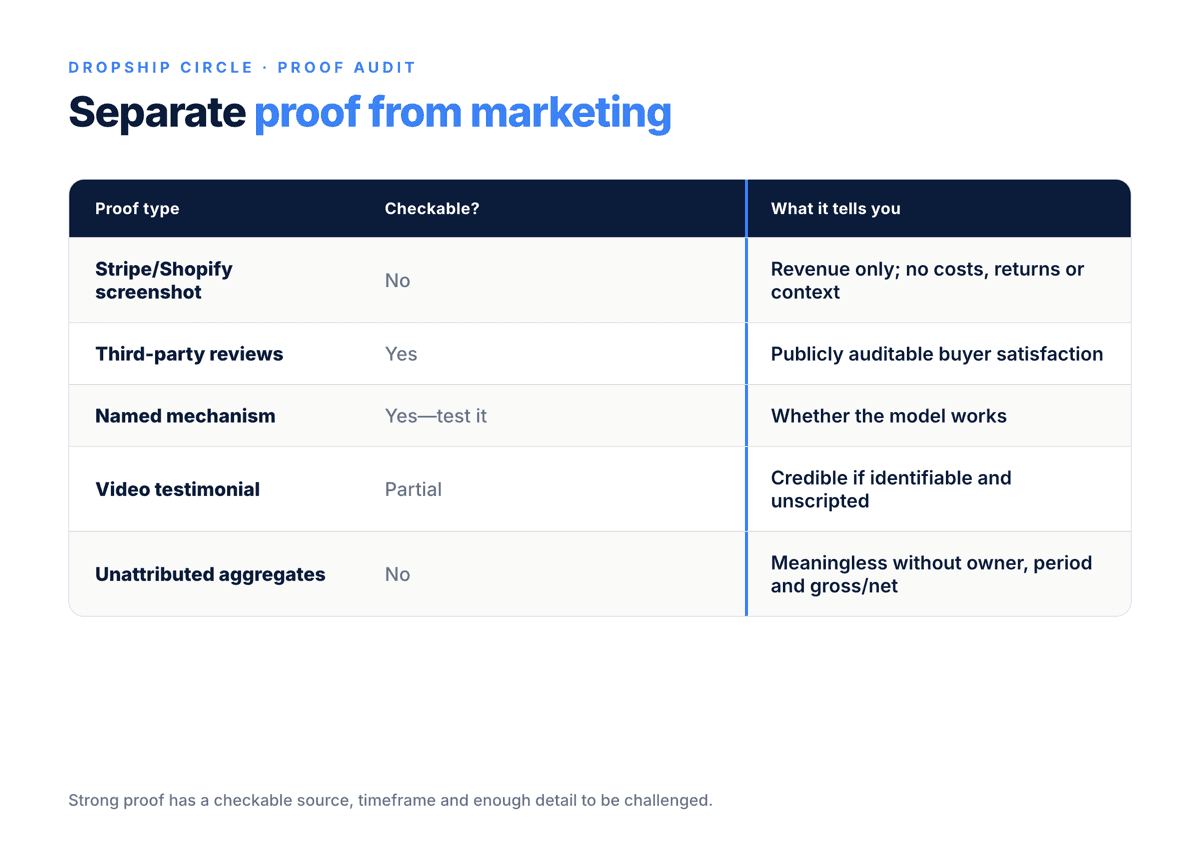
Proof type | Checkable? | What it actually tells you |
|---|---|---|
Stripe/Shopify screenshot | No | Revenue snapshot, no cost, no returns, no context |
Third-party reviews (e.g. Trustpilot) | Yes | Buyer satisfaction over time, publicly auditable |
Named mechanism (margin, supplier terms, ad spend) | Yes, by testing it yourself | Whether the model actually works, independent of who's teaching it |
Video testimonial | Partial | Real if the person is identifiable and not scripted, but easy to stage |
Aggregate figures without attribution | No | Meaningless until you know whose sales, over what period, gross or net |
If a mentor scores well on the left-hand column of that table and badly on the right, that's not proof. That's marketing.
What Does a Real Dealer Application Actually Prove?
A dealer application that gets approved proves the mechanism works, because it's a supplier saying yes to a business with no track record, not a mentor saying yes to your money.
Say you send 12 dealer applications and 9 say no. The three that say yes each carry £420 a sale. Three suppliers at £420 is £1,260 of margin per round of orders, and the nine noes cost you nothing but the afternoon it took to write them. That's not proof a mentor gave you. That's proof the model produces when you run it, which is a better kind of evidence than anything a sales page can show you.
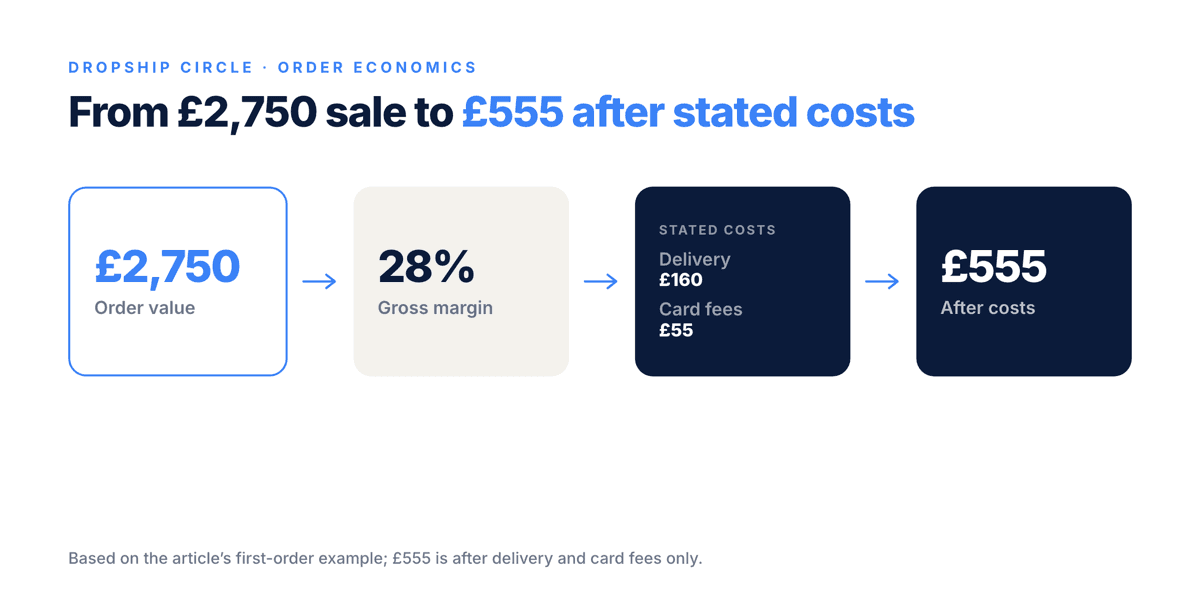
A first-time applicant in Carlisle had no sales, no company history and no stock, which is where every dealer application starts. He registered a company, put a number on the contact page that rang, wrote three lines on which counties he would cover and which two brands he already stocked, and sent it to the trade address rather than the contact form. Two of the four brands approved him inside a week. The first order through the better of them was a £2,750 range cooker at 28%, which is £770 gross, and after £160 of delivery and £55 in card fees that leaves £555. The brand that said no came back in the spring, after the site had been answering its phone for four months.
A dealer application isn't judged on your size. It's judged on whether you look like a business that will answer the phone when their product goes wrong. That's a harder, more honest proof point than any figure a mentor can show you, because it's a third party with nothing to gain from lying to you.
What Are the Realistic Risks a Mentor Should Be Upfront About?
A mentor should be upfront that returns, damaged deliveries and thin margins are routine, not rare, and that software can't fix any of them for you.
Take a returned item on a high-ticket order. A single damaged-in-transit garden building can eat a week's margin on its own if the supplier's returns process is slow or the freight terms leave you covering the second delivery. That's not a reason to avoid the model, it's a reason to check a supplier's returns terms before you list their product, not after your first customer complains.
The same goes for tools. The right stack makes a good operation cleaner. The wrong stack makes a weak operation noisier. I've seen operators spending £200 to £500 a month on software while unable to explain their own gross margin, delivery promise or returns process. No app fixes that. If a mentor's proof is entirely about their tech stack and none of it is about supplier relationships, margin control or cashflow, that's a gap worth noticing.
Inflated forecasts are the other tell. A mentor who promises fast, large monthly sales without describing a staged ramp, catalogue setup, content, campaign testing, modest early volume, then scaling once demand and profitability are validated, is selling you a forecast, not a plan.
How Do You Vet a Mentor's Supplier Claims?
Ask whether their supplier access is a list or a relationship, because a database of contacts is not the same thing as a working account.
A paid supplier directory can save research time, but it doesn't automatically create margin or differentiation. If a mentor's core proof is "I'll give you our supplier list," ask how many other buyers of that same programme have the same list. A database of 5,000 unqualified names is worth less than 5 proper supplier conversations, especially if 500 other sellers are listing the identical products with the identical stock feed and photos. That's not proof of a working model. That's a commodity market waiting to happen.
The better test is whether the mentor teaches you to approach suppliers as a retailer, dealer or authorised reseller, not with an email that leads with the word "dropshipping" and asks for a price list. Suppliers care about sales and brand representation more than fulfilment method. A mentor who can explain that distinction, and show you why it changes response rates, is teaching mechanism. A mentor who just hands you contacts is teaching nothing.
Key takeaways
Real proof is checkable: third-party reviews, named mechanisms, attributed figures. Screenshots and dashboards aren't proof, they're marketing.
Dropship Circle's Trustpilot record at trustpilot.com/review/dropshipcircle.com is there to be checked independently, not taken on trust.
Across £8.25M in tracked sales spanning our own, student and client stores, separating personal results from aggregate results is what distinguishes credible operators from guru claims.
A supplier saying yes to your dealer application is stronger proof of a working model than any figure a mentor can show you on a sales page.
Risks like returns, damaged deliveries and thinning margins are routine, and a mentor should be upfront about them, not silent until they happen to you.
A supplier list is not a business relationship; 5 proper conversations beat 5,000 unqualified contacts.
Related reading
Frequently asked questions
Is drop shipping dead in 2026?
No. Low-ticket, saturated-niche dropshipping is harder than it was, but high-ticket dropshipping, built around £300+ products, real supplier relationships and considered buyers, is a different economic model and remains viable. The model isn't dead; the low-effort version of it is.
What is the law of 33% in mentorship?
It's a rough rule of thumb some coaches cite: roughly a third of students take action and see results, a third take partial action and see partial results, and a third don't act at all. It's not a verified statistic, more a way of framing that mentorship gives you a system, not a guarantee, and outcomes depend heavily on execution.
Where can I find dropshipping mentors?
You'll find them on YouTube, Instagram, X, and through paid programmes like Dropship Circle. Wherever you find one, check their proof independently: third-party reviews, described mechanisms and honest attribution, before you check their sales page.
What percent of dropshippers fail?
There's no single reliable industry-wide figure, and most cited stats aren't sourced to anything checkable. What's consistent across operators is that low-ticket, low-margin, saturated-niche stores fail at a high rate, while higher-ticket models with real supplier relationships and proper margin control fail less often, largely because the economics tolerate more mistakes.
Are dropshippers millionaires?
Some are, most aren't, and anyone implying it's typical is selling you a story. High-ticket dropshipping can produce serious revenue, a single sale can be £3,000 and a single day can hit £80,000 in sales in a well-run store, but that's a result of margin control, supplier relationships and consistent execution, not a starting expectation.
How risky is dropshipping?
It carries real risk: cashflow gaps between paying suppliers and receiving customer funds, returns and damaged deliveries, and margin that can quietly collapse under freight and card fees. High-ticket dropshipping reduces some of that risk versus low-ticket volume models because margins are thicker and orders are fewer but bigger, but it still needs proper cash and supplier management, not just a store and an ad budget.
If you want to see how the high-ticket model actually works before you pay anyone for mentorship, our free training walks through the supplier approach, margin math and evidence gate we use before building a store at all. No pitch deck, no forecast, just the mechanism. You can check the rest, including our Trustpilot record, for yourself.
Ready to Build Your Ecommerce Business?
Get started with our free training and discover the exact framework we use to build sustainable high-ticket stores.
Related articles

Mentorship & Courses
Dropshipping Mentor Cost: What the Market Charges in 2026
What does a dropshipping mentor cost? Published 2026 prices by format, what to get in writing and what the fee omits.

Mentorship & Courses
Dropshipping Mentor vs Course: Which Do You Need First?
Dropshipping mentor vs course compared on feedback, cost and stage, with a table and a checklist to choose.

Mentorship & Courses
Do You Need a Dropshipping Mentor? An Honest Operator Answer
Do you need a dropshipping mentor? Not always, but the maths on wasted ad spend and rejected supplier applications.