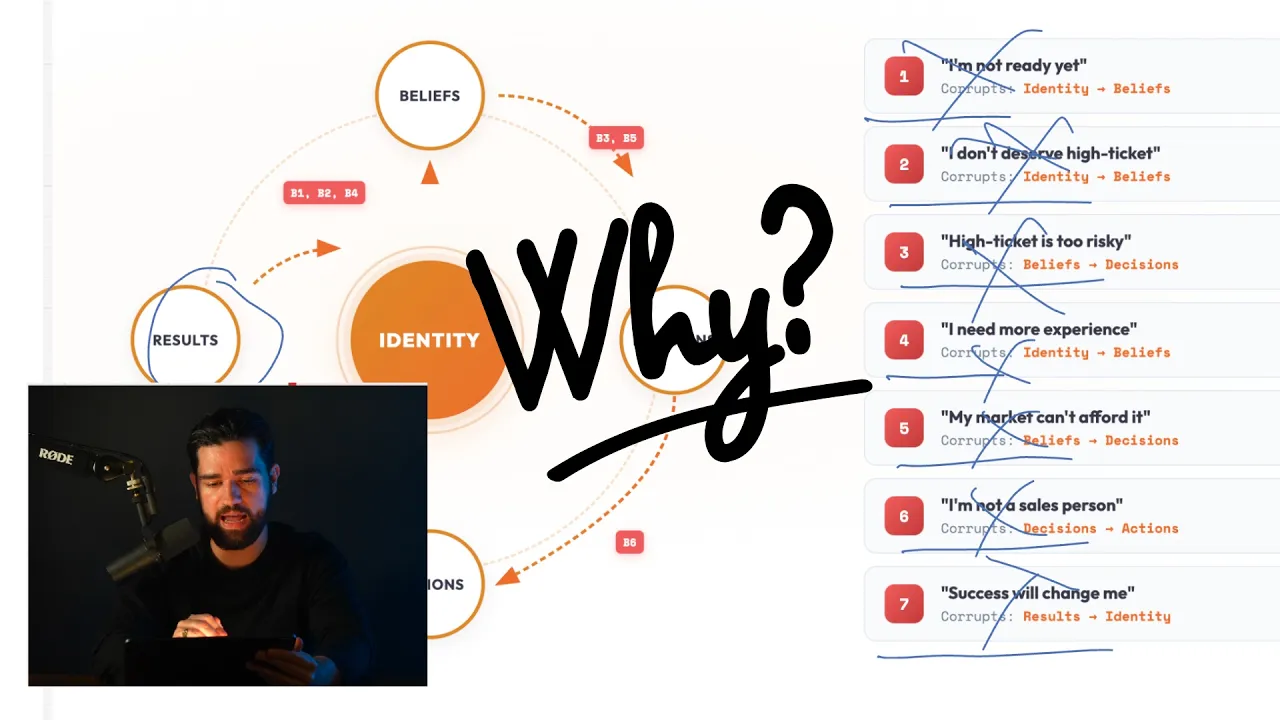

A sound high-ticket dropshipping mindset means testing seven common beliefs against the market before you accept them: I'm not ready, I don't deserve high prices, high ticket is too risky, I need more experience, my market can't afford it, I'm not a salesperson, and success will change me.
Most of what I publish is practical: niches, suppliers, stores, adverts. This piece covers the thing I have noticed over the years that holds back a lot of the people we work with, even when they know the practical steps. I recorded it as a video and this is the written version, with the supplier and pricing detail from our training added where it helps.
The model underneath all seven is identity. Your identity is made of your beliefs, your decisions, your actions and your results. What you believe about yourself and the market shapes what you decide. Decisions become actions, or the lack of them. Actions produce results, and the results feed back into the beliefs. If that loop never changes, the results do not change either.
Prefer to watch instead? The full video is on this page.
The seven barriers at a glance
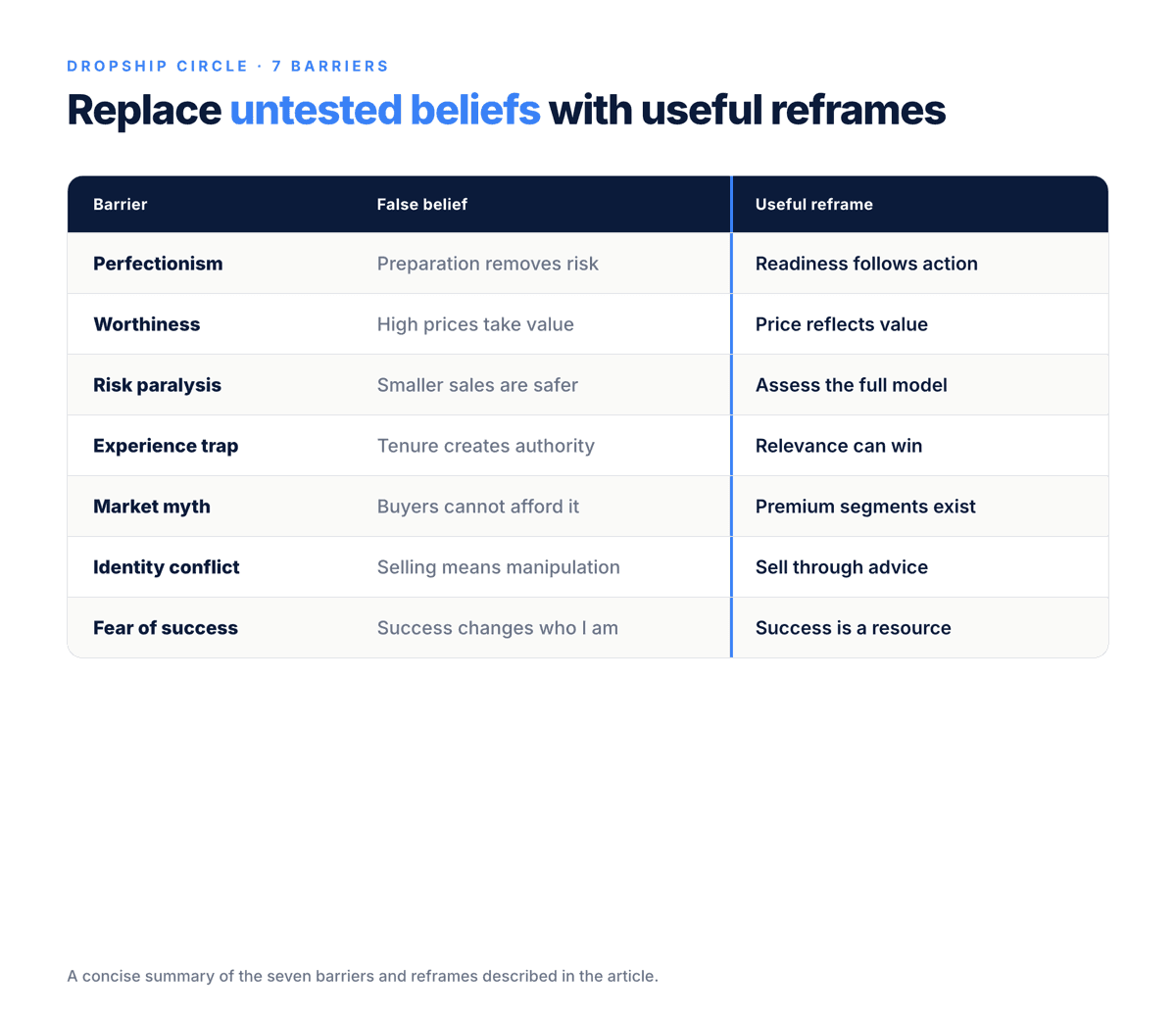
Each barrier is a false belief with a more useful reframe, and each one has a practical fix.
Barrier | What you tell yourself | The false belief | The reframe |
|---|---|---|---|
Perfectionism | "I'm not ready yet" | If I prepare more, I reduce my risk | Readiness is created after action |
Worthiness | "I don't deserve high ticket" | Charging high prices means taking something from someone | Price reflects the outcome for the customer |
Risk paralysis | "High ticket is too risky" | Smaller sales are a safer business | Judge the model, not the single transaction |
Experience trap | "I need more experience" | People buy from experts with years of tenure | People buy from those who understand them |
Market myth | "My market can't afford it" | Buyers in this niche are price sensitive | Every market has a premium segment |
Identity conflict | "I'm not a salesperson" | Selling is pushing and manipulation | Selling is diagnosing and advising |
Fear of success | "Success will change me" | More success means more problems and judgement | Success is a tool, not a personality change |
1. Perfectionism: "I'm not ready yet"
Perfectionism is treating "ready" as if it meant "safe", and using research to put off the moment the market can judge you.
The belief sounds reasonable: if I prepare more, I reduce my risk. So you watch more videos, read more reviews, read Reddit and the forums on whether dropshipping is a good idea. It feels like progress.
The problem is where that information comes from. There is bias in everything you read, and selection bias on top of it. On some forums you will mostly find the people for whom it did not work, because the people doing well are not spending their time there. You see one view of the subject and take it for the whole picture.
My line in the video was: "Preparation without exposure is just procrastination." Learning becomes avoidance. With no market feedback there is no real learning, however many hours go in.
The reframe is that readiness is created after action. Replace "am I ready?" with "what's the smallest test?" and learn from customers, not from content. In our model the smallest test is rarely a store launch. It is a conversation. We teach phoning suppliers as the first contact, with the single aim of reaching the decision maker. One call tells you more about a niche than another week of reading.
2. Worthiness: "I don't deserve high ticket"
Worthiness is guilt about charging a lot, and it shows up as underpricing or as avoiding expensive products altogether.
We have had people tell us they would feel bad selling a £3,000 or £5,000 item with a markup. Underneath that is an association between money and guilt, greed or morality. People cap themselves to stay acceptable and price below the value they deliver.
The false belief is that a high price takes something from the customer. A sale is an exchange of value. The customer wants the product and decides whether the price is worth it to them. Price reflects the outcome you create for the buyer. It says nothing about your worth as a person.
It helps to look at what the markup pays for. The example we use in training is a £3,000 order with a £2,100 supplier cost. The £900 between them is gross. It has to cover advertising, card fees, the time spent answering questions before the sale, and the order that goes wrong. A retailer who cannot fund those things lets the customer down.
So anchor the price to the customer's outcome and take your self-image out of the sum. Shift the question from "do I deserve this?" to "what does this enable for them?"
3. Risk paralysis: "High ticket is too risky"
Risk paralysis is confusing the size of one order with the risk of the whole business.
Every business is risky, and this one is too. Adverts cost money whether or not they produce a sale. But one large order feels heavier than many small ones, so people give too much weight to a single loss and conclude that cheap products must be safer. They overlook the built-in risk of low-margin models.
My view is that volume businesses are more fragile. They have more dependencies, tighter margins and less control. We teach the same point in our training: most stores that fail were built on weak economics, where the margin is too thin and one bad week of adverts can wipe out the month.
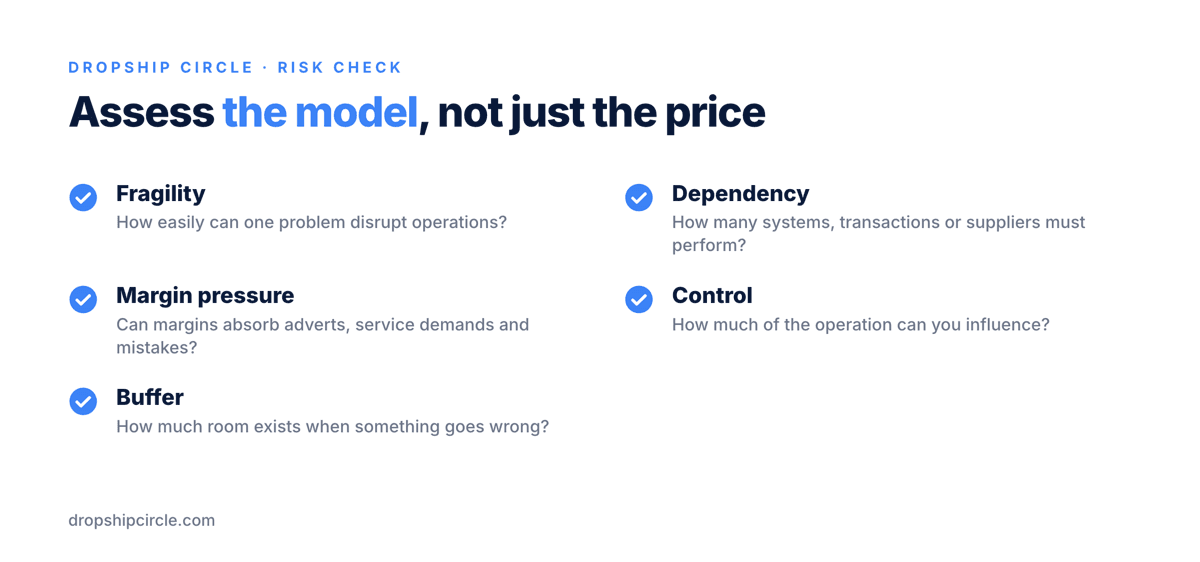
The definition I gave in the video is that risk is fragility plus dependency plus margin pressure:
Fragility. How easily one problem disrupts the operation.
Dependency. How many systems, transactions and suppliers have to perform.
Margin pressure. How much room there is to absorb advertising, service and mistakes.
Look at the model from first principles. You are not buying stock. You are using local suppliers. You are running some ads, and there is a cost to that. Fewer customers gives you more control over each order. None of this makes the business safe, and you still need capital to set up and test. It means you evaluate at the model level instead of the transaction level, and you prioritise margin, control and buffer.
4. The experience trap: "I need more experience"
The experience trap is mistaking years served for authority, and waiting to feel legitimate before you act.
This one is common in people whose career has been in something else. There is a fear of being exposed as an impostor, and a habit of overrating the competition. As I said in the video: "Trust me, they're not that good."
The false belief is that people only buy from experts with years of tenure. People buy from those who understand them. Customer empathy beats credentials, and relevance and clarity matter more than years.
That does not make knowledge optional. It makes it specific. Before a student calls a supplier, we expect them to know the niche's terminology, the product technologies, the brand's range and pricing structure, and why that supplier is better than its rivals. That is focused preparation on one niche, and it is enough to hold a credible conversation.
The focus I set out was: one avatar, one problem, one outcome, one niche, one store, and some suppliers. Go deep in one place. You are not trying to build the next Amazon.
5. The market myth: "My market can't afford it"
The market myth is projecting your own spending limit onto everyone else.
I have had clients and students ask why items at £40,000 or £50,000 would sell online, and who buys them. People with the money to do so buy them. The mistake is treating the market as uniform, then aiming at the loudest and cheapest buyers and competing on price.
Every market has premium segments. The right buyers exist. They are just not loud, and nobody talks about them.
The follow-up question is "why would they buy from me?" Some will buy from someone else. That is fine, because you need only a very small share of a large market. You do not need to out-compete Walmart, Target, Argos, Currys or Selfridges. You need the right buyers in one niche and the products and service to match.
The premium retailers are useful evidence in themselves. In our supplier research we send students to sites like Harrods, Selfridges, DFS and John Lewis to note the brands they stock, then trace each brand's UK distributor. It is a quick way to see which premium brands already sell in the UK.
6. Identity conflict: "I'm not a salesperson"
Identity conflict is believing that selling means manipulating people, and then avoiding the conversations that create revenue.
It usually arrives as three statements: I'm not a salesperson, I can't deal with suppliers, I can't deal with customers. If selling really were pushing people into things, resisting it would be right. The result is that people hide from calls and over-explain when they should be guiding.
High-ticket selling as we run it is diagnosing and advising. In the video I called it "decision and support, not persuasion." You ask questions and help the buyer choose correctly. That makes you a consultant.
The same applies to suppliers, and this is the part people find hardest to believe. You are not trying to push a supplier or cold call them into working with you. You are helping them sell their products. Our supplier pitch reflects that. You tell them you will never undercut their other retailers online, and that what you add is customer support, paid marketing and new online customers. If they hesitate, you offer a 90-day trial that they can end if there are problems. That is a proposal they can accept or decline on its merits.
7. Fear of success: "Success will change me"
Fear of success is linking progress with loss, and then quietly sabotaging yourself when things start to work.
The losses people imagine are relationships, friends and values. What will my family think? The behaviour that follows is keeping yourself relatable at the cost of progress and creating problems where things were working.
Success amplifies who you already are. It does not create a new person. The fix is to define your values before the pressure arrives and to treat success as a responsibility.
How the seven barriers feed each other
The barriers strike at different stages of the identity loop, which is why they keep each other alive.
"High ticket is too risky" and "my market can't afford it" are beliefs. They feed decisions and actions, where "I'm not a salesperson" does its damage. "I'm not ready", "I don't deserve it" and "I need more experience" attach to results, or the lack of them. And if results do come, "success will change me" is waiting. I described it in the video as a self-perpetuating machine.
You can break these on your own. Take one belief, find the smallest action that would test it, and let the market answer. Guidance and a system to follow can make that faster, but nobody else can make the supplier call for you.
Related reading
how to start a dropshipping business uk
high-ticket dropshipping vs amazon fba
high-ticket dropshipping uk
High-Ticket vs Low-Ticket Dropshipping: An Honest Comparison
dropshipping mentor vs course
dropshipping mentor cost
Frequently asked questions
What is the right high-ticket dropshipping mindset?
It is a habit of testing your beliefs against the market instead of treating them as facts. That covers seven common ones: not being ready, not deserving high prices, risk, experience, what the market can afford, selling, and what success will do to you. It does not mean ignoring costs or assuming things will work.
What risks remain if I do not hold stock?
Not buying stock removes one exposure. Advertising still costs money whether or not it produces a sale, and you still depend on suppliers performing. Judge the whole model on fragility, dependency and margin pressure, and keep a buffer.
Do I need years of experience before approaching suppliers?
No. You need to know the niche's terminology, the supplier's range and pricing structure, and why their products are worth selling. Then you make a straightforward offer: you will not undercut their other retailers, and you bring customer support and marketing. They decide whether it suits them.
Why would a customer buy an expensive product from a new store?
Because people buy from those who understand them. A focused store that answers the buyer's questions and guides the decision can win customers that a general retailer treats as one of thousands. Some buyers will still choose an established name, and that is fine.
How do I stop overthinking and take action?
Replace "am I ready?" with "what's the smallest test?" Pick one niche and one type of customer, then get evidence from a supplier call or a customer conversation instead of from more content.
Ready to Build Your Ecommerce Business?
Get started with our free training and discover the exact framework we use to build sustainable high-ticket stores.
Related articles

High-Ticket Dropshipping 101
High-Ticket vs Low-Ticket Dropshipping: An Honest Comparison
High ticket vs low ticket dropshipping compared honestly: margins, risk, timeline and who each model actually suits.

High-Ticket Dropshipping 101
High-Ticket Dropshipping Statistics 2026: Success Rates
See 2026 dropshipping statistics for the UK and US, including survival rates, buyer trust and source-linked data.

High-Ticket Dropshipping 101
High-Ticket Dropshipping: The Real Numbers Behind the Model
What high-ticket dropshipping actually costs, earns and breaks on — real margins, niches and a worked example, not