Dropshippers fail because weak products, thin margins, bad suppliers, poor traffic, low trust, and cash flow expose them.
Dropshippers fail because they pick weak products, run on thin margins, use unreliable suppliers, lack buyer-intent traffic, ignore cash flow, and quit before disciplined testing produces data.
The 7 reasons dropshippers fail are:
Weak products
Poor margins
Unreliable suppliers
No traffic plan
Low trust
Bad cash flow
Quitting before structured testing
Let’s have an honest conversation.
Most people entering dropshipping today are chasing an illusion. They’ve been misled by flashy videos, laptop-lifestyle promises, recycled product lists, and tactics that stopped working once everyone copied them. The result? A large share of beginners fail to reach meaningful profit because they never build the operating skill behind the model.
But it doesn’t have to be this way.
In this article, I’ll break down the real reasons most dropshippers never succeed, and more importantly, how to escape that trap and build a business that actually works now.
If you need the full route from first niche research to launch, start with the beginner dropshipping roadmap. If you already know you want the higher-ticket route, read the high-ticket dropshipping model page after this.
Mistake 1: Copying Viral Products Instead of Building a System
Most beginners copy visible tactics, not the invisible business system behind winning stores.
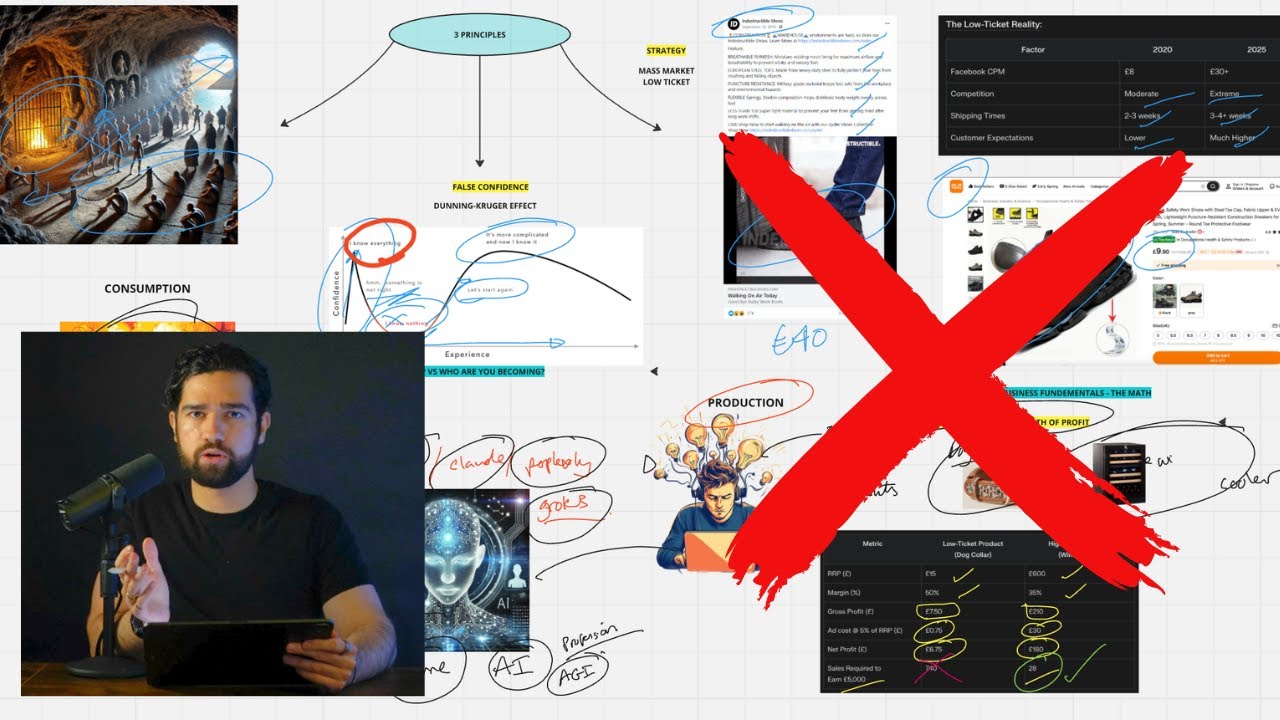
To understand why most people fail, let’s revisit a concept from ancient philosophy: Plato’s Allegory of the Cave.
In it, prisoners are chained in a dark cave, watching shadows on the wall. Those shadows become their reality, even though they’re only reflections of what’s real.
That’s what happens in today’s e-commerce space. New dropshippers are stuck chasing shadows:
Viral TikTok product ideas
Overnight success stories
Advice from unproven gurus
Shortcut-heavy “hacks” that skip fundamentals
AI-generated product lists with no supplier validation
Theme-copying instead of offer-building
Ad screenshots without context, costs, refunds, or cash flow
What they’re not doing is building real, sustainable businesses.
The shadow is the product. The reality is the system.
A real e-commerce business is not “find a winning product, throw up a store, launch ads, print cash.” That is the cartoon version. The real machine has moving parts:
A product category with proven demand
A supplier who can ship reliably
Margins that survive advertising costs
A website that builds trust
Product pages that answer buyer objections
A traffic source with buying intent
Customer service that protects reputation
A cash flow plan that does not collapse after two refunds
Most beginners never even see those parts. They stare at the shadow on the wall: the viral product, the rented car, the dashboard screenshot, the “one-product store” template.
The truth is, successful entrepreneurs aren’t in the cave. They’re not chasing viral trends. They’re using proven strategies, building brands with trust, and leveraging intelligent systems.
It’s time to stop watching the shadows, and step into the light.
Mistake 2: Launching With Confidence but No Testing Discipline
Dropshippers crash when confidence rises faster than skill, testing discipline, and cash control.
Enter the Dunning-Kruger Effect.
This psychological model perfectly explains why most dropshippers fail before they’ve even started properly.
At first, confidence is high. You’re watching motivational videos, joining cheap courses, and feeling ready to launch.
Then, reality hits. Ads fail, refunds pile up, customers complain, and suddenly everything feels overwhelming.
Next comes the downward spiral. More courses. More “secret” tactics. More spending. Less clarity. Less progress.
This is where most people quit, or worse, stay stuck for months or even years, thinking progress is just one course or trend away.
Here is what the trap looks like in practice.
A beginner launches a store after watching three videos. They choose a product because it “looks viral.” They use a supplier they have not tested. They write product copy with AI and never check whether the claims are compliant or believable. They launch ads before the product page has reviews, delivery clarity, proper sizing, warranty language, trust signals, or any reason to buy from that store instead of a known marketplace.
Then the first visitors arrive.
Nobody buys.
So they change the product.
Then they change the theme.
Then they change the ad hook.
Then they buy another template.
Then they blame the platform.
This is not testing. This is thrashing.
Real testing means isolating variables. One offer. One audience or intent source. One landing page. One clear measurement window. You need to know what failed:
Was the product weak?
Was the supplier offer uncompetitive?
Was the page unclear?
Was shipping too slow?
Was the price wrong?
Was the traffic too cold?
Was the checkout broken?
Were people clicking but not trusting?
Were people adding to basket but abandoning at delivery cost?
The answer isn’t more noise. It’s a better strategy.
Confidence is useful only when it is attached to competence. Otherwise, it becomes expensive.
Mistake 3: Choosing Low-Ticket Products With No Margin
Low-ticket dropshipping usually fails because tiny margins demand brutal volume and constant firefighting.
Let’s talk numbers.
Say you're trying to build a store around a dog collar that sells for £15. If you're lucky, you're keeping around £6.75 in profit per sale.
Now imagine a store trying to reach a £5,000 per month net-profit target as an illustrative scenario. At £6.75 per sale, that means over 740 sales every month. That’s 24–25 sales every single day.
That volume requires:
Constant ad testing
Customer service headaches
Refund processing
Massive ad spend
An iron stomach for stress
More parcels, more tracking problems, more “where is my order?” emails
More payment disputes
More stock-sync problems
More review risk
More operational drag for every small win
And even then, your margins are razor-thin.
Now, compare that to a high-ticket product like a wine cooler that sells for £600.
Your margin might be 35 percent
Your profit per sale could be £180
A store targeting the same illustrative £5,000 monthly net-profit figure would need 28 sales per month
It’s the same illustrative business target. But one is built on chaos and volume, the other on strategy and use.
Here is the blunt comparison:
Model | Example product | Sale price | Example margin | Profit per sale | Sales needed for illustrative £5,000 net profit | Operational reality |
|---|---|---|---|---|---|---|
Low-ticket | Dog collar | £15 | Around £6.75 kept | £6.75 | Over 740 per month | High volume, thin margin, constant support |
High-ticket | Wine cooler | £600 | 35 percent | £180 | 28 per month | Lower volume, higher trust requirement, better leverage |
Those numbers are illustrative, not a promise. They show the mechanical difference between small baskets and larger baskets.
Low-ticket is not impossible. It is just unforgiving.
When a product sells for £15, you have almost no room for:
Rising cost per click
Failed tests
Payment processing fees
Returns
Discounting
Delayed shipping
Replacement orders
Customer support time
Damaged goods
Chargebacks
External benchmarks make the squeeze clearer. Ecommerce benchmarks from firms like Dynamic Yield and IRP Commerce consistently put many ecommerce conversion rates in the low single digits, which means most paid clicks do not become orders. The National Retail Federation and Appriss Retail have repeatedly reported that online purchases tend to see materially higher return pressure than many store owners expect. Paid media benchmarks from firms like Tinuiti also show ongoing pressure in search and shopping advertising costs, which is exactly where thin-margin stores feel pain first.
Across £8.25M in tracked sales spanning own, student and client stores, the same pattern shows up operationally: stores with clearer supplier terms, stronger product data, and healthier gross margins have more room to diagnose problems before cash flow forces bad decisions.
High-ticket has different problems. You need stronger trust, better supplier relationships, better product information, and a more professional buying experience. But those are business problems worth solving. They build an asset.
Low-ticket often trains beginners to become ad gamblers. High-ticket forces them to become operators.
That is the difference.
If you want to see what better categories look like, use the high-ticket niches guide. It will save you from staring at £15 products and pretending the maths is kind.
Mistake 4: Staying in Consumer Mode Instead of Operating
Consumers collect information; producers publish, test, negotiate, measure, and improve every week.
This might be the most important shift you can make.
Most people stay stuck in consumer mode. They’re watching, researching, and collecting information. They feel like they’re moving forward, but they’re not producing anything.
Producers take action. They test. They build. They fail and iterate. They use AI not to brainstorm passively, but to accelerate real-world results.
Consumption has its place, but if you're not producing, you're not progressing.
Here is a practical operator split.
Consumer behaviour looks like this:
Watching five videos about niches
Saving 40 product ideas
Asking strangers if a niche is “saturated”
Changing the logo for the ninth time
Comparing apps before making sales
Reading supplier outreach scripts but sending none
Prompting AI for business ideas with no execution plan
Producer behaviour looks like this:
Shortlisting one niche based on demand and margin
Building a supplier list
Sending outreach emails
Calling distributors
Mapping product categories
Writing collection pages
Uploading real product data
Improving page speed
Checking Google Merchant Center issues
Testing search terms
Recording objections from customers and fixing the page
AI makes this divide bigger.
A consumer uses AI to create more noise: more names, more logos, more slogans, more hypothetical products.
A producer uses AI to compress work:
Turn supplier PDFs into clean product specs
Draft first-pass category descriptions
Create comparison tables
Summarise warranty terms
Generate FAQ drafts from real customer questions
Cluster keywords by buying intent
Review product pages for missing objections
Build outreach variations for supplier contact
But the producer still checks the work. AI is an accelerator, not a business owner.
If you want a simple weekly rule, use this: every week should create an asset. A supplier conversation. A published page. A tested campaign. A fixed conversion issue. A documented process. Something real.
If the week produced only notes, you were still in the cave.
Mistake 5: Letting AI Make Lazy Dropshipping Easier to Fail At
AI helps operators move faster, but it also helps lazy dropshippers publish bad work at scale.
AI is compressing tasks fast. Writing basic copy. Summarising documents. Making simple graphics. Answering common support questions. Analysing spreadsheets. Creating ad variations. Researching products. Producing first-pass video scripts. These tasks are already being compressed.
That does not make weak dropshipping stronger. It often makes the weakness faster.
AI cannot replace commercial judgement. It cannot make a weak supplier reliable. It cannot turn a bad offer into a good one. It cannot build trust if your store looks anonymous and careless.
The wrong way is treating AI like a button-pushing side quest.
The right way is treating it like an operator tool:
You choose a market with actual demand
You build supplier relationships
You earn trust before asking for the sale
You create useful product information
You use search intent instead of random interruption
You handle customers properly
You improve the system every week
That part is still on you.
Mistake 6: Building Without Suppliers, Trust, or Buyer-Intent Traffic
The fix is simple: better niches, better suppliers, and marketing built around buyer intent.
Here’s how to stop wasting time and start building something that works.
1. Focus on High-Ticket Niches
Stop trying to win the volume game with low-ticket gadgets.
Instead, find product categories with high margins, strong demand, and low refund risk. These are products typically priced above £500. And there are hundreds of niches available.
If you need inspiration, I offer a free niches guide with over 300 high-ticket products. It’s updated annually and built from real data.
No email scraping. No shady suppliers. Just genuine market opportunities.
A good high-ticket niche usually has these traits:
Clear product demand
Buyers searching with purchase intent
Products priced above £500
Margin potential that can absorb advertising costs
Known brands or specialist manufacturers
Low trend dependency
Low sizing complexity
Low hygiene issues
Low impulse-return behaviour
Useful accessories or related categories
Clear delivery and installation expectations
Bad niches usually have the opposite:
Products people buy mainly on impulse
Extreme price competition
Weak suppliers
High return rates
Fragile items with poor packaging
Complicated compatibility
Heavy regulation you do not understand
No meaningful reason to buy from a specialist store
The goal is not to find a magic niche. The goal is to find a category where good execution is rewarded.
That is very different.
Use the high-ticket niches guide to build your shortlist, then validate demand before you build the store.
2. Build Partnerships with Premium Suppliers
Avoid mass-market marketplaces like AliExpress or AutoDS.
Instead, build partnerships directly with local distributors and manufacturers. These are companies that already stock premium, branded products, and they’re often looking for authorized retailers to expand their reach.
You don’t need to mention “dropshipping.” You’re a marketing platform offering to promote their brand.
They benefit from new customers. You benefit from fast shipping, better margins, and real credibility.
This is how you move into a blue ocean: where you’re not competing on price, speed, or gimmicks.
Supplier outreach is where most beginners expose themselves. They send weak emails that scream “I watched a video and built a Shopify store yesterday.”
Do not do that.
Approach like an operator:
Use a business email address
Have a clean website, even if early
Explain the market you are building in
Show how you will represent their brand properly
Ask for trade terms, product data, stock feeds, delivery terms, and warranty process
Be ready for phone calls
Follow up professionally
Track every conversation in a spreadsheet or CRM
Your first supplier conversations may be rough. Good. That is how skill is built.
You are not begging for access. You are offering distribution, marketing, and customer acquisition. But you must look credible enough for that statement to land.
If this is the part you avoid, read the supplier outreach guide. Weak supplier access creates weak stores. Simple.
3. Use Authority-Based Marketing Instead of Interruption Ads
Authority marketing captures existing demand instead of forcing cold strangers to care.
Forget random TikTok or Facebook ads interrupting people who aren’t even shopping.
Authority-based marketing is about intent.
You use Google Shopping and Google Search to show your products to people already looking for them. They’re deeper in the buying journey. They trust real brands. They’re ready to purchase.
And when your brand looks professional, ranks at the top of search, and stocks real products? That’s when they are more likely to buy, from you.
This is how you create a cleaner traffic system without relying on the next trend.
The operator detail matters here.
A strong authority-based setup includes:
Clean product titles with brand, model, size, and key attributes
Product pages with delivery time, warranty, returns, specs, FAQs, and clear images
Collection pages built around how buyers actually search
Google Merchant Center with clean feeds and no policy mess
Search campaigns separated by intent level
Negative keywords to block research-only traffic
Conversion tracking that actually works
Call tracking if buyers need help before ordering
Review systems and visible trust signals
Content that answers pre-purchase questions, not fluffy blog filler
A weak setup is obvious:
Generic product names
Thin descriptions copied from suppliers
No delivery clarity
No phone number or support visibility
No warranty detail
Random ad campaigns
No search-term review
No understanding of contribution margin
No plan for abandoned carts or quote-style enquiries
Authority is not a slogan. It is the buyer feeling, “This store knows the category, carries real products, and will not disappear after payment.”
That feeling converts better than a gimmick.
For the traffic side, use the Google Shopping guide instead of guessing your way through Merchant Center and paid search.
Mistake 7: Quitting Before the Boring Machine Has Data
The crossroads is this: keep chasing tactics, or build the boring machine that compounds.
There are two paths in front of you:
Stay in the cave, chasing shadows, hoping the next video or trick finally works
Step out, follow a proven path, and build something real
This is your decision. Not mine.
But know this. If you’ve read this far, you already have one thing most people do not: enough curiosity to question the noise.
Now you need discipline.
The path is not glamorous day to day. It looks like:
Finding better suppliers
Fixing ugly product data
Improving landing pages
Writing clearer FAQs
Reviewing search terms
Calling back customers
Removing weak products
Tightening delivery promises
Building category depth
Tracking margin properly
That is the work most people avoid. That is also why the opportunity exists.
And whether you do that with me, with someone else, or entirely on your own, make sure it’s based on fundamentals, not fads.
FAQ
FAQ answers the common failure points fast: margin, suppliers, traffic, cash flow, and beginner execution.
Why do most dropshippers fail?
Most dropshippers fail because they choose weak products, use unreliable suppliers, underestimate traffic costs, ignore cash flow, and copy tactics without understanding the business system.
Is dropshipping still profitable in 2026?
Dropshipping can still be profitable in 2026 when it is treated like a real retail operation with good suppliers, clear margins, strong product pages, and buyer-intent traffic. Trend-chasing stores with poor margins are the ones that usually get crushed.
What is the biggest dropshipping mistake?
The biggest mistake is choosing a product before validating the full commercial model: demand, margin, supplier reliability, delivery terms, return risk, and traffic cost.
Why do low-ticket dropshipping stores struggle?
Low-ticket stores struggle because small profit per sale leaves little room for ad costs, refunds, support time, chargebacks, and failed tests. The maths is tight before the beginner has any skill.
How can beginners avoid failing at dropshipping?
Beginners can avoid failure by starting with a real niche, contacting legitimate suppliers, building trust-heavy product pages, using buyer-intent traffic, and measuring contribution margin before scaling.
Is high-ticket dropshipping better than low-ticket dropshipping?
High-ticket dropshipping is often more forgiving operationally because each sale has more margin to absorb acquisition costs and support work. It is not easier; it just rewards better execution instead of pure volume.
Final Thoughts
Dropshipping still works when it is built as a real retailer, not a trend-chasing shortcut.
Dropshipping isn’t dead, but the way most people do it is.
If you're tired of dead-end strategies, burnout, and fake success stories, then consider this your wake-up call.
Stop chasing shadows. Start building with clarity.
There’s a practical model. The path is visible. You still have to do the work.
If you’re ready to get started, download the free high-ticket niches guide linked below the video. No cost, no pitch, just value.
And if you found this article helpful, subscribe to the channel and leave a comment. I reply personally, and I’d love to hear where you’re at in your journey.
Lex
Founder, Dropship Circle
Register to watch the free training →
Related reading
Ready to Build Your Ecommerce Business?
Get started with our free training and discover the exact framework we use to build sustainable high-ticket stores.
Related articles

High-Ticket Dropshipping 101
High-Ticket Dropshipping vs Amazon FBA: Fees, Cash and Control
High ticket dropshipping vs Amazon FBA: Amazon's published fees, a worked £1,200 sale and who each suits.

High-Ticket Dropshipping 101
How to Start a Dropshipping Business in the UK: Step by Step
Start a dropshipping business in the UK: registration, HMRC, VAT, returns law and budget, sourced from GOV.UK.

High-Ticket Dropshipping 101
High-Ticket vs Low-Ticket Dropshipping: An Honest Comparison
High ticket vs low ticket dropshipping compared honestly: margins, risk, timeline and who each model actually suits.