To dropship on Shopify, you set up a store, source products from a supplier who ships directly to your customer, set your own retail price, and keep the margin between what you charge and what the supplier bills you. You never hold stock. The platform handles checkout, payments and order admin; you handle the supplier relationship, the pricing, and the customer.
That's the mechanical answer. The part most guides skip is what actually determines whether the store makes money once it's live: which niche, what margin, and whether the store is built to survive a return or a delivery failure without wiping out the week's profit. Shopify is the infrastructure. It doesn't pick your supplier, doesn't set your margin, and won't stop you launching a bad offer on a nice-looking theme.
This covers how to set up a dropshipping store on Shopify properly: the build, the supplier process, shipping rates, pricing, and the realistic economics behind making money from it.
How Do You Start a Dropshipping Business on Shopify?
You start by choosing a niche with real margin room, then building the store around suppliers you've actually vetted, not just imported into an app.
Most people do this backwards. They pick a theme, install an automation app, import 200 products from a supplier feed, and launch. That gets a store online fast but it doesn't build a business, because none of those 200 products have been checked for margin, delivery reliability, or whether the supplier will even ship direct to customer.
The order that actually works:
Pick a niche with genuine margin headroom. Low-ticket, saturated categories (phone cases, generic gadgets) compete on price alone. Categories like eBikes, mobility equipment, and outdoor structures (gazebos, garden rooms, greenhouses) carry higher price points and buyers who do less price-comparing.
Contact suppliers directly, don't just browse a marketplace feed.
Build the store around a curated catalogue, not an auto-imported one.
Set up the trust and operational layer before you spend a pound on ads.
Launch with a small, well-specified catalogue and expand once you know what sells.
Shopify's own marketing pitches dropshipping to new entrepreneurs precisely because it removes upfront inventory cost. That's true, but it also means the platform's ease of entry hides the part that actually separates a working store from a dead one: supplier quality and pricing discipline, neither of which Shopify provides.
How Do You Create a Dropshipping Store on Shopify, Step by Step?
A dropshipping store on Shopify needs a theme, a curated product catalogue, trust pages, payment and shipping setup, and tracking live before launch.
Here's the build in order.
1. Set Up the Store Shell
Pick a Shopify plan, choose a domain, and install a clean theme. If your first-choice domain name is taken, don't force it, pick a different name; dashes between words are acceptable if needed but a clean name reads better to a buyer checking you're a real business.
2. Source Suppliers Before You Build Product Pages
Don't build pages around a feed. Contact suppliers directly and run a proper follow-up sequence, because a large share of first enquiries get ignored. A workable cadence: initial enquiry on day 1, a polite follow-up on day 4 or 5, a final follow-up around day 10 or 12 with a specific question, then a phone call if the brand is worth pursuing. Most people email once, hear nothing, and give up on a supplier who would have replied to a second message.
3. How Do You Add a Product on Shopify for Dropshipping?
Go to Products > Add product, and fill in title, description, images, price, and inventory tracking (set to not tracked, since the supplier holds stock). For high-ticket items, a supplier feed title and three images are not enough. Buyers spending £900 to £3,000 want dimensions, delivery timeframes, warranty terms and a way to ask a question before they buy. A manually curated catalogue of 20 to 50 well-specified products, built page by page or via a structured CSV, is a stronger asset than an auto-imported list of 300 thin ones. The thin catalogue looks like progress. It isn't.
4. Add the Trust Pages Before Traffic
Before switching on ads, a high-ticket Shopify store needs: product pages with specs and delivery times, a contact page, delivery and returns policies, a warranty page, an about page, and FAQs. At high ticket, buyers investigate. If someone is about to spend £1,500, they check whether the business looks real before they check out. A store with no returns page and a stock theme logo fails that check in seconds.
How Do You Set Shipping Rates on Shopify for Dropshipping?
Set shipping rates under Settings > Shipping and delivery, using zones and either flat rates, free shipping thresholds, or rates matched to your supplier's actual delivery cost.
Most new stores either absorb shipping into the product price (cleaner checkout, works well above £300) or charge a flat rate that roughly covers what the supplier charges you to ship. For transit times, you don't need an exact figure per product; an average across the store, such as 2 to 5 working days per brand, is a workable standard most buyers accept.
Where this goes wrong: charging a flat £5.99 shipping fee on a product that actually costs £120 to freight because it ships on a pallet. That's a margin killer disguised as a small detail. Check what the supplier actually charges to deliver before you set the customer-facing rate, not after your first order arrives and the invoice doesn't match what you charged.
How Much Money Do You Need to Start Dropshipping on Shopify?
A realistic minimum sits around £1,000 to £3,000, covering the Shopify subscription, a domain, a small ad test budget, and buffer for the first supplier order before payment clears.
Shopify itself costs from roughly £25 to £70 a month depending on plan. That's the smallest part of the cost. The real spend is testing, which means running paid traffic to find out whether an offer converts, and having enough buffer that one slow week or one refund doesn't take the whole operation down.
Generic low-ticket dropshipping guides quote £100 to £500 as a starting figure. That number works for £15 gadget stores running on razor margins and volume. It does not work for a high-ticket model, where a single supplier order can run into hundreds of pounds and a single bad week without cash buffer can end the store before it's proven anything.
High-Ticket vs Low-Ticket: What's the Real Difference?
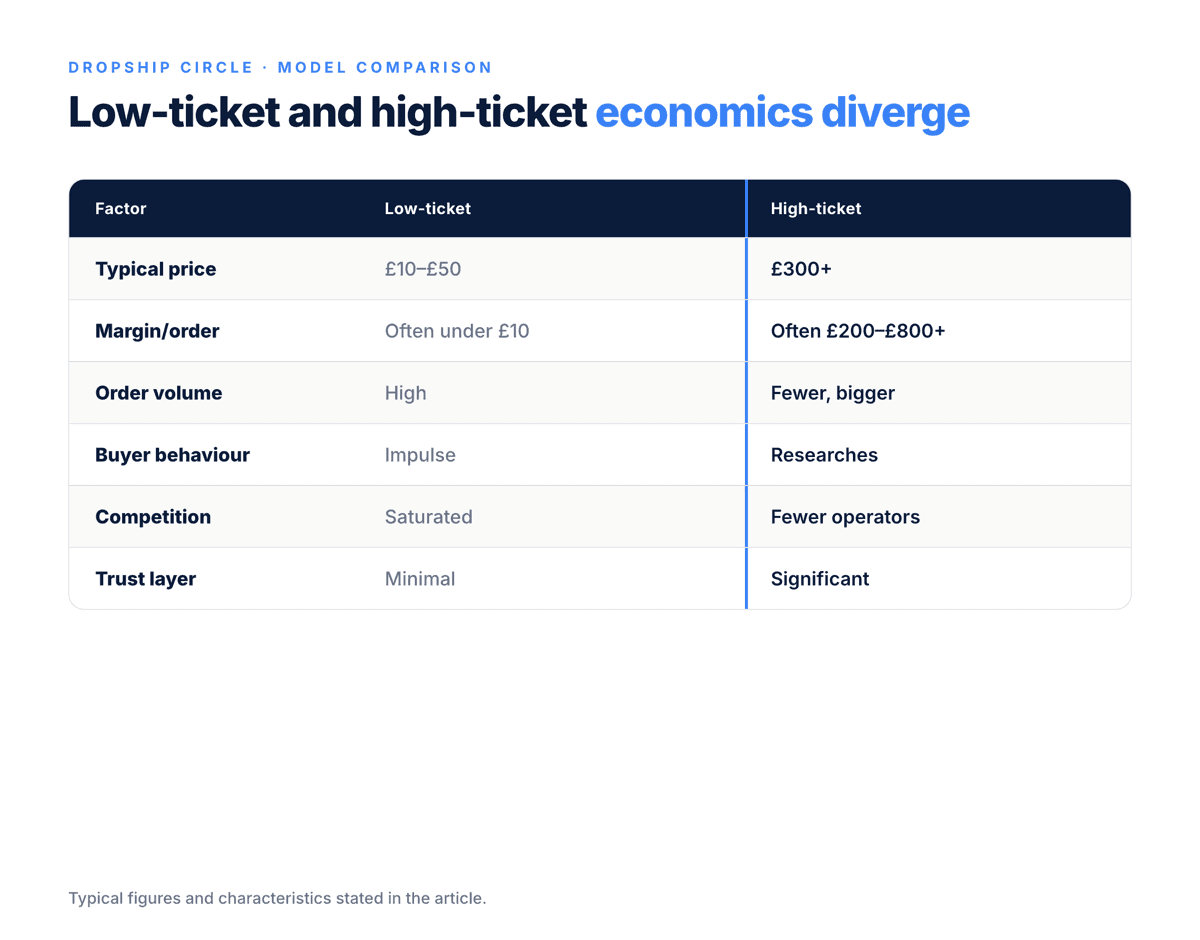
The two models look similar on the surface, a Shopify store and a supplier, but the economics diverge fast once orders start coming in.
Low-ticket | High-ticket | |
|---|---|---|
Typical price | £10-£50 | £300+ |
Order volume needed | High | Fewer, bigger orders |
Margin per order | Thin, often under £10 | Often £200-£800+ |
Buyer behaviour | Impulse | Researches, asks questions |
Competition | Saturated, race to the bottom | Fewer serious operators |
Trust infrastructure needed | Minimal | Significant |
High-ticket demands more setup work up front, product specs, delivery clarity, a real returns policy, because the buyer is doing due diligence a £15 impulse buyer never does. That extra work is also the moat. A £15 store is easy to copy. A store with proper supplier relationships and specced product pages is not.
How Do You Make Money on Shopify Dropshipping?
You make money on the margin between your retail price and your supplier's cost price, after shipping, payment fees, returns and ad spend are subtracted, not on revenue.
This is where most new operators get the maths wrong. A £1,200 product at 25% gross margin looks like £300 profit. Once you subtract £40 to £120 delivery, 1.4% to 2.9% payment processing, £20 to £80 of support time on a product a buyer had questions about, and the risk of a return, that £300 can shrink fast, sometimes to nothing.
Say a £2,700 walk-in bath sits in a cart that never checks out. Most buyers at that price won't put a card in on a first visit. A quote form on the product page catches 6 of the 10 who leave, and 2 come back and buy. Two sales at £700 margin each. That's £1,400 the checkout alone would have lost, recovered by giving a hesitant buyer a lower-friction way to say yes.
Margin percentage matters more than price tag. A £900 product at 38% gross margin, with clean supplier terms and reliable delivery, can outperform an £1,800 product at 20% margin with a messier fulfilment process. Chase the margin, not the sticker price.
When the Finance Option Changes the Conversation
One operator selling £3,000 hot tubs kept losing buyers at the exact point the total appeared on screen. He added a finance option, a fee paid by the seller per order rather than the buyer, and changed nothing else on the page.
On a £3,000 tub at 27% margin, that's £810 gross. Subtract £108 for the finance fee and £160 for delivery. That leaves £542. Less than the full-margin number, but the enquiries stopped asking for a discount and started asking what the monthly figure was, which is a different conversation with a different ending. At high ticket, the objection is rarely the price itself. It's the size of the single payment, and those aren't the same problem.
What Software Do You Actually Need for a Dropshipping Store on Shopify?
A lean stack of 6 to 10 reliable tools, covering supplier data, email, reviews, analytics and support, beats 25 cheap apps chasing automation.
Every app you install costs more than its monthly fee suggests. £25 a month is £300 a year, before it's proven any return, and every extra app is a potential site speed hit or a conflict with something else installed. A generic bolt-on understands your business about as well as a generic AI tool does, which is to say not at all: a discount-wheel popup or a generic upsell app doesn't fix a weak offer, it just adds another moving part.
What actually earns its place: a reviews app, an email/SMS tool, a supplier feed or CSV process, a helpdesk, GA4 and Google Merchant Centre for tracking, and something to track margin and cash, not just revenue. Software supports the operation. It does not replace a good supplier deal or a real niche.
How Long Does It Take to Build and Launch a Dropshipping Store on Shopify?
A properly built high-ticket store, with vetted suppliers and a curated catalogue, typically takes 3 to 6 weeks from first supplier contact to launch, not the 48 hours some app ads imply.
Most of that time isn't spent on Shopify's build tools, which are genuinely fast, it's spent waiting on supplier replies and building out product pages properly. The follow-up cadence alone (day 1, day 4-5, day 10-12) takes nearly two weeks per supplier if they're slow to respond. Rushing this stage to launch faster is how stores end up live with unreliable suppliers nobody's actually spoken to.
What Are the Real Risks of Dropshipping on Shopify?
The main risks are a supplier who doesn't deliver reliably, a return on a high-value item eating a week's margin, and a store built for maximum efficiency with no buffer for when something goes wrong.
A damaged delivery on a £1,800 item, a supplier who quotes 5 days and takes 15, a customer who wants a refund on a product that cost £90 to ship each way, these aren't edge cases, they're the normal cost of doing business at this price point. Squeezing every process for maximum efficiency and leaving no slack for delays, cash-flow gaps or supplier problems is how operators get blindsided by something predictable.
This isn't a reason to avoid high-ticket dropshipping. It's the reason a curated 20 to 50 product catalogue with real supplier relationships beats a 300-product auto-import every time: fewer things that can go wrong, and each one specced well enough that when something does, you know what you're dealing with. Across £8.25M in tracked sales spanning our own, student and client stores, the pattern holds consistently: the stores that survive their first bad delivery or refund are the ones that had margin buffer and a real supplier relationship going in, not the ones running the thinnest margin at the highest volume.
Key takeaways
Dropshipping on Shopify means selling products a supplier ships directly to the customer; you never hold stock and keep the margin between retail and cost price.
A curated catalogue of 20-50 well-specified products beats an auto-imported list of hundreds every time.
Set shipping rates against what the supplier actually charges to deliver, not a flat guess, especially on pallet-freight items.
High-ticket products (£300+) need real margin work: subtract delivery, payment fees, support time and return risk before you trust the headline percentage.
Trust pages (delivery, returns, warranty, FAQs) aren't optional at high ticket; buyers investigate before they spend £900+.
Shopify is the infrastructure. Supplier quality, pricing discipline and cash buffer are what actually determine whether the store makes money.
Related reading
Frequently asked questions
Is $100 enough for dropshipping?
Not for a properly run store. $100 (about £80) might cover a domain and a starter Shopify plan for a month, but it leaves nothing for supplier orders, ad testing, or a buffer if a refund or delivery issue hits. For high-ticket in particular, budget $1,300 to $4,000 (roughly £1,000 to £3,000) minimum.
Is drop shipping dead in 2026?
No, but the low-ticket, race-to-the-bottom version of it is struggling under saturation and thin margins. High-ticket dropshipping, fewer orders, bigger margins, real supplier relationships, is a genuinely different model and remains viable.
Can you make 10k a month on Shopify?
It's possible with the right margin structure, but it's not a starting-point figure and it's never guaranteed. At high ticket, £10k a month might mean roughly 15-25 sales depending on margin, which is realistic once a store has proven suppliers and a working offer, not in the first month.
How much money do I need to start dropshipping on Shopify?
Realistically £1,000 to £3,000 to cover the Shopify subscription, domain, initial ad testing, and a buffer for supplier orders and any early refunds. Less than that leaves no room for the normal bumps of running a real store.
Why do so many dropshippers fail?
Most fail from thin margins stacked on saturated low-ticket products, auto-imported catalogues with no real supplier relationship behind them, and no cash buffer for the first return or delivery delay. The model isn't broken; the execution usually is.
Is Shopify still worth it in 2026?
Yes, as the commercial infrastructure. It handles checkout, payments and order admin reliably. But it's a tool, not a strategy, the supplier deal, margin, and niche choice still decide whether the store makes money.
If you want the full system behind this, suppliers, pricing, product pages, trust infrastructure and launch, laid out properly rather than pieced together from app store listings, Dropship Circle runs a free training that walks through it. No pitch deck, no rented-Lamborghini nonsense, just the operator process. Worth an hour if you're serious about doing this properly rather than launching a thin store and hoping.
Ready to Build Your Ecommerce Business?
Get started with our free training and discover the exact framework we use to build sustainable high-ticket stores.
Related articles

Building Your Store
Shopify Dropshipping Apps: What a Serious Store Actually Needs
Shopify dropshipping apps ranked by real use case, margin impact, supplier model and fulfilment risk.

Building Your Store
Shopify Dropshipping Platform
A blunt operator guide to using Shopify as a dropshipping platform for high-ticket UK and US ecommerce without guru.

Building Your Store
Dropshipping Companies Shopify
Which dropshipping companies Shopify owners should use, avoid, or compare for real suppliers and cleaner margins.