High Ticket Products: What They Are and How to Find Ones Worth Selling
By Lex, Founder of Dropship Circle
High ticket products are premium items typically priced above £300 that generate meaningful profit per sale, whether you're dropshipping them, selling them as an affiliate, or building a digital product around them. The appeal is simple: fewer sales needed to hit real revenue, because each order carries far more margin than low-ticket stock ever will.
I run high-ticket ecommerce stores and mentor operators through Dropship Circle, and the question I get most isn't "what's a high ticket product". It's "which ones are actually worth building around." Those are different questions. Anyone can list saunas, e-bikes and outdoor kitchens. Fewer people can tell you why one £1,200 chair makes money and another one quietly loses it. That's what this is about.
What Are High Ticket Products, Really?
High ticket products are items priced high enough that a small number of sales produces significant revenue and profit, generally starting above £300 and often running into the thousands.
The label isn't about the product category. It's about the economics. A £1,200 sauna and a £1,200 chair are both high-ticket by price, but they behave completely differently once you factor in delivery risk, return rates, and how much service the buyer expects before and after the sale. High ticket products meaning, in practical terms, is: expensive enough to change your unit economics, but demanding enough to change your operations too.
This applies across three different business models, and it's worth being clear which one you're building:
High ticket dropshipping products: you sell the item, the supplier ships it, you never hold stock.
High ticket affiliate marketing products: you refer the buyer and earn a commission, usually 5-40% depending on the vertical.
High-ticket digital products: courses, coaching, software or done-for-you services with no physical fulfilment at all.
They share one trait: the profit per transaction is large enough that acquisition cost, service quality and margin discipline matter far more than volume.
Why Do Operators Choose High Ticket Over Low Ticket?
High ticket products let you hit meaningful revenue from far fewer orders, which is the core reason operators move away from low-ticket dropshipping.
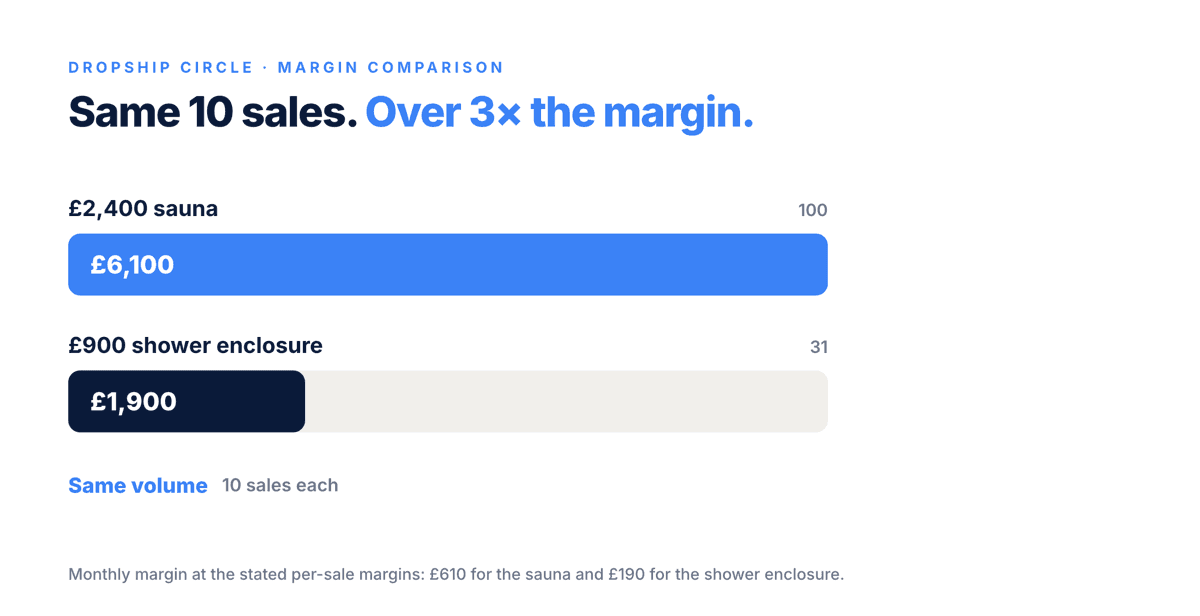
Say two products both sell 10 units a month. A £900 shower enclosure at £190 margin, and a £2,400 sauna at £610 margin. Ten sales of the sauna is £6,100. Ten sales of the shower enclosure is £1,900. Same ad budget, same order volume, same operational effort, three times the money on the sauna.
That gap is the entire argument for high ticket. Low-ticket dropshipping competes on price against thousands of near-identical listings, chasing pennies of margin on each £15 gadget. High ticket competes on trust, service and positioning, and the margin per sale gives you room to actually invest in getting the customer right, rather than racing to the bottom on ad spend.
The trade-off is real, though. Fewer buyers are shopping at the £1,000+ price point at any given moment, and each one expects more: clearer answers, faster support, a business that looks like it will still exist if the product breaks in eight months. Low ticket forgives sloppy operations. High ticket doesn't.
How Do You Find High-Ticket Dropshipping Products?
Find high-ticket dropshipping products by starting from a buyer need, not a product idea, then checking the category against real market data before building anything.
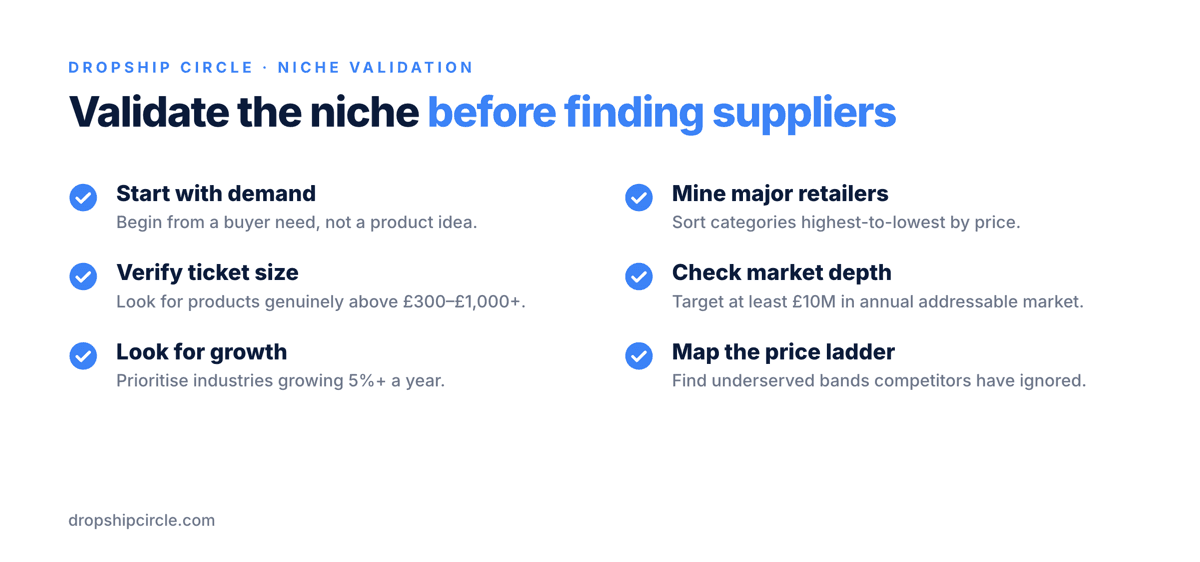
Here's the process I teach inside Dropship Circle, and it starts with a major retailer, not a supplier directory.
Step 1: Mine categories from a big retailer
Open a large retailer like Very and jump into verticals: homewares, furniture, appliances, bedroom. Sort each category highest-to-lowest by price and check whether items genuinely sit above £300-£1,000+. This shows you what UK and US consumers are already buying at high-ticket prices, rather than guessing.
Step 2: Check the market has depth
A scalable niche needs enough size to support long-term expansion, not just a good first month. Look for at least £10 million in annual addressable market size in your target region, and industries growing 5%+ a year. That growth rate is what gives you tailwind instead of a shrinking pond.
Step 3: Read the competitor price ladder before you commit
A seller in Bath once listed every competitor's prices in one category on a single sheet before deciding what to sell. The sheet showed three clusters: £400-£700, £1,100-£1,600, and a thin band above £3,000 with only two sellers in it and no photographs worth looking at.
He built for the top band. On a £3,400 order at 26% margin, that's £884 gross. Subtract £240 delivery and £102 card fees, and you're left with £542, still the strongest per-order return on the sheet. A year later, the same two sellers were still the only two in that top band, which is the only competitor research that has ever actually meant something: nobody else had bothered to serve it.
That's the mechanism. An empty rung on the price ladder usually isn't empty because it doesn't work. It's empty because it's harder to serve, and most sellers won't put in the work.
How Do You Calculate Whether a High Ticket Product Is Actually Profitable?
Model gross margin per SKU, retail price, supplier cost, payment fees, ad spend target and delivery risk, before you build anything on Shopify, because the sticker margin and the real margin are rarely the same number.
Take a £1,200 chair: supplier cost £720, shipping £48, payment processing £36, returns £24, customer service £12, marketing £180. Total costs: £1,020. Net profit: £180. A 15% net margin, which is a realistic target once every cost is accounted for, not the 40%+ that retail-minus-wholesale math suggests on paper.
Here's where it goes wrong for people who skip this step. A £700 trade price against a £1,000 RRP looks like £300 gross margin. Add £85 delivery and roughly £120 in ad spend, and you're already under £100 before payment fees and support time are even counted. Thin gross margins get destroyed fast: a £1,000 product with only £120 gross margin leaves almost no room once a single delivery issue costing around £60 gets absorbed.
Across £8.25M in tracked sales spanning our own, student and client stores, the pattern holds consistently: the operators who model contribution margin per SKU before launch are the ones still trading a year later. The ones who skip it are the ones who discover their margin was fictional after the first damaged delivery.
Cost line | £1,200 chair example |
|---|---|
Retail price | £1,200 |
Supplier cost | £720 |
Shipping | £48 |
Payment processing | £36 |
Returns allowance | £24 |
Customer service | £12 |
Marketing/ads | £180 |
Net profit | £180 (15%) |
What Makes a Product Good for High-Ticket Affiliate Marketing?
High ticket products for affiliates work best when the commission is a fixed high percentage on an expensive item, and the referral doesn't require you to handle fulfilment, returns or customer service at all.
The appeal of high-ticket affiliate marketing products over dropshipping is that you skip the operational load entirely, no supplier calls, no damaged deliveries, no returns processing. You're paid to send a qualified buyer, and the merchant handles everything after the click. That makes it a genuinely lower-risk entry point than dropshipping, though your income ceiling depends entirely on someone else's product, pricing and conversion rate.
How to promote high-ticket affiliate products comes down to content that pre-sells: comparison content, honest reviews, and demonstrations that answer the buyer's real objections before they land on the merchant's page. Wellness (saunas, ice baths, red light therapy) and Outdoor Living (outdoor kitchens, fire pits, pizza ovens) are both categories with strong affiliate programmes attached, because the products are considered purchases. Buyers research heavily before spending £1,000+, which is exactly the gap good content fills.
The honest trade-off: affiliate cuts you out of pricing, brand control and repeat-customer relationships. Dropshipping keeps those, at the cost of doing the fulfilment work yourself.
What Are the Best High-Ticket Digital Products to Sell?
High-ticket digital marketing products, courses, coaching, software licences, done-for-you services, carry the highest theoretical margin of any high-ticket model because there's no physical delivery cost at all.
The catch is that digital products live or die on trust, because the buyer can't touch, inspect or return something physical if it disappoints. A £2,000 coaching programme or a £1,500 software licence needs proof it works before someone pays that much for something intangible. Which is why case studies, testimonials and a visible track record matter more here than almost anywhere else in ecommerce.
Software spend for operators building any of these models tends to scale with complexity: a lean validation stack can run under £100 a month, early sales £150-£350, and growth-stage operations £350-£800+. As context for scale, Triple Whale's analytics platform serves over 20,000 active DTC brands (Triple Whale, 2026), a sign of how large the tooling market around ecommerce data has become, and how much competition exists in the software layer if that's the digital product you're considering building.
What Is the Most High-Demand High Ticket Category Right Now?
Wellness and Outdoor Living are two of the strongest high-ticket categories, both with room to expand horizontally once the core range is proven.
Wellness covers saunas of all types, ice baths, red light therapy, hypobaric chambers and massage equipment, with natural horizontal expansion into fitness and gym equipment once the core range sells. It's not a fringe trend either. Luxury real estate coverage in 2026 has pointed to recovery-focused amenities like hyperbaric chambers and cold plunges becoming standard features in premium properties, a signal of how mainstream the category has become at the top end.
Outdoor Living starts with outdoor kitchens, grills, pizza ovens, fire pits and dining/seating, then expands later into outdoor saunas and storage. Both categories share what makes a high-ticket niche durable: physical showrooms from competitors aren't a red flag, they're evidence of a real market, and long waiting times you find in a niche often signal genuine demand outstripping supply, not weak interest.
Category | Starting products | Natural expansion |
|---|---|---|
Wellness | Saunas, ice baths, red light therapy, hypobaric chambers, massage | Fitness/gym equipment |
Outdoor Living | Outdoor kitchens, grills, pizza ovens, fire pits, dining/seating | Outdoor saunas, storage |
Home & Garden | Furniture, tables, seating | Storage, wider furniture lines |
Key takeaways
High ticket products are typically priced above £300, and the model works because fewer, larger sales replace high-volume low-margin grinding.
Contribution margin, not gross margin, decides whether a product is actually profitable: model supplier cost, delivery, payment fees, returns and ad spend before building.
A realistic net margin target for high-ticket dropshipping is around 15% once every real cost is accounted for.
Mine product ideas from major retailers, check for £10M+ addressable market and 5%+ growth, then read the competitor price ladder before committing.
Affiliate and digital products remove fulfilment risk but also remove pricing and customer control, dropshipping keeps both at the cost of operational load.
Empty rungs at the top of a price ladder are usually empty because they're harder to serve, not because they don't work.
Related reading
Best Dropshipping Products: What Actually Works for High-Ticket Stores
Trending Dropshipping Products: What to Ignore and What to Take Seriously
The Smartest Online Business Model for 2026 (And Why High-Ticket Wins)
Frequently asked questions
What is a high ticket product?
A high ticket product is an item typically priced above £300 that generates significant profit per sale, whether sold via dropshipping, affiliate marketing or as a digital product. The defining feature is that a small number of sales can produce meaningful revenue, unlike low-ticket items that rely on volume.
What is an example of a high ticket sales product?
Common examples include saunas, ice baths and red light therapy panels (Wellness), outdoor kitchens and pizza ovens (Outdoor Living), e-bikes, premium furniture, and high-end appliances. In digital products, examples include coaching programmes, software licences and done-for-you services priced £1,000+.
What is the most high demand product?
Demand shifts by season and market, but Wellness (saunas, ice baths, red light therapy) and Outdoor Living (outdoor kitchens, fire pits) are consistently strong high-ticket categories with genuine market depth and room for horizontal expansion.
Where can I find high ticket items to sell?
Mine categories from major retailers like Very by sorting verticals highest-to-lowest by price, then verify the niche has at least £10 million in addressable market size and 5%+ annual growth before committing. Supplier directories come after you've confirmed the category, not before.
Do people actually make money from high ticket sales?
Yes, but margin is thinner than the sticker price suggests once supplier cost, delivery, payment fees, returns and ad spend are all counted, a realistic net margin is around 15%. The operators who model contribution margin per SKU before building are the ones who stay profitable past the first damaged delivery or return.
What is the most profitable item to sell?
There's no single universal answer, profitability depends on contribution margin, not sticker price. A £2,400 item with £610 margin outperforms a £900 item with £190 margin at the same sales volume, which is why modelling margin per SKU matters more than chasing a specific product.
If you want the full framework for finding, pricing and fulfilling high ticket products, the niche scoring, the supplier vetting, the margin modelling, Dropship Circle runs a free training that walks through exactly how we build these stores from zero. No pitch deck, no rented-Lambo nonsense, just the actual process. Worth an hour if you're serious about doing this properly.
Ready to Build Your Ecommerce Business?
Get started with our free training and discover the exact framework we use to build sustainable high-ticket stores.
Related articles

Products
Trending Dropshipping Products: What to Ignore and What to Take Seriously
Trending dropshipping products: what to ignore, what to take seriously, and how to find ones with real margin left.

Products
Best Dropshipping Products: What Actually Works for High-Ticket Stores
The best dropshipping products aren't the trending £20 gadgets — here's the £300+ pricing logic that actually holds