Trending Dropshipping Products: What to Ignore and What to Take Seriously
By Lex, Founder of Dropship Circle
Trending dropshipping products are items showing a genuine, sustained rise in search volume and paid ad activity, not just a TikTok spike that fades in three weeks. Most lists of them are noise dressed up as research.
I run high-ticket stores, not a blog that reposts "25 winning products" every month with no margin maths behind any of them. Trend lists get you a name. They don't tell you what's left after freight, payment fees and a damaged delivery eat into the number that looked good on the spreadsheet. That's the part that actually decides whether the product is worth touching.
What Are Trending Dropshipping Products Right Now?
Trending dropshipping products right now split into two camps: cheap impulse items with a short shelf life, and higher-ticket items with durable, seasonal or ongoing demand.
Scalp massagers, heatless hair curlers, dog water fountains and filtered shower heads are the kind of names that show up on trend trackers month after month. That's fine as a starting point, but it's also exactly what every other dropshipper searching the same list is looking at. A product being trending doesn't mean it's yours to win cheaply.
The higher-value version of "trending" is a category with rising demand and enough price to carry real margin: garden buildings, saunas, ride-on toys, office furniture, e-bikes. These don't spike on TikTok. They climb steadily on search, and they're the ones an operator can actually build a defensible store around rather than chasing a fad that dies before the ad account learns anything.
How Do You Find Trending Products for Dropshipping?
You find trending products for dropshipping by cross-checking rising search volume against price stability, competition and whether the margin survives real costs, not by copying a list.
At Dropship Circle we score opportunities on a niche research sheet with columns for search volume, price range, price stability, brand dominance, number of competing brands, seasonality, B2B/B2C fit, existing ecommerce competitors and personal interest in the niche. A product can look trending and still fail half of those columns. Price instability alone kills more "winning products" than saturation does, because if the wholesale cost swings 15% month to month, your retail price and your ad creative are both out of date within weeks.
Free tools worth using before you spend on anything: Google Trends for the shape of demand over time, the "also bought" and best-seller sections of Amazon and eBay for what's already converting, and Meta's Ad Library to see who's running paid traffic on a product and for how long. If an ad's been live for two months, that's a far stronger signal than a 30-second TikTok clip with no landing page behind it.
How to Find Trending Products for Dropshipping Free
Google Trends, Amazon best-seller pages, eBay's "trending" category filter and Meta's Ad Library cost nothing and tell you more than most paid trend tools.
Paid trend software (Trendtrack and similar platforms charge for what's essentially aggregated ad-spy data) can save time once you're running several stores, but a beginner doesn't need it to start. Cross-reference three free sources against each other, watch a product for a fortnight rather than acting on day one, and check the price against a UK or US wholesale supplier before you commit a penny to ads.
eBay Dropshipping Trending Products: Is eBay Worth It?
eBay dropshipping trending products tend to be lower-ticket, fast-turnover items, because eBay's buyer base skews toward price comparison rather than brand trust.
eBay works differently from a Shopify store built around one product line. Buyers are searching by item, not browsing a brand, and they're price-sorting by default. That rewards volume and undercutting, which is exactly the low-ticket grind that burns most beginners out: thin margins, constant price wars, and a platform that can suspend your account with little warning if your supplier's delivery times slip.
High-ticket product on eBay can work, but it's a harder sell without your own site to build trust, product detail and support around. If you're serious about margin, a Shopify store you control is the better foundation, with eBay as a secondary channel at most.
Trending Dropshipping Products 2025 vs What's Trending Now
Trending dropshipping products 2025 leaned heavily on wellness and pet gadgets; the underlying pattern (impulse items fade fast, durable-demand categories hold) hasn't changed.
Looking back at what was hyped through 2023 into 2025 is useful mainly as a warning: most of those individual SKUs are gone or saturated now. What survived isn't the specific product, it's the category logic behind it. Pet care, home comfort and outdoor/garden items kept climbing because they answer an ongoing need, not a viral moment.
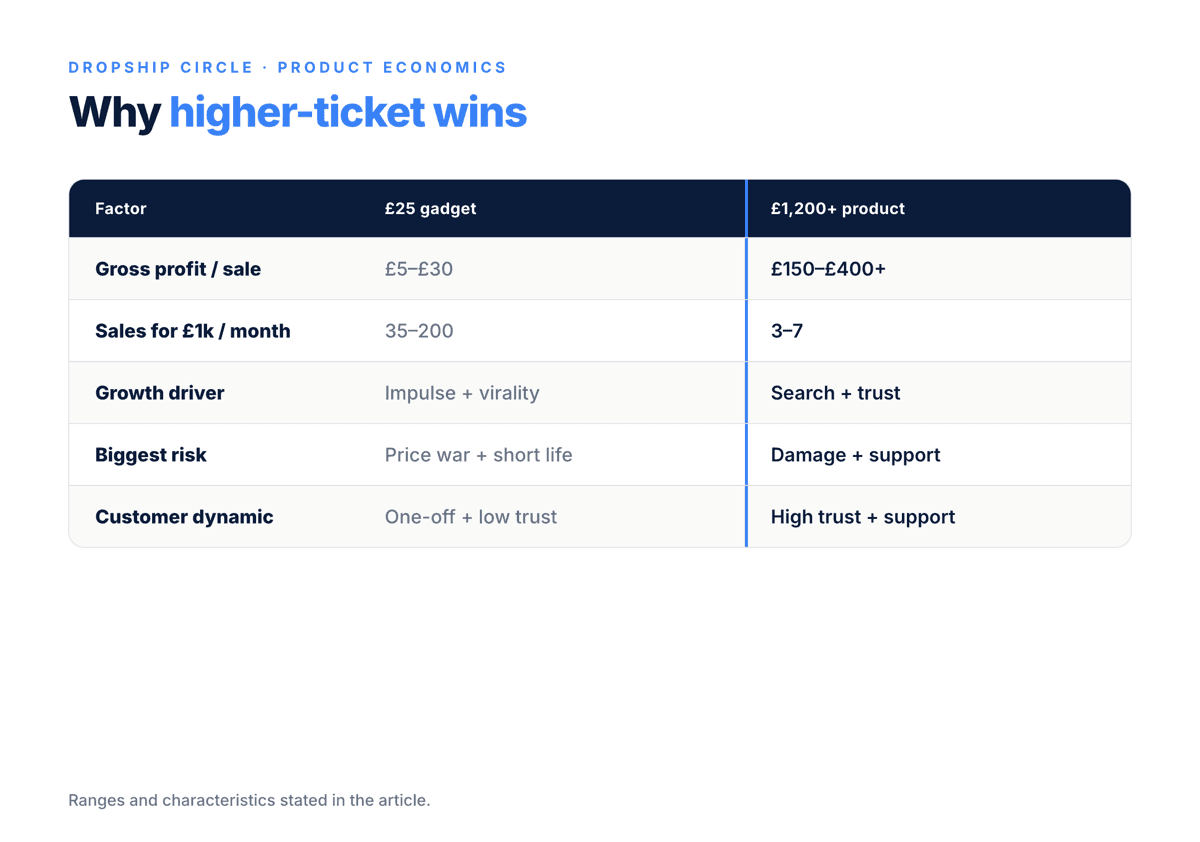
Here's the comparison that actually matters when you're picking between two live options today:
Factor | Low-ticket trending item (e.g. £25 gadget) | High-ticket trending item (e.g. £1,200+ garden/home product) |
|---|---|---|
Typical gross profit per sale | £5–£30 | £150–£400+ |
Sales needed for £1,000 profit/month | 35–200 | 3–7 |
Main growth driver | Impulse, virality, ad creative | Search intent, trust, product detail |
Biggest risk | Saturation, price war, short shelf life | Delivery damage, returns, support load |
Typical customer relationship | One-off, low trust needed | Higher trust, higher support expectation |
A £30 back massager at 30% margin nets around £9. A £300 inflatable kayak at the same 30% nets about £90. Ten low-ticket sales get you the same money as one high-ticket sale, for roughly the same amount of admin and customer contact per order.
Do the Numbers Actually Work Once You Run the Maths?
Yes, but only if you run contribution margin, not headline gross margin, because delivery, payment fees and support costs quietly eat 20-40% of what looked like profit.
Say two products both sell 10 units a month: a £900 shower enclosure at £190 margin, and a £2,400 sauna at £610 margin. Ten sales of the sauna is £6,100 against £1,900 for the enclosure, off the same ad budget testing the same volume. Same effort, three times the money, because the trending product you picked carried three times the contribution per order.
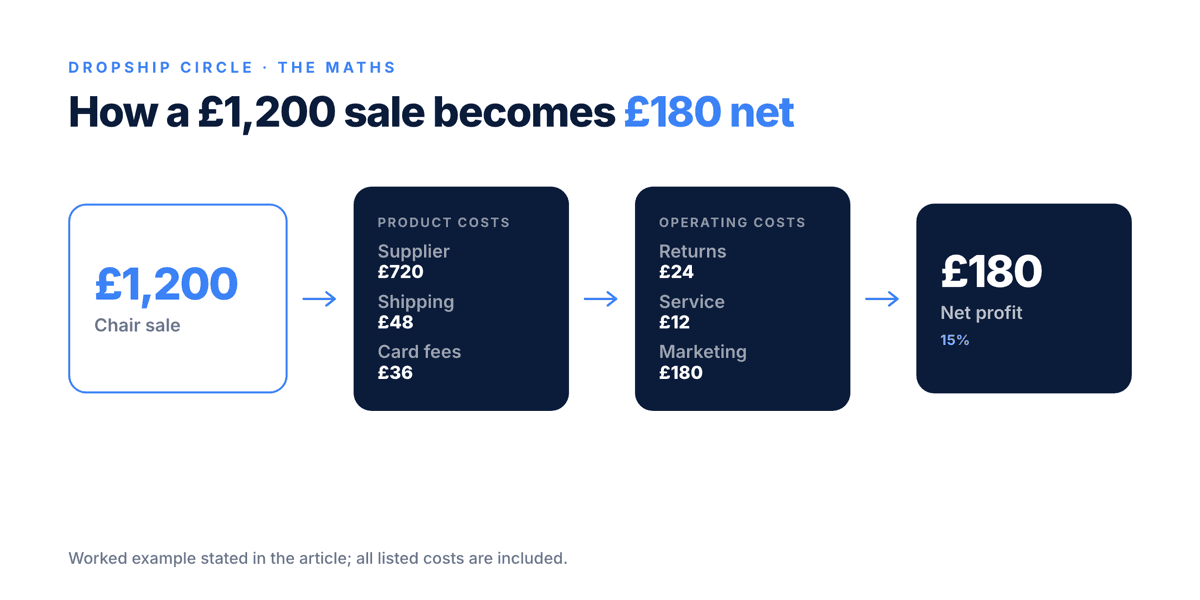
That's the case for going higher-ticket when a product is genuinely trending rather than chasing the cheapest viral item on the list. But the maths only holds if you price in the real costs. A £1,200 product at 40% gross margin gives you £480 gross profit before £40-£120 delivery, 1.4%-2.9% payment processing, and £20-£80 of support time, before you've even dealt with a return. A realistic net margin target for high-ticket dropshipping, once supplier cost, shipping, payment processing, returns, customer service and marketing are all in, sits around 15%. On a £1,200 chair: £720 supplier cost, £48 shipping, £36 payment processing, £24 returns, £12 customer service, £180 marketing, leaves £180 net. Chase the headline margin instead of the net one and you'll think you're profitable for months before you actually check.
What Happens When a Trending Product Goes Wrong?
A single damaged delivery or a bad return can wipe out most of a trending product's margin in one event, which is why thin-margin picks are the riskiest kind of "trending."
On a £1,000 product with only £120 gross margin, a single £60 delivery issue leaves almost nothing for the traffic and support that got the sale in the first place. This is where thin trending picks fall over even with a good guide sitting above them, because there's no room left to absorb the ordinary cost of running the business.
How Content Turns a Trending Category Into Steady Sales
A well-built buying guide around a trending category can take months to rank, then convert at no ongoing ad cost once it does.
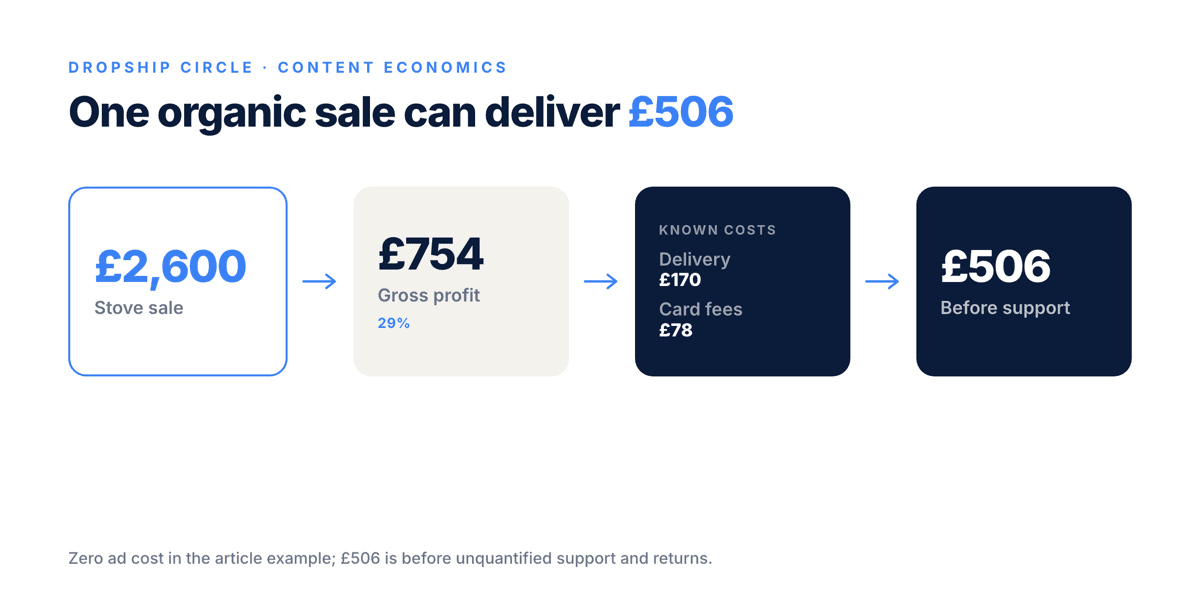
A seller in Harrogate wrote a 2,400-word guide to choosing a wood burning stove and it did nothing for four months. He left it alone, added the flue diagrams a fitter had drawn up for him, and stopped checking it every week. In the fifth month it started ranking for the exact comparison people search the week before they buy. On a £2,600 stove at 29% margin, that's £754 gross. Subtract £170 delivery and £78 card fees, and £506 lands on each sale, at zero ad cost.
The guide had barely changed: one set of diagrams. What changed was that it had sat there long enough to be trusted by the thing that ranks it. Content on a high-ticket, genuinely trending category is not fast, and it doesn't need to be. The quiet months are the entry fee, not a sign it failed.
Trending Dropshipping Products in India: Does the Model Work the Same?
Trending dropshipping products in India follow the same demand logic as the UK and US, but supplier reliability, COD payment norms and domestic shipping infrastructure change the risk profile.
Much of the product-level advice above transfers directly, since search intent behaves similarly wherever it's measured. What's different in India is the payments layer (cash-on-delivery is still common, which changes your effective conversion and return-refusal risk) and the supplier landscape, where domestic sourcing on platforms like IndiaMART can beat international dropshipping on delivery time for bulkier, higher-ticket items. Anyone testing trending products in India should treat COD refusal rates as a cost line the same way UK operators treat card payment fees; it's real money, it just shows up differently.
Is There Room to Do This With Free or Cheap Tools?
A lean Shopify dropshipping setup can run below £100 a month at the validation stage, rising as the operation grows.
Early validation typically runs £50-£150/month in software, early sales £150-£350, growth-stage stores £350-£800+, and established operations £800+. Every paid tool has to earn its place by saving time, cutting errors, lifting trust or clarifying a decision you'd otherwise be guessing at. A free trend source and a £29/month Shopify plan is a legitimate way to validate a trending product before you spend on anything heavier. Across £8.25M in tracked sales spanning our own, student and client stores, the pattern that holds is simple: the stores that survive are the ones that priced in the real cost of fulfilment and support from day one, not the ones with the flashiest trend-spotting software.
Key takeaways
A product being "trending" on a public list means everyone else searching that list sees it too; the edge is in the maths after fulfilment, not the discovery.
Run contribution margin, not gross margin: delivery (£40-£120), payment fees (1.5-3%) and support time all come off before profit is real.
Higher-ticket trending categories (garden, home comfort, office, e-bikes) convert on trust and detail, not impulse, and carry far more margin per sale.
Free tools (Google Trends, Amazon best-sellers, eBay trending filter, Meta Ad Library) are enough to validate a product before spending on anything paid.
A realistic net margin target once every cost is included sits around 15%, not the 25-30% gross figure that looks good before you check.
Content built around a trending category compounds slowly and then converts at no ongoing ad cost, once it's had time to rank.
Related reading
High Ticket Products: What They Are and How to Find Ones Worth Selling
Best Dropshipping Products: What Actually Works for High-Ticket Stores
High Ticket Dropshipping With AI: The Five Systems You Actually Need
The Smartest Online Business Model for 2026 (And Why High-Ticket Wins)
Frequently asked questions
Which product is most selling in dropshipping?
There's no single fixed answer since it shifts by season and platform, but categories that consistently sell well include home and garden items, pet products, and higher-ticket furniture and outdoor equipment, per repeated industry trend tracking. The specific SKU matters less than whether the category has durable, ongoing demand rather than a short viral spike.
Is drop shipping illegal in the UK?
No, dropshipping is fully legal in the UK. You need to register as a business, handle VAT correctly once you cross the threshold, and be accurate in your product descriptions and consumer rights compliance, the same as any other retailer.
Is £100 (or $100) enough for dropshipping?
It's enough to open a store and run a very small test, but it isn't enough to properly validate a product with real ad spend or absorb a delivery issue if one happens. A realistic starting budget for testing gives you room for daily ad tests of £30-£100 for at least a couple of weeks, plus a buffer for returns.
What to sell dropshipping right now?
Focus less on a specific product name and more on a category with rising search demand, price stability and enough margin to survive delivery and payment costs. Home, garden, outdoor and office furniture categories tend to offer better economics than cheap viral gadgets.
How many dropshippers fail?
Most people who start dropshipping quit within the first year, largely because they chase low-margin impulse products that can't absorb ad costs, returns or supplier issues. The ones who last tend to be the ones who priced in the real cost of running the business before they launched, not after.
If you want to see how we actually score a trending product before touching it, the niche research method, the margin sheet, the supplier vetting, it's covered in Dropship Circle's free training. No hype, just the workings.
Ready to Build Your Ecommerce Business?
Get started with our free training and discover the exact framework we use to build sustainable high-ticket stores.
Related articles

Products
High Ticket Products: What They Are and How to Find Ones Worth Selling
What are high ticket products, real examples, and how to find profitable high-ticket dropshipping and affiliate items

Products
Best Dropshipping Products: What Actually Works for High-Ticket Stores
The best dropshipping products aren't the trending £20 gadgets — here's the £300+ pricing logic that actually holds