High-ticket dropshipping suppliers in the USA are brands and distributors selling products above roughly £500-£1,000 (outdoor kitchens, e-bikes, saunas, audio equipment, furniture) that will ship direct to your customer under a trade or dealer account. There is no single master directory. You find them category by category, apply properly, and get approved on merit.
I run high-ticket stores myself, and most of what gets called a "supplier list" online is a rebrand of the same AliExpress catalogue with a higher price tag stuck on it. That's not what this is. A real high-ticket supplier wants a dealer who will make them money without causing them problems, and that changes how you find them and how you approach them.
This piece names real categories and real routes in, gives you the actual application mechanics, and shows the maths on what a deal like this pays once delivery and fees are stripped out.
What counts as a "high-ticket dropshipping supplier" in the USA?
A high-ticket supplier sells products retailing above roughly £500-£1,000, ships direct to the end customer, and vets dealers before approving them rather than letting anyone sign up.
That vetting is the whole difference from low-ticket sourcing. A low-ticket marketplace supplier will take anyone with a login. A high-ticket brand is protecting its retail price, its warranty process and its reputation, so it looks at every applicant through four questions: will this dealer make me money, will they create support or pricing problems, will they respect the rules, and will they still be here in three months. Get those four answered before you apply and you're already ahead of most of the queue.
Categories that consistently work at high-ticket price points in the US market include outdoor power equipment, e-bikes and mobility, saunas and spas, outdoor kitchens and grills, patio furniture, and audio equipment such as speakers, amps and recording gear. Each has manufacturers and regional distributors actively looking for dealers who can move volume online without undercutting their existing retail network.
How do you actually find high-ticket suppliers instead of a recycled list?
Reverse-engineer them from competitors already selling the products you want, then confirm each brand with a direct Google search.
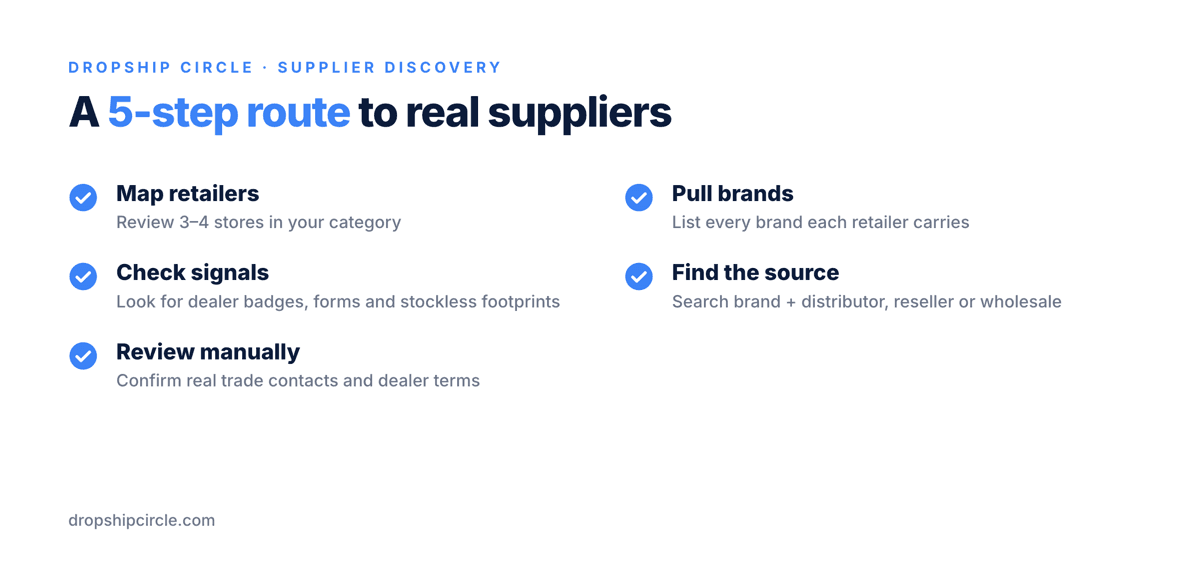
Go to three or four existing retailers in your category and pull every brand they carry. If a brand shows an "authorised dealer" badge or has its own dealer application page, that's a strong signal it accepts online-only retailers. Then check the retailer's own address on Google Street View: a suite number or a small office unit with no shopfront usually means that retailer is stockless too, which tells you the brand behind them is dropship-friendly.
Once you have brand names, search the brand plus "US distributor", "reseller", "wholesale" or "dealer application" to find the actual company behind the products, not just the storefronts using it. Tools built for this, like DSCAI, speed up the harvesting, but every result still needs manual review: you're filtering for real trade contacts, not scraping a list and hoping. SaleHoo is worth mentioning here too, not as an automated fulfilment platform but as a directory of roughly 8,000 verified suppliers for $67/year or $127 lifetime, useful for pulling documentation and seller-of-record agreements suppliers sometimes ask for.
Buried suppliers rarely rank on Google at all. Digging through a distributor's own dealer pages, rather than searching the brand name directly, is often how you find the contact that actually answers the phone.
Named US high-ticket supplier routes by category
There is no single "best" US high-ticket supplier because the right one depends entirely on category, but each of the following niches has established, dealer-friendly distribution worth applying to directly.
Rather than list individual brand names that go stale within a year as distribution changes, the durable approach is knowing which categories have real US dealer infrastructure and how to find the current names inside them today.
Outdoor kitchens, grills and fire features
Manufacturers in this space regularly run dealer or authorised-retailer programmes with published application forms, because the product needs proper freight and white-glove delivery that a marketplace can't offer.
Search "[brand] dealer application" or "[brand] authorised retailer" directly on the manufacturer's site before assuming you need a cold outreach script. If the form exists, use it.
Saunas, spas and outdoor wellness
E-bikes and outdoor mobility
Patio and outdoor furniture
Audio equipment
How do you get approved by a high-ticket supplier?
You get approved by positioning as a retailer with a plan, not by asking to "sell your products and get prices."
Suppliers care about sales, service quality and brand protection far more than they care about your fulfilment method. Lead with "online retailer", "authorised reseller" or "ecommerce dealer", not "dropshipper". Use a branded email address, contact@yourbrand.com rather than a free Gmail account; suppliers visibly take the former more seriously because it signals a real business rather than a hobbyist testing the water.
On the call or in the application, position yourself as a marketing platform that will bring the supplier new customers at no cost to them: offer a 90-day trial, offer to pay upfront on every order, and don't invent inflated monthly volume projections. A realistic ramp, catalogue setup, content, ad testing, then modest early volume scaling once campaigns are profitable, reads as credible where a fantasy number reads as inexperience. If a supplier still wants stock payment upfront, offer to spend on advertising for them instead and revisit stock discussions after 90 days once you've proven you can move product.
This is a learnable skill, not a personality trait. Plenty of people are uneasy about supplier calls the first time; the ones who commit to doing them properly are the ones who end up with a supplier list worth having.
What does a real high-ticket supplier deal actually pay?
On a typical high-ticket deal, expect gross margin in the 15-30% range, with delivery, card fees and support time cutting a meaningful chunk before you see net profit.
Say a product carries £340 margin and you place a first order of 5 units. That's £1,700 of margin in transit at once. One delivery slip that goes missing, or a customer who disputes the charge, and that margin is gone before it ever reaches your account. That's why the first order with any new supplier stays deliberately small: you're testing the delivery and support experience, not betting the account on volume.
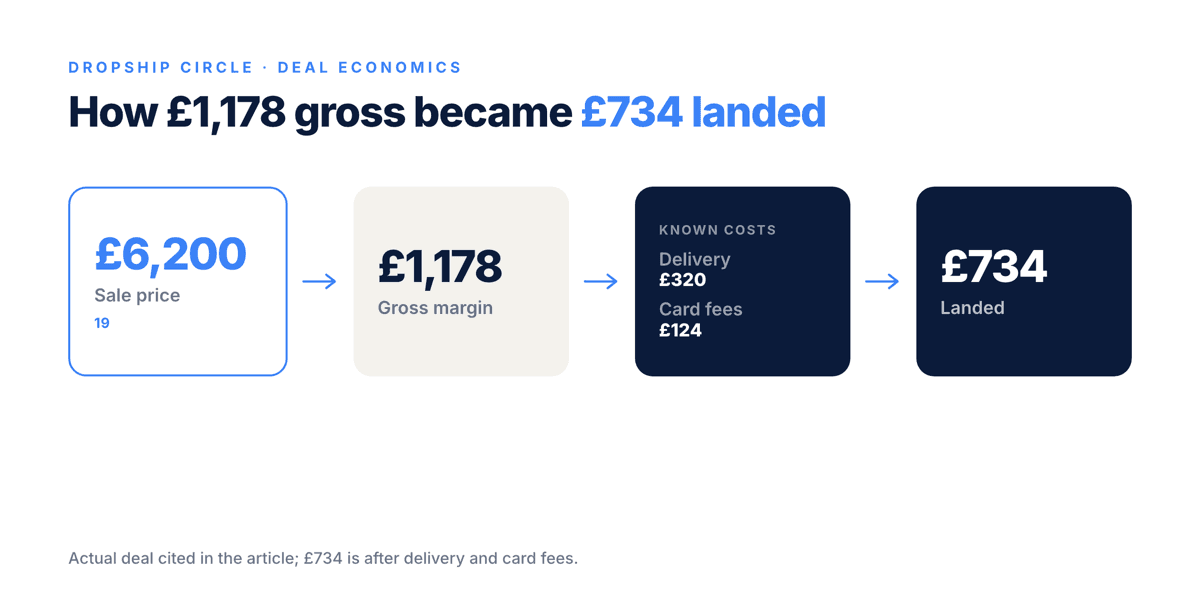
An operator in Lincoln had one reliable supplier and a quiet February with nothing much to do in it. Rather than sit on that, he used the slow weeks to apply to six more brands in the same category and signed two of them before spring. The second supplier covered a price point the first one didn't touch. The first order out of it was a £6,200 outdoor kitchen at 19% margin, £1,178 gross, and after £320 delivery and £124 in card fees, £734 landed. In June the original supplier ran out of stock on the two models that actually sold. Because of the quiet February, that was an inconvenience instead of a lost quarter.
Across £8.25M in tracked sales spanning our own, student and client stores, the pattern holds: retailers who diversify suppliers during their slow periods survive stock-outs that sink single-supplier operators.
How do US high-ticket suppliers compare to UK ones?
US high-ticket suppliers generally offer larger catalogues and more established dealer programmes, but UK suppliers usually beat them on delivery speed and returns handling for a UK-based store.
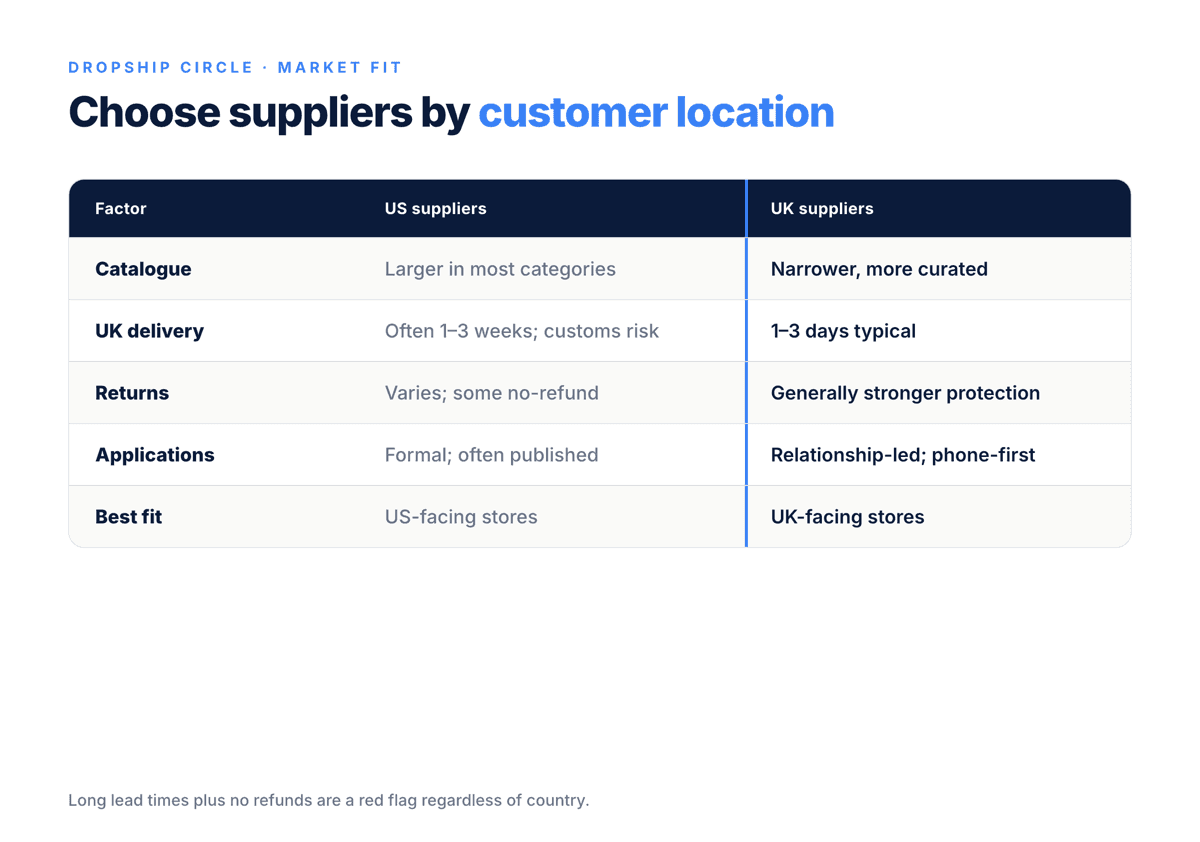
If you're building a US-facing store, US suppliers cut freight time and customs complexity versus importing. If you're UK-based selling into the UK, a US-only supplier with long transatlantic lead times and no refund policy is a risk worth replacing with a UK distributor offering next-day shipping and a proper returns process. Long lead time plus no refunds is a combination worth walking away from regardless of country, because it puts the return-shipping and refund cost entirely on you.
US suppliers | UK suppliers | |
|---|---|---|
Catalogue depth | Larger in most categories | Narrower, more curated |
Delivery to UK customers | Often 1-3 weeks, customs risk | 1-3 days typical |
Returns handling | Varies, some no-refund | Generally stronger consumer protection |
Dealer application process | Formal, often published forms | More relationship-driven, phone-first |
Best fit | US-facing stores | UK-facing stores |
Don't rule out a market just because it's crowded with existing sellers. What matters is whether there's real demand, strong products, suppliers worth working with, and healthy economics, and whether you can build a better-positioned offer than what's already there.
Is there any legal risk to know before signing with a supplier?
The main legal exposure is selling products or in territories you don't have documented permission for, not the dropshipping model itself.
Supplier willingness to work with you isn't the same as resale permission. Before you build a store around a supplier, get written confirmation of what you can sell, where, and what media or catalogue content you're allowed to use. Product rights, territory rights, website rights and advertising rights aren't automatically bundled together, and a mismatch here is what causes takedowns, inaccurate listings, or a supplier relationship that sours fast. Get this in writing before publication, not after your first order ships.
Key takeaways
High-ticket US suppliers are found by reverse-engineering competitor brand lists and Street View footprints, not by buying a pre-made directory
Lead applications with "online retailer" or "authorised dealer", use a branded email, and offer a realistic ramp-up plan rather than inflated volume projections
A £340-margin, 5-unit first order puts £1,700 of margin in transit, which is why first orders stay small on purpose
Diversifying suppliers during quiet periods is what protects you when your main supplier runs out of stock
US suppliers usually win on catalogue depth; UK suppliers usually win on delivery speed and returns for UK-facing stores
Confirm product, territory and media rights in writing before you build a store around any supplier
Related reading
Frequently asked questions
What is the best dropshipping supplier in the USA?
There's no single best supplier because it depends entirely on your category. The stronger question is which category has real dealer infrastructure, then which manufacturer or distributor inside it will approve an online-only retailer with a proper application.
Who are some reliable dropshipping suppliers for high-ticket products?
Reliable high-ticket suppliers tend to be manufacturers or regional distributors in categories like outdoor kitchens, saunas, e-bikes, patio furniture and audio equipment that run formal dealer programmes. You find the current names by pulling brand lists from existing retailers in that niche and confirming distribution directly.
Is high ticket dropshipping profitable?
Yes, when the margin, delivery cost, card fees and support time are properly modelled. A £340-margin order on 5 units puts £1,700 of margin in transit, and a single failed delivery can wipe it, which is why small first orders and tight cost tracking matter more than the headline margin percentage.
Can I make $10,000 per month dropshipping?
It's possible with high-ticket products because far fewer orders are needed to hit a revenue target than with low-ticket goods, but it isn't a guaranteed outcome for any individual reader. It depends on supplier relationships, ad performance and the operational discipline to get through the slow months.
Is drop shipping dead in 2026?
No. Low-ticket dropshipping is more saturated and thinner-margin than it was a few years ago, but high-ticket dropshipping, fewer, bigger orders with proper supplier relationships, remains a workable model built on real distribution rather than marketplace arbitrage.
Who is the richest dropshipper?
There's no verified, independently audited answer to this, and most figures thrown around online are unverifiable guru claims. It's a more useful question to ask what specific numbers a business can actually show its workings on than to chase a headline ranking.
If you want the fuller system behind finding and getting approved by suppliers like these, categories, application scripts, and how to model the real economics before you sign, Dropship Circle runs free training that walks through it properly. No pitch deck, no fantasy numbers, just the mechanics.
Ready to Build Your Ecommerce Business?
Get started with our free training and discover the exact framework we use to build sustainable high-ticket stores.
Related articles

Suppliers & Sourcing
Free Dropshipping Suppliers
Free dropshipping suppliers can work, but only if margins, stock, delivery and support terms survive real trading

Suppliers & Sourcing
Spocket Dropshipping Suppliers
Searching for a sprocket supplier? If you mean Spocket, this blunt guide covers suppliers, margins and product fit.

Suppliers & Sourcing
How to Get Approved by High-Ticket Suppliers
Get approved by high-ticket suppliers with a dealer application script, proof checklist and operator-led approach.