Dropshipping pet suppliers are manufacturers, distributors or brands that let an online retailer sell pet products without holding stock, then dispatch orders to the customer. For high-ticket pet ecommerce, I’d focus on products around £500–£3,000 / $500–$3,000, not £9 chew toys.
The pet market attracts beginners because everyone understands dogs, cats and animal owners spending money. That does not mean every pet niche is good. Most low-ticket pet dropshipping is a margin trap: £18 beds, novelty collars, cheap toys, high ad costs, awkward returns and no real supplier relationship.
The smarter play is high-ticket pet equipment: dog kennels, premium crates, catios, grooming tubs, dog treadmills, aquariums, aviaries, reptile enclosures, pet strollers, livestock-adjacent products and commercial pet business equipment. Fewer orders, bigger margins, proper suppliers, and a business that looks like a retailer instead of another Shopify store chasing trends.
What are dropshipping pet suppliers?
Dropshipping pet suppliers fulfil pet product orders direct to customers while you own the sale and customer relationship.
That last part matters. The customer buys from your store, not from the supplier. If the kennel turns up scratched, the grooming bath leaks, or the cat enclosure arrives missing bolts, the complaint comes to you first.
A good pet supplier is not just “someone with a product feed”. I want suppliers who can:
Dispatch bulky products reliably
Provide accurate stock information
Package products properly for courier or pallet freight
Honour warranties without making the retailer look stupid
Protect pricing so every seller is not racing to the bottom
Communicate like an actual trade partner
In the UK you may see terms like trade fulfilment, direct dispatch, stockist support, reseller account or dealer programme. In the US, look for authorized dealer, wholesale account, reseller program, dealer application and direct ship. Strong suppliers often do not advertise themselves as “dropshipping suppliers” because that phrase attracts beginners.
This is one reason high-ticket works better than low-ticket. A serious supplier selling a £1,400 dog kennel or $1,600 grooming tub is usually more interested in competent retailers than viral-product sellers asking for CSV feeds.
Is pet dropshipping better high-ticket or low-ticket?
High-ticket pet dropshipping is usually stronger because one sale can carry enough gross margin to pay for ads, support and freight issues.
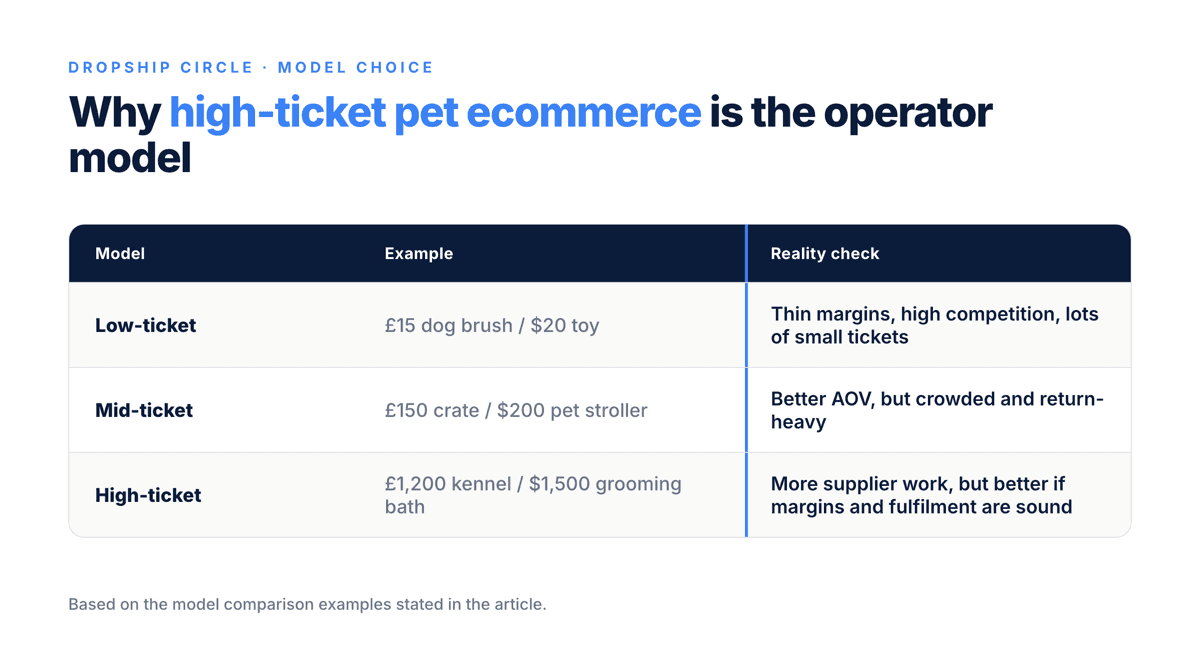
Low-ticket pet products look easy because they are cheap to source. In reality, they are usually expensive to sell. If a £22 pet toy costs £8 from a supplier, another £4 to ship, and your card fees and packaging admin take another bite, you might need extremely cheap traffic just to break even.
High-ticket is not easier in the lazy sense. It requires better suppliers, proper product pages, phone-ready customer support, finance options where appropriate, and clean operations. But it gives you room to operate.
Model | Example product | Typical issue | Operator verdict |
|---|---|---|---|
Low-ticket pet dropshipping | £15 dog brush / $20 toy | Thin margins, high competition, lots of small tickets | Hard to build a durable business |
Mid-ticket pet products | £150 crate / $200 pet stroller | Better AOV, but still crowded and return-heavy | Can work with strong niche angle |
High-ticket pet ecommerce | £1,200 kennel / $1,500 grooming bath | More supplier work, freight, pre-sale questions | Better operator model if margins and fulfilment are sound |
The difference is not just order value. It is the type of business you are building. Low-ticket sellers often obsess over hacks: creatives, trends, bundle offers, scarcity timers. High-ticket operators obsess over supplier quality, margin, freight, conversion rate, product education and trust.
That is where I prefer to play.
Which pet products work best with dropshipping suppliers?
The best pet dropshipping products are expensive, bulky, problem-solving and awkward for mainstream retailers to stock deeply.
I would not start with generic pet bowls, collars, beds or toys. Amazon, Temu, Walmart, Chewy, Pets at Home and every other broad retailer already make those products painful. You need products where the buyer researches, compares, asks questions and accepts a considered price.
Better categories include:
Outdoor dog kennels and runs
Heavy-duty dog crates
Catios and outdoor cat enclosures
Dog treadmills and rehabilitation equipment
Grooming baths, dryers and tables
Large aquariums and aquarium cabinets
Reptile vivariums and enclosures
Aviaries and bird cages
Premium pet ramps and mobility products
Commercial dog daycare or grooming equipment
Livestock-adjacent pet products, such as poultry housing or small animal shelters
A useful filter: if the product can be impulse-bought for £19, it is probably not the product I want. If it costs £700+, needs measurements, has delivery questions and solves a real problem, it is worth investigating.
The other filter is logistics. A £1,500 dog kennel with pallet delivery can be great if the supplier knows how to pack and ship it. It can also become a nightmare if panels arrive damaged every other week and nobody has spare parts ready.
What pet niches would I avoid first?
I’d avoid crowded, low-margin pet accessories unless you have a serious brand angle.
Beginner-friendly products are usually supplier-unfriendly and margin-unfriendly. If every YouTube video recommends the same “winning pet product”, the ads get expensive, copycats pile in, and customers compare you to Amazon.
I would be cautious with:
Cheap chew toys
Generic pet beds
Novelty collars
Low-cost grooming brushes
Print-on-demand pet mugs and shirts
Unbranded pet cameras already sold everywhere
Can these work? Sometimes. But for a first serious high-ticket store, I would rather deal with 20 well-qualified enquiries for £1,000 products than 300 tiny orders with thin margins and constant “where is my parcel?” emails.
How do you find dropshipping pet suppliers?
Find pet suppliers by searching trade terms, dealer language and category-specific manufacturers, not just “dropshipping supplier”.
The best suppliers often do not sit on public dropshipping directories. Directories can be useful for research, but the strongest partnerships usually come from doing boring operator work: searching, calling, following up and presenting yourself properly.
Use searches like:
dog kennel trade account UKcat enclosure direct dispatch supplierpet grooming equipment wholesale accountreptile enclosure distributoraquarium cabinet trade supplierdog treadmill authorised dealer UKdog crate authorized dealer USApet equipment wholesale account USAbrand name reseller programbrand name dealer application
Also look at brands stocked by niche retailers. If three independent stores sell the same premium kennel brand, there is usually a trade structure behind it. You can then contact the manufacturer or distributor and ask about becoming an online stockist.
Do not lead with “I’m a dropshipper.” That phrase carries baggage. Position yourself as an online retailer looking to become a stockist and generate incremental sales through paid search, SEO and product education.
There is a difference between asking for permission and presenting a commercial opportunity. Suppliers approve dealers who look useful and low-risk.
Should you use pet dropshipping directories?
Pet dropshipping directories can help with research, but they should not be your whole supplier strategy.
Directories tend to attract obvious products and obvious competitors. If 500 beginners have access to the same pet beds with the same images and the same shipping terms, you do not have much edge.
I would use directories to understand categories, prices and common brands, then build my own supplier list from Google, trade shows, manufacturer sites, distributor pages and competitor research. A spreadsheet with 80 targeted suppliers beats a directory login full of products everyone else can sell.
How do you vet a pet dropshipping supplier?
Vet a pet supplier on margin, fulfilment, damage handling, pricing rules, warranty process and communication before listing products.
Most beginners ask one question: “Do they dropship?” Operators ask ten better questions. The supplier’s answer to these questions tells you whether you are building a business or inheriting a customer service problem.
Ask:
What is the trade price and recommended retail price?
Is VAT included or excluded on UK price sheets?
What are the US sales tax implications and nexus responsibilities for your setup?
What are standard dispatch times?
Which carriers are used: DPD, DHL, FedEx, UPS, Royal Mail, USPS, pallet freight or LTL?
Who handles damaged deliveries?
Are replacement parts available?
What is the returns window?
Who pays return freight for buyer’s remorse?
Is there MAP pricing in the US or minimum advertised pricing guidance?
Are there UK pricing rules or brand guidelines?
Can you use their images, manuals and specification sheets?
Do they provide stock updates?
UK operators need to be especially careful with VAT. If the supplier sheet shows retail price including VAT but trade price excluding VAT, your margin can look better than it is. Ask for your trade price including VAT before calculating margin.
US operators need to pay attention to sales tax, state rules, exemption certificates, resale certificates and nexus. I am not your accountant, but I am blunt about this: do not wing tax because a YouTube video told you dropshipping is simple.
What margin do you need on high-ticket pet products?
For high-ticket pet products, I want enough gross margin to cover ads, fees, support, freight errors and still leave profit.
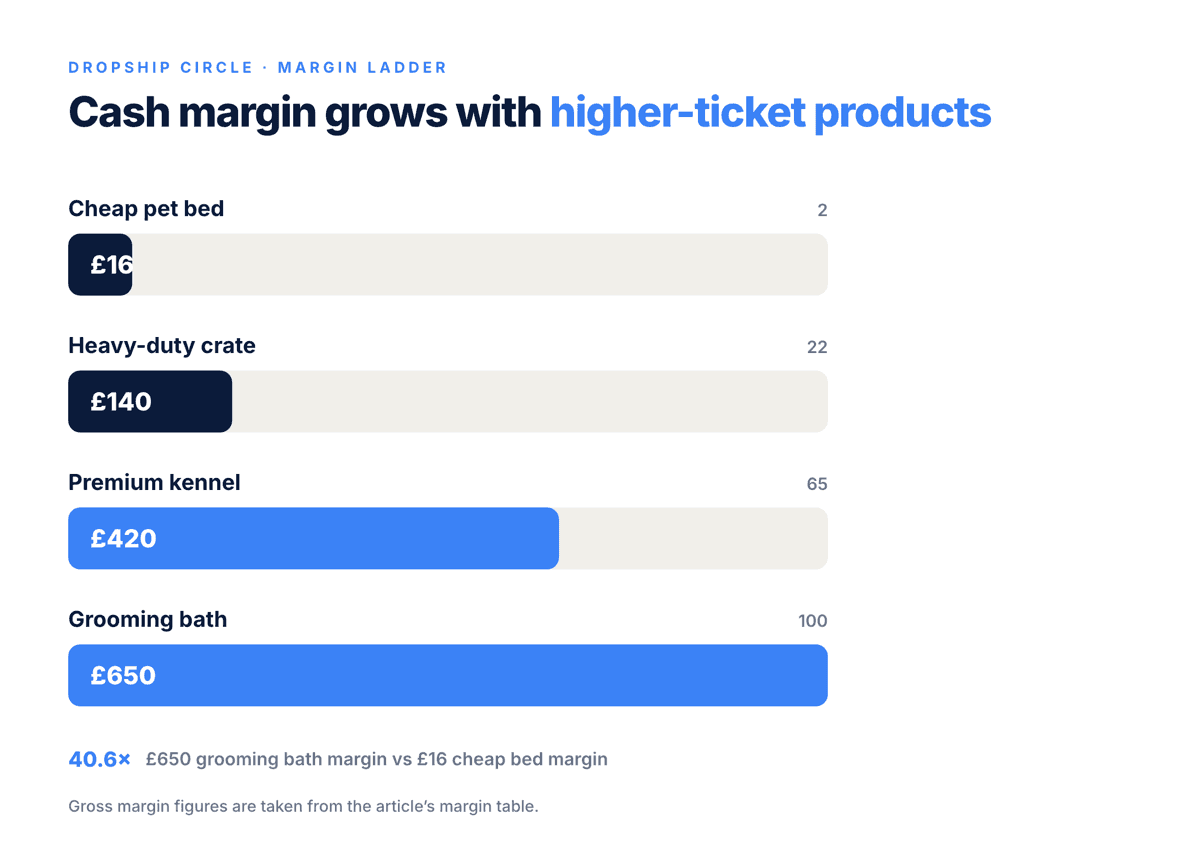
There is no magic margin percentage. A 25% gross margin on a £2,000 product can be more workable than a 60% margin on a £30 product because the cash per order is different.
Here is the operator pattern I care about:
Product | Sell price | Landed supplier cost | Gross margin | Problem |
|---|---|---|---|---|
Cheap pet bed | £35 | £19 | £16 | Little room for ads or returns |
Heavy-duty crate | £450 | £310 | £140 | Workable if ads are controlled |
Premium kennel | £1,200 | £780 | £420 | Room for paid traffic and support |
Grooming bath | £2,000 | £1,350 | £650 | Stronger cash margin, but freight risk matters |
The mistake is calculating margin once and calling it done. You need to include:
Payment processing fees
Shipping or pallet delivery charges
VAT or sales tax treatment where relevant
Returns and replacement parts
Discounts and finance costs
Ad spend
Customer support time
If your gross margin is £300 but one damaged pallet costs £180 to fix, that is not a minor detail. That is the business.
Worked scenario: how a £1,200 pet product can quietly lose money
Say you sell a £1,200 premium outdoor dog kennel.
The supplier trade price is £780 including delivery to the customer. On paper, you have £420 gross margin. That looks healthy.
Then the real numbers appear:
Payment fee: roughly £25–£35, depending on processor
Paid search cost to acquire the sale: say £160
Customer discount code used: £60
Support/admin time: not cash out, but still real capacity
Net before issues: around £165–£175
Still fine. Not spectacular, but workable.
Now add a realistic failure mode: the courier damages one side panel. The customer sends photos and refuses to assemble it. The supplier agrees to send a replacement panel, but it takes 7 days and costs £55 in freight. You also refund £75 as a goodwill gesture because the customer waited in for pallet delivery.
That one order may now be close to break-even. If your product page overpromised “easy next-day delivery”, you also created the complaint yourself.
This is why high-ticket is not about pretending problems do not happen. It is about having enough margin, the right supplier, accurate delivery expectations and a process for when something goes wrong.
How do you contact dropshipping pet suppliers?
Contact pet suppliers as a retailer offering incremental sales, not as a beginner asking to dropship their catalogue.
Phone calls beat lazy emails. Email response rates can be poor because suppliers are busy, sceptical or tired of beginners sending the same template. Call during business hours, ask for the trade, wholesale or dealer team, and keep it commercial.
A simple opening:
“Hi, I run an online retail business in the pet equipment space and I’m looking at adding a small number of strong brands as stockists. Do you support online retailers with direct dispatch or trade fulfilment?”
That sounds very different from:
“Hi, do you allow dropshipping? I don’t have any sales yet.”
Suppliers care about four things:
Can you generate sales?
Will you create customer service problems?
Will you respect pricing and brand rules?
Are you likely to stay consistent?
If you can answer those before they ask, you improve your odds. Mention your plan for Google Shopping, search ads, SEO content, product education, customer support and clean post-sale communication. Keep it factual. Do not pretend to be bigger than you are.
What should you do if a supplier says no?
If a supplier says no, ask why, handle the objection, and follow up instead of acting offended.
Some suppliers have had bad experiences with online sellers: refunds, damaged-product disputes, bad reviews, MAP violations, warranty headaches and price complaints. Your job is to show you are not that type of retailer.
If they are hesitant, ask for a limited trial:
“Would you be open to a 90-day direct-to-customer dispatch trial? I’ll focus on a small number of products, keep pricing aligned with your brand, and invest in paid traffic to test incremental demand.”
If they ask you to place a bulk order upfront, I would not take stock just to impress them. Offer to put that same amount into paid ads and run a 90-day trial instead. That is a better use of capital for a lean ecommerce operator.
How often should you follow up with pet suppliers?
Follow up 24 hours after the first message, then again after 2–3 days if there is no reply.
Do not spam them. Do not send desperate essays. Keep it professional and specific.
A practical cadence:
Call between 9am and 5pm local business time
Send a short email after the call summarising the request
Follow up after 24 hours
Follow up again after 2–3 days
Try one final call the next week if the supplier is a strong fit
In the UK, call during UK business hours. In the US, respect time zones. A California supplier does not want a call at 6am because you forgot the map exists.
What makes a supplier approve your pet store?
Suppliers approve pet retailers who look commercially useful, low-risk and capable of representing the brand properly.
Your website does not need to be massive, but it cannot look like a half-built theme with copied descriptions and no contact details. High-ticket suppliers are trusting you with their brand, their warranty burden and their customer’s first impression.
Before applying, make sure you have:
A clean store with a real domain
Professional category structure
Clear contact details
Returns, delivery and warranty pages
Strong product page templates
No fake countdown timers or guru nonsense
Brand-safe copy and imagery
A plan for traffic beyond “posting on TikTok”
If I were applying for a premium grooming equipment brand, I would not send a vague email. I would say which products I want to launch with, how I intend to position them, what traffic channels I will use, and how I will handle customer enquiries.
That makes you sound like a retailer. That is the point.
How do UK and US pet dropshipping differ?
UK and US pet dropshipping differ mainly in tax, freight scale, supplier language and customer delivery expectations.
The model is similar: you sell, the supplier fulfils, you support the customer. The operational details change.
Area | UK | US |
|---|---|---|
Tax | VAT treatment matters; check whether prices include or exclude VAT | Sales tax varies by state; nexus and resale certificates matter |
Supplier terms | Trade account, stockist, reseller, direct dispatch | Authorized dealer, wholesale account, reseller program, MAP |
Carriers | DPD, DHL, Royal Mail, Parcelforce, pallet networks | UPS, FedEx, USPS, LTL freight, regional carriers |
Geography | Smaller delivery footprint, but islands and remote areas matter | Huge delivery zones; freight costs can swing hard |
Pricing control | Brand guidelines and trade terms | MAP policies are more common |
For a UK store, one of the most common margin mistakes is mixing VAT-inclusive retail prices with VAT-exclusive trade costs. For a US store, one of the most common mistakes is ignoring sales tax complexity until orders start coming in from multiple states.
The high-ticket model works in both markets. You just need to build with the local operating rules instead of copying someone else’s template blindly.
Should you sell branded or unbranded pet products?
Branded pet products are usually better for trust, while unbranded products need stronger differentiation and quality control.
High-ticket customers want confidence. If someone is spending £1,500 / $1,500 on a dog kennel, grooming bath or reptile enclosure, they care about reviews, warranty, manuals, materials and support. A recognised brand helps.
Branded products can also come with restrictions:
MAP pricing in the US
Brand guidelines
Approved image usage
Limited discounting
Territory rules
Dealer performance expectations
Unbranded products give more flexibility, but you carry more trust burden. You may need better photography, deeper product education, clearer warranties and more pre-sale support.
If I had to choose for a first serious pet store, I would rather become an authorised online stockist for a smaller quality brand than sell anonymous catalogue products with no defensibility.
How do you avoid bad dropshipping pet suppliers?
Avoid pet suppliers with unclear costs, slow replies, poor packaging, weak warranty support or no process for damage claims.
Bad suppliers rarely announce themselves upfront. They reveal themselves in small ways: vague shipping answers, outdated stock sheets, inconsistent pricing, no spare parts, no named contact, and “we’ll sort it” instead of a real process.
Red flags:
They cannot confirm dispatch times
They will not explain damage procedures
They refuse to clarify VAT, shipping or trade pricing
They have poor reviews mentioning delivery damage
They use weak packaging for bulky items
They expect you to absorb every customer issue
They have no warranty documentation
They sell to anyone with no approval process
That last one sounds convenient but can be dangerous. If a supplier approves everyone, your products may get flooded by sellers undercutting each other within weeks.
A supplier being selective is not always bad. Often it means they care about brand control, pricing and customer experience, all things that help serious operators.
What store setup do you need before listing pet products?
You need a trust-led ecommerce store with clear policies, strong product pages and support systems before sending paid traffic.
Pet customers can be emotionally intense because the purchase is for an animal they care about. If the product is expensive, bulky or safety-related, your store has to reduce doubt.
Minimum setup:
Shopify or another reliable ecommerce platform
Proper product specifications and dimensions
Delivery lead times by region
Returns policy that matches supplier terms
Warranty page
Contact email and phone number where possible
FAQ blocks on product pages
Trust badges that are real, not tacky
Google Merchant Center feed if running Shopping ads
Analytics and conversion tracking
For high-ticket, product pages need more than a title and three images. Include dimensions, materials, delivery method, installation notes, warranty, who it is for, who it is not for, and what happens after ordering.
The sale often happens before checkout. A buyer comparing three £1,200 kennels may choose the store that answers the awkward delivery question clearly.
How long does it take to build a pet dropshipping business?
Most serious operators should expect months, not days, to find suppliers, test products and reach consistent profitability.
Timelines vary. Some people move faster because they already understand ads, SEO, sales or ecommerce operations. Others take longer because they are learning everything at once.
A realistic early timeline might look like:
Weeks 1–2: niche research and supplier list building
Weeks 2–6: supplier calls, applications and follow-ups
Weeks 4–8: store build, product pages and tracking setup
Months 2–4: traffic testing, conversion fixes and supplier refinement
Months 3–6: push toward consistent profitable sales, if the fundamentals are right
That is not a promise. It is a sensible operating window. Anyone telling you this is a weekend copy-paste job is selling you the fantasy version.
The good news is that high-ticket pet ecommerce rewards the boring work. Supplier relationships, proper pages, careful numbers and clean customer service compound better than chasing another £12 viral gadget.
Key takeaways
The best dropshipping pet suppliers are usually manufacturers, distributors or brands offering trade fulfilment, direct dispatch or dealer accounts.
High-ticket pet products such as kennels, grooming equipment and enclosures give more margin room than cheap toys and accessories.
Do not lead supplier outreach with “I’m a dropshipper”; position yourself as an online retailer or stockist bringing incremental sales.
Always check real margin after VAT or sales tax treatment, freight, payment fees, ad spend, returns and damage claims.
Supplier quality matters as much as product demand because customers hold your store responsible when fulfilment goes wrong.
The model works in both the UK and US, but tax, freight and supplier terminology differ enough that you need to build locally.
Related reading
High-Ticket Dropshipping Suppliers in the USA: The Named List
The Smartest Online Business Model for 2026 (And Why High-Ticket Wins)
Frequently asked questions
How do I find dropshipping pet suppliers?
Search for trade and dealer terms, not just “dropshipping pet suppliers”. Use phrases like “pet equipment wholesale account”, “dog kennel trade account”, “authorized dealer”, “reseller program” and “direct dispatch supplier”, then call suppliers and ask about becoming an online stockist.
What pet products are best for dropshipping?
High-ticket, problem-solving pet products are usually better than cheap accessories. Look at dog kennels, grooming baths, catios, reptile enclosures, dog treadmills, aquariums and commercial pet equipment where customers expect to research before buying.
Can I dropship pet products in the UK and US?
Yes, but the operating details differ. UK sellers must be careful with VAT-inclusive and VAT-exclusive pricing, while US sellers need to understand sales tax, resale certificates, state rules and freight distances.
Do pet suppliers allow dropshipping?
Some do, but they may not call it dropshipping. Many use terms like trade fulfilment, direct dispatch, reseller account, dealer programme or authorized dealer, and they are more likely to approve retailers who look professional and low-risk.
Is pet dropshipping profitable?
It can be, but only if the product economics work after ads, fees, shipping, returns and support. Low-ticket pet products often collapse under ad costs, while high-ticket pet products give more room if you secure strong suppliers and manage operations properly.
If you want to build this properly, I cover the high-ticket model in more depth inside the free Dropship Circle training, supplier outreach, niche selection, store structure, margins and the mistakes that make beginners look risky to good brands. No hype, no copy-paste product list; just the operator framework I’d want if I were starting again.
Ready to Build Your Ecommerce Business?
Get started with our free training and discover the exact framework we use to build sustainable high-ticket stores.
Related articles

Suppliers & Sourcing
High-Ticket Dropshipping Suppliers in the USA: The Named List
A named list of high-ticket dropshipping suppliers in the USA, how to get approved, and the real economics behind

Suppliers & Sourcing
Free Dropshipping Suppliers
Free dropshipping suppliers can work, but only if margins, stock, delivery and support terms survive real trading

Suppliers & Sourcing
Spocket Dropshipping Suppliers
Searching for a sprocket supplier? If you mean Spocket, this blunt guide covers suppliers, margins and product fit.