To get approved high ticket suppliers, you need to look like a real dealer, not a beginner asking for a price list. That means applying with a focused niche store, a credible traffic plan, proper business details, clear customer-service handling, and a short dealer pitch that shows how you will protect their brand.
I have filled in more supplier forms than I care to remember. Some were simple dropshipping dealer application forms. Others were long back-and-forth email threads with sales managers who wanted to know exactly how we planned to sell, support, price, advertise and represent their products.
The bit most beginners miss is this: suppliers are not looking for another random Shopify store. They are looking for distribution without brand damage. If you understand that, high ticket supplier approval becomes a sales process, not a begging process.
What High-Ticket Suppliers Actually Care About
A high-ticket supplier is usually selling products where one order might be worth £800, £1,500, £3,000 or more. Think garden buildings, saunas, commercial equipment, furniture, mobility gear, premium fitness kit, outdoor kitchens, machinery, specialist home products.
The supplier has more to lose than you think.
If you sell a £1,200 sauna badly, the supplier does not just lose one order. They may get:
Refund requests
Damaged-product disputes
Poor reviews
Price complaints from other dealers
Brand damage from ugly ads
Customer support headaches
Warranty claims handled incorrectly
So when you ask to become a dealer, they are silently asking four questions:
Will this person make us money?
Will this person create problems?
Will this person respect our pricing and brand rules?
Will this person disappear after two weeks?
Your entire application should answer those four questions before they need to ask them.
Supplier approval comes down to four checks, particularly when individual orders can be worth £800 or more.
Concrete fact | What it means for approval |
|---|---|
One high-ticket order might be worth £800, £1,500, £3,000 or more | Suppliers face greater risk from refunds, disputes, warranty claims and poor support |
Suppliers are silently asking four questions | They assess sales potential, likely problems, respect for pricing and brand rules, and whether the dealer will stick around |
A £1,200 sauna sold badly can create more than one lost order | It may also lead to poor reviews, price complaints, brand damage and support headaches |
Applicants need five core signals | A focused niche store, credible traffic plan, proper business details, clear customer-service handling and a short dealer pitch |
The Big Mistake: Applying Like a Dropshipper
The big mistake is applying like a dropshipper asking for a price list, when suppliers want a dealer who can sell well and protect their brand. Most people apply with the wrong posture.
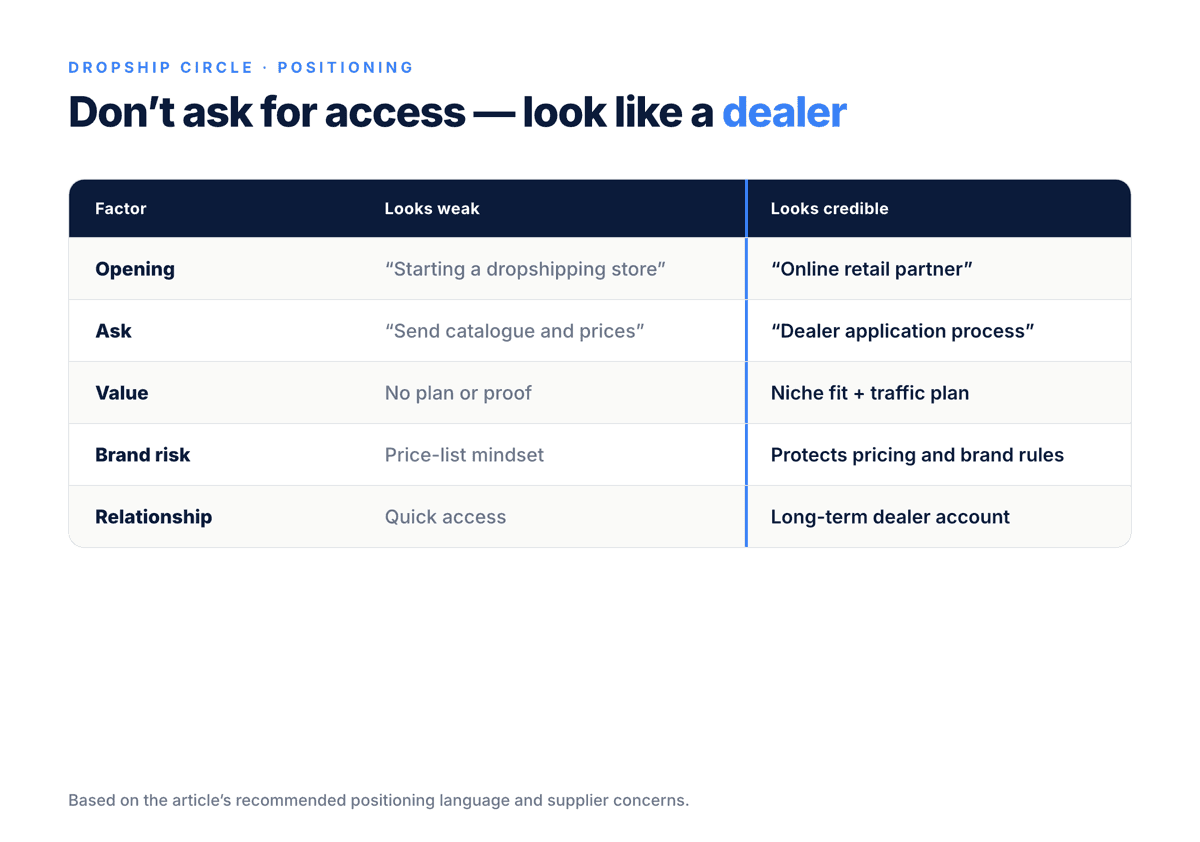
They write something like:
Hi, I am starting a dropshipping store and would like to sell your products. Please send your catalogue and prices.
That email screams: no positioning, no plan, no proof, no value.
I do not lead with the word “dropshipping” unless the supplier uses it first. I lead with dealer, retailer, online retail partner, authorised reseller, or ecommerce dealer depending on the category.
That is not about being sneaky. It is about using the language suppliers already understand. A proper dealer can still operate without holding every unit in a warehouse. Many suppliers already ship direct to customers for dealers. What they care about is whether you can sell responsibly.
A supplier does not approve you because you want access. They approve you because you look like a commercially useful account.
Before You Apply: Build the Minimum Dealer Profile
You do not need a massive brand to start conversations. But you do need enough substance that a supplier can take you seriously.
Here is the minimum I would want in place before submitting a dropshipping dealer application:
1. A Niche-Specific Store
Do not apply from a general store selling pet beds, ice baths, chandeliers and patio heaters on the same site.
High-ticket suppliers prefer focus because focus suggests competence. A supplier of garden rooms would rather see a site about garden living, outdoor structures or home workspace products than a random “best deals online” shop.
Your store should have:
A clear niche
A professional logo
Product-category pages, even if not fully populated yet
Delivery and returns pages
Contact details
Basic trust pages
No placeholder text
No fake reviews
You are not trying to look like John Lewis. You are trying not to look like a weekend experiment.
2. A Clear Customer Support Setup
High-ticket orders create pre-sale questions. Customers ask about measurements, delivery access, lead times, installation, warranty, finance, spare parts and returns.
Before applying, decide how you will handle support:
Email address on your domain
Phone number or call-back system
Live chat if you can staff it properly
Written process for delivery questions
Warranty escalation process
Clear returns policy aligned with supplier rules
If a supplier asks, “How will you support customers?”, do not say, “I’ll just email you.”
Say something more like:
We handle first-line customer support ourselves: product questions, order updates, delivery coordination and after-sales queries. Anything technical, warranty-specific or parts-related is escalated to the correct manufacturer contact with the order details attached.
That sounds like an operator.
3. A Real Traffic Plan
Suppliers hear vague nonsense all day:
“We will do social media.”
“We are building a brand.”
“We have marketing experience.”
Be more specific.
For a £1,500 product, you might say:
Google Shopping for bottom-of-funnel searches
Search ads for brand and category terms, where permitted
SEO category pages for comparison queries
Buying guides for measurement and installation questions
Email follow-up for quote and abandoned checkout enquiries
Retargeting if margins allow
You do not need to pretend you have thousands of customers. You need to show that you understand how buyers actually find expensive products online.
4. Business Basics
Depending on the supplier and country, they may ask for business details. Have the basics ready:
Registered business name
Trading name
Business address
Website URL
Business email
Phone number
VAT status if applicable
Company registration details if relevant
Resale certificate or tax details for US suppliers where required
Main sales channels
Expected categories
If your answers look inconsistent, approval becomes harder. Suppliers notice when your email says one brand name, your website says another, and your application form says a third.
The Dealer-Application Script I Use
This is the style of message I would send to a supplier when I want to open a proper conversation.
Do not copy it word for word if it does not fit your niche. Adapt it. The point is the structure.
Supplier Email Script
Subject: Dealer enquiry for [Brand/Product Category]
Hi [Name],
I run [Store Name], an online retailer focused on [specific niche/category] for customers in [UK/US/regions served].
We are currently expanding our range of [category] products and came across [Supplier/Brand]. The range looks like a strong fit because [specific reason: build quality, category coverage, warranty, design, commercial use, UK stock, etc.].
We are interested in becoming an authorised online dealer for your products.
Our plan is to represent the range through dedicated category pages, buying guides, Google Shopping/search campaigns where permitted, and first-line customer support for product questions, delivery coordination and after-sales enquiries.
We do not compete purely on discounting. We are more interested in building a long-term dealer relationship, protecting brand presentation, following any MAP/RRP rules, and sending qualified customers who understand the product before they order.
Could you let me know your dealer application process, trade pricing structure, fulfilment options and any requirements for new retail partners?
Website: [URL]
Business name: [Name]
Contact: [Name, email, phone]Thanks,
[Your Name]
That email does a few important things.
It shows:
You know the niche
You have a sales plan
You can support customers
You respect brand control
You are not just asking for a CSV file
You want a dealer relationship, not a quick flip
That is how you improve high ticket supplier approval.
Shorter Version for Contact Forms
Some suppliers only give you a tiny box on a dealer form. Use something tighter:
We run [Store Name], a niche online retailer focused on [category]. We are interested in becoming an authorised dealer for [Brand] and representing the range through dedicated category pages, buying guides, search-led traffic and first-line customer support. We follow supplier pricing and brand guidelines and are looking for a long-term retail partnership. Please send your dealer application details, trade pricing and fulfilment requirements.
That is enough to separate you from the “send prices please” crowd.
What to Put on a Dropshipping Dealer Application
A dropshipping dealer application is not just admin. It is a positioning document.
Here is how I think about the common fields.
Business Type
If there is an option for “online retailer”, “ecommerce retailer” or “dealer”, use the one that most accurately describes how you operate.
Avoid making the whole application about the fulfilment method. Dropshipping is logistics. The supplier is judging your ability to sell and service customers.
Sales Channels
If you sell through your own website, say that clearly.
Be careful with marketplaces. Some suppliers do not want their products on Amazon, eBay, Walmart or similar platforms because of price erosion and brand-control issues.
A better answer often looks like:
Primary channel is our own ecommerce website. We do not list products on third-party marketplaces unless approved by the supplier.
That removes a big fear.
Expected Monthly Sales
Do not invent huge numbers. A supplier would rather hear a realistic ramp-up plan than fantasy volume.
For example:
We expect the first stage to be catalogue setup, content creation and campaign testing. Initial order volume may be modest while we validate demand, with the aim of building consistent monthly sales once the range is live and campaigns are profitable.
That is honest. It tells them you understand the process.
Do You Hold Stock?
If you do not hold stock, do not lie.
Say:
We usually operate on a direct-fulfilment model for large products, with orders sent to the supplier or warehouse for delivery to the end customer. For proven bestsellers, we are open to discussing stock commitments, pre-orders or inventory planning where commercially sensible.
That last sentence matters. In high-ticket ecommerce, there are times when holding or pre-buying inventory makes sense. If a component is expected to become scarce or expensive, buying ahead can protect margin and delivery timelines. But it only works when you have demand confidence and cash discipline. Otherwise, you have just turned a supplier problem into your own warehouse problem.
The Follow-Up That Gets Replies Without Sounding Desperate
The follow-up that works is a short, specific nudge a few days later that adds something useful, not a desperate "just checking in." Most people give up after one email, which is lazy.
Suppliers are busy. Sales managers are travelling. Dealer inboxes are messy. Your message may be fine and still get missed.
I usually follow a simple sequence:
Day 1: Initial dealer enquiry
Day 4 or 5: Polite follow-up
Day 10 or 12: Final follow-up with a specific question
Then phone if the brand is worth it
Example follow-up:
Hi [Name], just checking whether you are currently accepting new online dealers for [Brand/Product Range]. We are building out our [category] range and would like to understand your dealer requirements, especially around trade pricing, delivery, warranty handling and pricing rules. If you are not the right person, who would be best to speak with?
That last line often helps because you are making it easy for them to forward you to the correct person.
If you phone, do not waffle. Say:
Hi, I sent a dealer enquiry about becoming an authorised online retailer for [Brand]. I just wanted to check who handles new dealer applications and whether there is a process we should follow.
Simple. Professional. No guru theatrics.
How to Handle Supplier Objections
Supplier objections are normal. Do not treat them as rejection. Treat them as information.
“We Are Not Taking New Dealers”
Reply with:
Understood. Are there any gaps in your current dealer coverage by region, category or customer type? If not now, when would be a sensible time to check back?
Sometimes the answer is genuinely no. Move on. There are always more suppliers.
“We Do Not Work With Dropshippers”
This can mean several things. It may mean they dislike low-effort stores, marketplace sellers or people who create support problems.
Respond by reframing:
I understand. To clarify, we operate as an online retailer and handle the customer relationship, product presentation and first-line support ourselves. For large items, we prefer supplier-direct fulfilment where available because it avoids unnecessary handling and freight cost. If direct fulfilment is not available, are there opening order or stocking requirements for new dealers?
You may still get a no. Fine. But this answer shows you are not the typical chancer.
“You Need to Place an Opening Order”
This is common.
Do not automatically run away. But do not blindly buy stock either.
Ask:
What is the minimum opening order?
Can it be mixed across SKUs?
What are the lead times?
What are the bestsellers?
Are there seasonal peaks?
What is the return or exchange policy for slow-moving stock?
Are spare parts available?
Can they provide sales data by category, not confidential dealer data?
If the opening order is, say, £3,000 and the product has clear demand, good margins and manageable storage, it may be worth considering. If it is £10,000 of unproven decorative homeware heading into a period where household budgets are tight, I would be more cautious. Practical, replacement-driven household products are usually safer inventory bets than purely aspirational items when customers are watching spending.
“We Already Have Dealers in Your Area”
Online retail changes this conversation. Brands increasingly want better customer data, more control over experience and stronger differentiation. As retail moves online, brands have fewer barriers to selling directly or testing new digital channels than they had with physical stores.
That can work for or against you. Some suppliers will protect old dealer relationships. Others will consider you if you bring a specific angle.
Try:
That makes sense. We are not trying to disrupt existing dealer relationships. Our focus is [specific niche/customer type/content angle], and we would represent the range online with clear product education and controlled pricing. Would that create any conflict with your current dealer setup?
You are showing awareness of channel conflict, which is exactly what they worry about.
What Makes a Supplier Worth Getting Approved For?
A supplier is worth getting approved for when it has real margin, reliable stock, clean delivery and genuine demand. Not every approval is worth celebrating.
Beginners collect supplier accounts like trophies. Operators judge suppliers by economics and execution.
Before I care about approval, I care about the deal.
Margin
If the product sells for £1,000 and your gross margin is £120 before payment fees, advertising, returns, admin and support, you may not have a business. High-ticket does not automatically mean high-profit.
Look at the real maths:
Retail price
Trade price
VAT/sales tax implications
Shipping cost
Payment processing fees
Expected advertising cost
Return risk
Warranty burden
Discount pressure
A £2,000 order can look impressive and still be thin.
Stock and Lead Times
Stock availability can make or break a store.
Retailers often get squeezed when demand rises at the same time supplier capacity, labour, manufacturing or shipping constraints tighten. In Q4 categories, this becomes brutal. Customers want delivery before a deadline, suppliers run low, and everyone starts blaming the retailer.
Ask suppliers:
How often is stock updated?
Do they provide live stock feeds?
What are normal lead times?
What happens when an item oversells?
Are there known seasonal bottlenecks?
Can you reserve stock after order placement?
Are price increases expected?
Price pressure often starts upstream. Energy, fuel, logistics, commodity and input costs can all work their way into supplier pricing. If you quote customers from old costs and your supplier updates pricing the next week, your margin takes the hit.
Brand Rules
Good suppliers often have rules:
Minimum advertised price
Brand guideline documents
Marketplace restrictions
Product image rules
Paid search restrictions
Territory limits
Warranty-process requirements
Bad beginners hate rules. Serious operators understand that rules can protect margin. If every dealer is allowed to undercut by £50 until nobody makes money, the category becomes miserable.
Support Quality
This is underrated.
If a supplier ignores you before approval, imagine how they behave when a customer has a damaged £1,800 delivery.
Before pushing hard, test how they communicate:
Do they answer technical questions?
Do they give clear delivery terms?
Do they explain warranty handling?
Do they have product data?
Do they offer proper images and manuals?
Do they provide realistic lead times?
A supplier with slightly lower margin but excellent fulfilment can beat a high-margin supplier that causes chaos.
How to Improve Approval Odds If You Are New
If you are brand new, you can still get approved. You just need to reduce perceived risk.
Use a Narrow Category Angle
Instead of “we sell home products”, say:
We specialise in compact outdoor living products for UK homeowners with small gardens.
Or:
We focus on ergonomic equipment for home offices and small commercial workspaces.
Specific beats broad.
Create Buying Guides Before You Have Every Product
Content is proof of intent.
A supplier looking at your site should see that you understand the customer’s buying journey. For example:
“How to Choose the Right Garden Sauna Size”
“Electric vs Wood-Fired Hot Tubs”
“What to Check Before Buying a Commercial Ice Machine”
“Delivery Access Checklist for Large Garden Buildings”
Information becomes more valuable when paired with expert access. The same applies in ecommerce. A product page is basic. A product page plus clear guidance, comparison help and support access is more commercially useful to a buyer.
Offer Controlled Launch Terms
You can say:
We are happy to start with a controlled launch of selected SKUs, follow your pricing rules, and review performance after the first 60–90 days.
That feels safer than asking for the full catalogue immediately.
Do Not Pretend to Be Bigger Than You Are
Suppliers can smell fake scale.
Do not invent warehouses, staff or revenue. Say you are building a focused online retail operation and explain how you will sell properly.
Most operators take months, not days, to build consistent traction. For many, 3–6 months to first consistent profit is a realistic working window, but it varies heavily by niche, supplier terms, margin, traffic skill, cash flow and execution.
My Approval Checklist Before I Send the Email
Before I apply, I want these boxes ticked:
The niche makes commercial sense
The supplier has products people already search for
Retail prices are high enough to support paid traffic
Margins appear workable after shipping and fees
The brand is not being destroyed on marketplaces
The website is presentable
My category page is relevant
I have a clear traffic plan
I can explain customer support handling
I know whether I am willing to hold stock if required
I have follow-up questions ready
Then I send the enquiry.
Not 200 emails in a blind spreadsheet blast. Targeted. Researched. Commercial.
You do not need every supplier to say yes. In high-ticket ecommerce, a few strong supplier relationships can be far more useful than dozens of weak accounts with poor margin and bad fulfilment.
The Real Game: Becoming Worth Approving
The real game is becoming a dealer suppliers want to keep: consistent orders, low hassle and clean operations. Getting approved is not the finish line.
Once approved, you still need to:
Build accurate product pages
Keep pricing updated
Confirm stock before scaling campaigns
Handle customer questions quickly
Protect margin when supplier costs rise
Avoid overpromising delivery dates
Feed product and customer insights back to the supplier
That last point matters. Brands want better customer relationships and better market information. If you can tell a supplier what buyers ask before ordering, where customers hesitate, which SKUs get quote requests, and what objections stop sales, you become more than an order forwarder.
That is how you move from “new account” to useful dealer.
And that is the part most SaaS blogs will never tell you because they have not sat there deciding whether to eat £180 in freight cost to keep a customer happy, whether to pause ads because stock feeds are unreliable, or whether to walk away from a supplier with good products but awful operations.
High-ticket supplier approval is not about sounding clever. It is about proving you can sell without making the supplier regret saying yes.
Key takeaways
To get approved high ticket suppliers, position yourself as a serious online dealer, not a beginner asking for wholesale prices.
Your store should be niche-specific, presentable and backed by a clear traffic and support plan before you apply.
The best dealer applications explain how you will protect the supplier’s brand, pricing and customer experience.
Do not obsess over approval alone; check margin, stock reliability, lead times, brand rules and support quality.
If you are new, use a narrow category angle, honest expectations and a controlled launch proposal to reduce supplier risk.
Register to watch the free training →
Related reading
High-Ticket Dropshipping Suppliers in the USA: The Named List
The Smartest Online Business Model for 2026 (And Why High-Ticket Wins)
Frequently asked questions
How do I get approved by high ticket suppliers with no sales?
You need to reduce perceived risk. Build a focused niche store, create useful buying guides, show a clear traffic plan and explain how you will handle customer support. Do not fake sales numbers; suppliers prefer a credible new dealer to a sloppy one pretending to be bigger than they are.
What should I say in a high ticket supplier approval email?
Say who you are, what niche you serve, why their range fits, how you plan to market it and how you will protect their brand. Ask for their dealer application process, trade pricing, fulfilment terms and pricing rules. Keep it commercial and specific.
Should I mention dropshipping on a dealer application?
If the supplier asks directly, answer honestly. But do not make the whole application about dropshipping; frame yourself as an online retailer or dealer and explain your fulfilment model clearly. Suppliers care more about customer experience, pricing control and brand protection than the label.
Do high-ticket suppliers require an opening order?
Some do. Before placing one, check the minimum order value, bestseller data, lead times, storage needs, return terms and whether demand is proven. An opening order can make sense, but buying stock blindly can tie up cash fast.
How many suppliers should I apply to?
Apply to enough to build options, but do not spray generic emails at hundreds of brands. A smaller list of researched suppliers with proper follow-up usually beats a lazy mass email. Quality of relationship matters more than the number of accounts.
If you want to see how I think through niches, suppliers, margins and the actual build-out of a high-ticket ecommerce store, I cover it in Dropship Circle’s free training. No hype, no magic button, just the operating model, the trade-offs and what you need to get right before spending serious money on stock or ads.
Ready to Build Your Ecommerce Business?
Get started with our free training and discover the exact framework we use to build sustainable high-ticket stores.
Related articles

Suppliers & Sourcing
High-Ticket Dropshipping Suppliers in the USA: The Named List
A named list of high-ticket dropshipping suppliers in the USA, how to get approved, and the real economics behind

Suppliers & Sourcing
Free Dropshipping Suppliers
Free dropshipping suppliers can work, but only if margins, stock, delivery and support terms survive real trading

Suppliers & Sourcing
Spocket Dropshipping Suppliers
Searching for a sprocket supplier? If you mean Spocket, this blunt guide covers suppliers, margins and product fit.