eBay dropshipping suppliers are wholesalers, distributors, brands or fulfilment partners that dispatch products directly to your customer after an eBay sale. The catch is simple: eBay allows dropshipping only when you use legitimate wholesale-style suppliers, not when you resell from another retailer or marketplace.
That one distinction is where most beginners get themselves into trouble. They search “eBay dropshipping suppliers”, find a marketplace-style source, list 200 products with thin margins, then wonder why late deliveries, returns and account issues wipe them out.
I’m Lex, founder of Dropship Circle. Across my own stores and the student and client stores I’ve helped build, I’ve seen £8.25M in aggregate tracked sales, not personal earnings, not a magic claim, just enough real trading to know the difference between theory and what actually happens when a supplier misses a dispatch, a customer opens a return, or VAT quietly eats the margin.
My blunt view: eBay can be useful, but high-ticket ecommerce is usually a smarter operator model than low-ticket marketplace arbitrage. Better margins, fewer orders, stronger supplier relationships and less race-to-the-bottom nonsense. If you’re going to use eBay, use it like an operator, not like a beginner hunting loopholes.
What are eBay dropshipping suppliers?
eBay dropshipping suppliers fulfil products for your customer while you remain the seller responsible for the order.
A proper supplier is not another retailer. It is usually one of these:
A manufacturer offering direct dispatch
A distributor with reseller accounts
A wholesaler with trade pricing
A brand with an authorised dealer programme
A fulfilment partner that supports stockist accounts
The important bit: the customer buys from you. If the product arrives damaged, is 3 days late, or the customer says the colour is wrong, that problem lands on your account, not the supplier’s.
That is why “supplier” is not just a product source. It is a risk partner. On a £25 gadget, a bad supplier creates annoying admin. On a £1,200 garden sauna or $1,500 patio set, a bad supplier can create a serious margin problem in one order.
What supplier terms should I search for?
Good suppliers often do not call themselves “dropshipping suppliers”.
Beginner language attracts beginner-level sources. Real suppliers often use trade language like:
Trade account
Wholesale account
Direct dispatch
Trade fulfilment
Dealer programme / authorized dealer program
Reseller account
Partner account
Online stockist
Stockist support
Distributor
Pallet delivery supplier
In the UK, searches like garden furniture trade account UK, hot tub wholesale supplier UK, or home gym direct dispatch supplier can surface better options than generic dropshipping lists.
In the US, use terms like authorized dealer, wholesale account, reseller program, and dealer application. For example: sauna authorized dealer USA or outdoor kitchen wholesale account.
Is eBay dropshipping allowed?
eBay allows dropshipping from wholesale suppliers, but not retail arbitrage from other marketplaces.
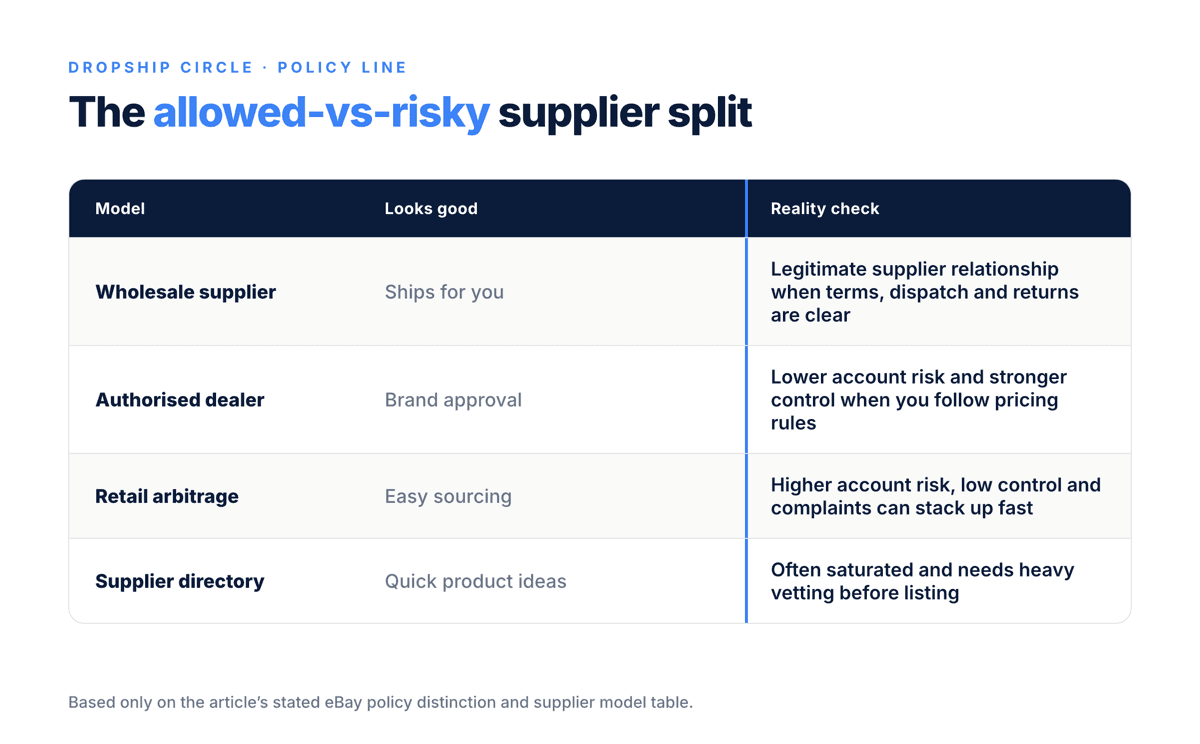
This is the line most people blur. Using a legitimate supplier who ships on your behalf is one thing. Listing items on eBay and then buying them from Amazon, Walmart, Argos, Home Depot or another retailer after the sale is a different game. And it is where account risk, delivery issues and customer complaints stack up fast.
I do not build real ecommerce businesses on policy loopholes. If a model depends on hoping a platform does not notice where the item came from, that is not a business. That is borrowed time.
For eBay specifically, you need to care about:
Item location accuracy
Dispatch time accuracy
Tracking uploads
Returns handling
Supplier stock reliability
Customer message response speed
Feedback quality
Pricing consistency
One late pallet delivery on a £1,000+ / $1,000+ product can trigger more stress than 20 low-ticket orders. But the same high-ticket order, handled properly, can be worth doing because the gross profit per order is meaningful.
What is the difference between supplier dropshipping and retail arbitrage?
Supplier dropshipping is a retailer relationship. Retail arbitrage is buying from another retailer after you make the sale.
Here’s the practical difference:
Model | Source | Account risk | Margin quality | Control | Operator view |
|---|---|---|---|---|---|
Wholesale supplier | Brand, distributor or wholesaler | Lower when compliant | Better if trade pricing is real | Medium to high | Viable if margins and fulfilment work |
Authorised dealer | Brand-approved supplier | Lower | Often stronger | High | Best fit for high-ticket stores |
Retail arbitrage | Amazon, Walmart, Argos, Home Depot | Higher | Usually thin | Low | Fragile and not how I’d build |
Supplier marketplace list | Generic supplier directory | Mixed | Often weak | Low to medium | Needs heavy vetting |
The eBay dropshipping suppliers worth having are rarely the ones shouting the loudest online.
Where do you find good eBay dropshipping suppliers?
Find suppliers through trade terms, niche brands, distributors, trade shows, Google operators and competitor research.
Do not start by typing “best eBay dropshipping suppliers” and joining every directory. That is how you end up selling the same products as 500 other sellers with no margin and no supplier use.
Start with the niche, then work backwards to the supply chain.
For example, instead of searching “dropshipping suppliers”, search:
electric fireplaces wholesale accountgarden rooms dealer programmehome sauna distributor UKpatio furniture authorized dealer USAmobility scooter trade accountcommercial gym equipment reseller programpallet delivery furniture supplier
Then look for brands and distributors who already understand dealer relationships.
What are the best supplier sources for eBay?
The best source depends on whether you want quick testing or a defensible business.
Supplier source | Best for | Typical weakness | What to check first |
|---|---|---|---|
Brand direct | Stronger margin and brand control | Harder approval | Dealer terms, MAP/MRP rules, dispatch process |
Distributor | Range and availability | Less exclusivity | Stock feeds, trade pricing, return rules |
Wholesaler | Faster onboarding | More competition | True margin after VAT/sales tax, shipping and fees |
Trade show contact | Relationship building | Takes time and travel | Whether they support online stockists |
Supplier directory | Initial research | Saturated products | Whether products are already overlisted on eBay |
Local manufacturer | Differentiation | Manual operations | Can they direct dispatch reliably? |
If you are in the UK, watch VAT. Supplier sheets can show retail price including VAT and trade price excluding VAT. Before you calculate margin, ask: “Can you confirm my trade price including VAT?”
In the US, sales tax rules vary by state, marketplace collection and your nexus position. Do not guess. Use an accountant or tax software once you have real volume.
Should I use AliExpress, Amazon or Walmart as eBay suppliers?
I would not build a serious eBay business using retailers or long-distance marketplace sources as the supplier base.
The numbers usually look tempting before the real costs appear. A £60 product with a £15 apparent margin becomes ugly when the delivery is late, the packaging shows another retailer’s branding, the customer returns it, and eBay fees have already taken their bite.
High-ticket operators think differently. They would rather have 20 supplier conversations and land 1 proper account than scrape 1,000 products from retail sites.
How do you contact eBay dropshipping suppliers?
Contact suppliers as an online retailer offering incremental sales, not as a dropshipper asking for permission.
This matters. The words “I’m a dropshipper” often sound like “I’m new, I’ll cause support issues, and I’ll probably undercut your dealers.”
Position yourself as a retailer or online stockist. You are looking to open a trade account, list selected products, run paid traffic or marketplace visibility, follow pricing rules, and send clean orders for direct dispatch.
Phone calls beat cold emails in many niches. Email response rates are often poor because suppliers are busy and get low-quality enquiries all day. A 5-minute call can tell you more than 10 unanswered emails.
What should I say on the supplier call?
Keep it direct and commercial.
Example:
“Hi, I run an online retail business in the [category] space. I’m looking to expand our range and open a trade account with suppliers who can support direct-to-customer dispatch. We’d be promoting selected products online, following your pricing guidelines, and sending orders through cleanly. Who would be the right person to speak to about a reseller or dealer account?”
That is a different energy from: “Do you dropship?”
If they hesitate, ask about a trial:
“Would you be open to a 90-day direct-to-customer dispatch trial? We’d focus on a small number of products, invest in bringing new customers, and prove we can send clean orders without creating support problems.”
If they ask for a bulk order upfront, I would not rush into taking stock. A better reply is:
“I understand the concern. Rather than tying the same amount up in stock before we’ve tested demand, I’d rather invest that budget into paid advertising and run a 90-day trial to prove sales volume first.”
When should I follow up with suppliers?
Follow up after 24 hours, then again after 2–3 days if there is no response.
For UK suppliers, call during normal business hours, roughly 9am to 5pm UK time. For US suppliers, respect their time zone. A supplier in California is not picking up at 9am London time.
Expect noes, maybes and silence. That is normal. Supplier outreach is not a magic script game; it is a commercial persistence game.
How do you vet eBay dropshipping suppliers?
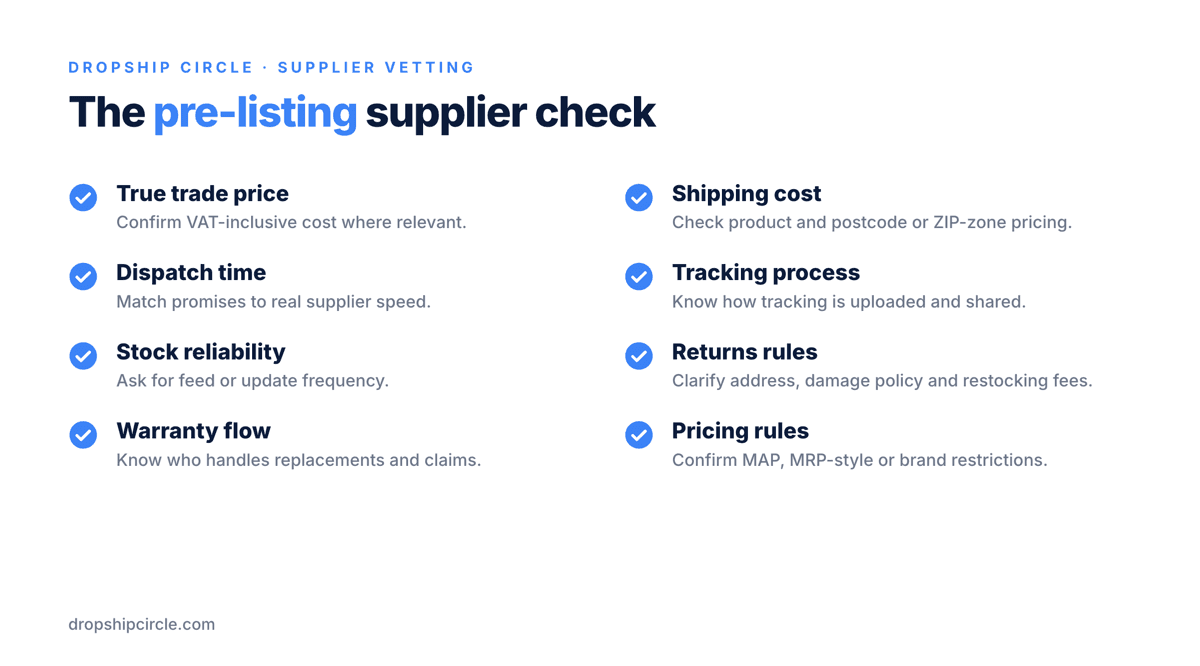
Vet suppliers on margin, stock reliability, delivery process, returns, warranty, packaging and support speed.
A supplier is not good because they say yes. Some of the easiest approvals are the worst relationships because they approve anyone.
Before listing anything on eBay, ask for:
Trade price including VAT where relevant
Shipping cost by product and postcode/ZIP zone
Dispatch time
Carrier used: DPD, DHL, FedEx, UPS, XPO, pallet networks, etc.
Tracking process
Stock feed or update frequency
Damage policy
Return address and restocking fee
Warranty process
Brand packaging rules
Pricing rules such as MAP in the US or MRP-style policies in the UK
For high-ticket items, delivery is not a footnote. A £1,500 sofa, $2,000 grill or £1,200 sauna can involve pallet delivery, booked delivery slots, kerbside drop-off and customer expectations that need managing before the order is placed.
What margin should I look for?
Look at net contribution after all costs, not the headline trade discount.
Say a supplier offers 30% off retail. That sounds good. But after VAT or sales tax treatment, eBay fees, payment fees, shipping, returns allowance and customer support cost, the real margin may be much thinner.
A simple margin check:
Selling price
Minus supplier cost
Minus VAT/sales tax where applicable
Minus marketplace fees
Minus payment processing
Minus shipping
Minus returns/damage allowance
Equals contribution before ads and overhead
If the deal only works when nothing goes wrong, it does not work.
What does a real high-ticket eBay supplier deal look like?
A workable high-ticket deal must survive fees, delivery costs and at least one realistic problem.
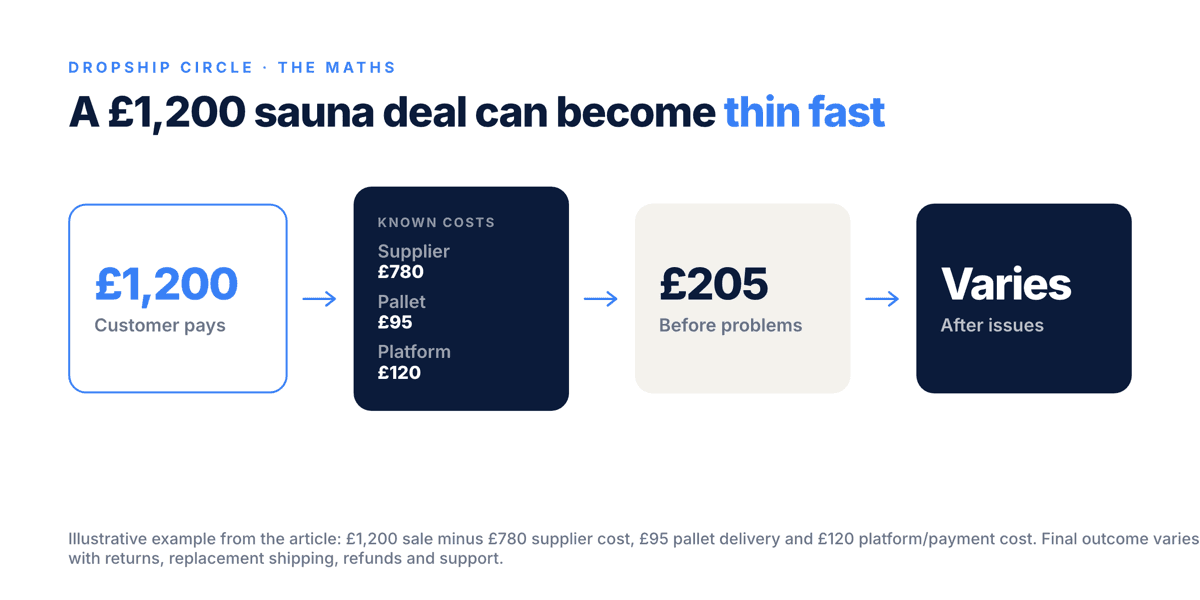
Here’s an illustrative operator pattern.
Say you sell a £1,200 garden sauna on eBay. The supplier gives you a trade price of £780 including VAT, and pallet delivery costs £95. eBay and payment-related costs might take a meaningful chunk depending on category and account terms, so let’s illustrate a £120 platform cost.
Your rough contribution before returns and support looks like this:
Line item | Amount |
|---|---|
Customer pays | £1,200 |
Supplier cost incl. VAT | -£780 |
Pallet delivery | -£95 |
Platform/payment costs | -£120 |
Gross contribution before problems | £205 |
On paper, £205 looks decent. Now add the operator reality.
The sauna arrives with a damaged panel. The customer sends photos and wants a replacement. The supplier agrees to send a new panel, but it takes 5 working days. You spend time managing the customer, the supplier, and eBay messages. If the customer escalates, your account metrics and feedback are on the line.
If the supplier charges £40 for replacement shipping, your £205 becomes £165. If you offer the customer a £75 partial refund to avoid a return, your £205 becomes £90. If the whole unit has to come back on a pallet, the deal can go negative fast.
That does not mean high-ticket is bad. It means high-ticket has to be operated properly. The margin per order is worth chasing, but only if the supplier relationship, delivery communication and returns process are strong enough.
This is exactly why I prefer high-ticket over low-ticket. With low-ticket, you can sell 100 units and still barely have enough margin to absorb issues. With high-ticket, one clean order can matter. But one sloppy process can also expose you.
Is eBay the best place to build a high-ticket dropshipping business?
eBay can be a sales channel, but your own store gives more control over brand, data, pricing and customer experience.
This is where I’m blunt. eBay is useful for demand signals and some categories, but I would not want my entire high-ticket business dependent on one marketplace account.
On eBay, you borrow trust and traffic. On your own store, you build an asset. That asset can use Google Shopping, SEO, email, retargeting, supplier relationships, reviews and content to compound over time.
High-ticket ecommerce works best when the business looks like a real retailer, because it is one. You are not just listing products. You are building a category store with supplier accounts, customer support, pricing discipline and fulfilment control.
How does eBay compare with your own store?
Channel | Strength | Weakness | Best use |
|---|---|---|---|
eBay | Existing buyer demand | Platform control and fee pressure | Testing demand, supplementary sales |
Shopify / own store | Brand, data and control | You must generate traffic | Main high-ticket asset |
Amazon | Huge demand | Strict rules and intense competition | Brand-approved catalogue strategy |
Facebook Marketplace | Local demand | Low trust and manual work | Bulky/local items |
Google Shopping to own store | Buyer intent | Needs margin and optimisation | Strong high-ticket acquisition channel |
For serious operators, I’d rather build around a Shopify store and use marketplaces selectively. That is the model with more control, better positioning and more room to build supplier trust.
What mistakes kill eBay dropshipping supplier deals?
Most supplier deals fail because sellers underprice, overlist, ignore delivery reality or create support headaches.
Suppliers approve dealers who look commercially useful and low-risk. They are quietly asking four questions:
Can this retailer make us money?
Will they create customer service problems?
Will they respect our pricing and brand rules?
Will they still be here in 6 months?
If your outreach, store, eBay account or communication screams “beginner”, approvals get harder.
The common mistakes:
Leading with “I’m a dropshipper”
Asking for the entire catalogue immediately
Listing products before confirming stock and shipping terms
Ignoring VAT or sales tax
Competing only on lowest price
Not understanding pallet delivery or bulky item returns
Using supplier images with no improvement or differentiation
Failing to answer customer messages quickly
Blaming the supplier when the customer bought from you
A supplier may manufacture and fulfil the product, but you own the customer relationship. That is the job.
How long does it take to get good suppliers?
Expect supplier acquisition to take weeks, not hours.
Some suppliers approve quickly. Better suppliers often require calls, forms, follow-ups and proof you can represent the brand properly. For many operators, building the first set of worthwhile supplier relationships can take several weeks of consistent outreach.
Getting to consistent profit can take 3–6 months for many operators, but it varies heavily by niche, budget, execution and supplier quality. Anyone pretending it is instant is selling you a fantasy.
Should beginners use eBay dropshipping suppliers or start with high-ticket stores?
Beginners can test with eBay, but high-ticket stores are usually the cleaner long-term operator model.
If you are brand new, eBay can teach useful lessons: customer messages, listings, pricing, dispatch, returns and supplier communication. But it can also train bad habits if you build around cheap products and marketplace loopholes.
The smarter path is learning how to build a real retailer model from day one:
Choose a niche with high-ticket demand
Find suppliers using trade language
Build a credible online store
Get approved as a dealer or stockist
Drive buyer-intent traffic
Manage customers like a real business
Track margin order by order
That is the difference between playing dropshipping and operating ecommerce.
The high-ticket model is not easier because there are no problems. It is better because the problems are worth solving. A £1,000+ / $1,000+ product gives you room to build margin, service and supplier relationships in a way £12 impulse products usually do not.
Key takeaways
eBay dropshipping suppliers should be wholesalers, distributors, brands or authorised dealer partners, not other retailers.
Use trade language like direct dispatch, reseller account, dealer programme, authorised dealer and online stockist.
Always calculate margin after VAT or sales tax treatment, platform fees, shipping, returns and damage risk.
Phone suppliers where possible, position yourself as a retailer, and follow up after 24 hours, then again after 2–3 days.
High-ticket ecommerce is more operationally demanding, but it gives better room for margin, supplier trust and a defensible business.
Related reading
High-Ticket Dropshipping Suppliers in the USA: The Named List
The Smartest Online Business Model for 2026 (And Why High-Ticket Wins)
Frequently asked questions
Can you dropship on eBay from wholesale suppliers?
Yes, eBay allows dropshipping when you use legitimate wholesale-style suppliers who fulfil orders for you. You remain responsible for delivery, returns, complaints and customer satisfaction.
What are the best eBay dropshipping suppliers?
The best suppliers are usually not generic dropshipping directories. Look for brands, distributors, wholesalers and authorised dealer programmes in a specific niche, then vet margin, shipping, returns and stock reliability.
Can I dropship from Amazon to eBay?
I would not build a serious business that way. Retail arbitrage from another marketplace creates policy risk, packaging issues, late delivery problems and weak margins.
How do I ask a supplier to dropship for me?
Do not lead with “I’m a dropshipper.” Say you run an online retail business and want to open a trade, reseller or dealer account with direct-to-customer dispatch support.
Is high-ticket dropshipping better than eBay dropshipping?
High-ticket dropshipping through your own store is usually a stronger long-term model because you control the brand, data, pricing and customer experience. eBay can still be useful as a channel, but I would not want it to be the whole business.
If you want to build this properly, don’t start by scraping random eBay listings. Learn how to choose a high-ticket niche, approach real suppliers, get approved like a serious retailer and run the numbers before you spend money. I break down the operator model in the Dropship Circle free training, no hype, just the process I’d want someone to understand before they start.
Ready to Build Your Ecommerce Business?
Get started with our free training and discover the exact framework we use to build sustainable high-ticket stores.
Related articles

Suppliers & Sourcing
High-Ticket Dropshipping Suppliers in the USA: The Named List
A named list of high-ticket dropshipping suppliers in the USA, how to get approved, and the real economics behind

Suppliers & Sourcing
Free Dropshipping Suppliers
Free dropshipping suppliers can work, but only if margins, stock, delivery and support terms survive real trading

Suppliers & Sourcing
Spocket Dropshipping Suppliers
Searching for a sprocket supplier? If you mean Spocket, this blunt guide covers suppliers, margins and product fit.