The best dropshipping companies Shopify operators should use are not usually public product-feed apps; they are real UK or US suppliers with trade terms, clear fulfilment rules, and products priced high enough to leave margin after ads, VAT, refunds, and Shopify fees.
I have built in this space from the operator side, not from a screenshots-and-vibes course seller angle. Across our own and our students’ and clients’ stores, I have seen £8.25M go through high-ticket ecommerce, and the big lesson is blunt: your Shopify theme is not the business. Your supplier base is.
Most people searching dropshipping companies Shopify are looking for a neat list of apps. That is fine if you want to test candles, gadgets, or cheap impulse products. But if you are serious about building a proper high-ticket ecommerce store, the better question is: which kind of supplier model gives you enough margin, delivery control, and customer trust to survive past month 3?
What are the best dropshipping companies for Shopify?
The best Shopify dropshipping suppliers are local, trade-focused companies with £500+ products and reliable fulfilment.
That answer will annoy people who wanted me to say “use this one app and crack on”. But it is the truth from operating real stores.
There are two completely different worlds hiding under the same word, dropshipping:
App-based dropshipping: DSers, Zendrop, AutoDS, CJdropshipping, Spocket, Syncee.
Supplier-led high-ticket dropshipping: UK and US brands, distributors, wholesalers, manufacturers, and importers who already hold stock and will fulfil on trade terms.
The first route is easy to start. The second route is harder to start but usually much cleaner as a business.
If you sell a £19.99 gadget, one refund, one late parcel, or one ad campaign at £30 cost per purchase can wipe the whole thing. If you sell a £1,200 sauna, £850 cost of goods, £80 delivery contribution, and £120 in ad spend, you still have room to operate. Those are illustrative numbers, but that is the margin maths I care about.
Which Shopify dropshipping supplier types should I compare first?
Start by comparing supplier type, not brand name.
Supplier type | Typical product value | Main benefit | Main problem | Best for |
|---|---|---|---|---|
AliExpress-style apps | £5-£80 | Fast setup, huge catalogue | Weak shipping control, thin trust | Low-ticket testing |
Print-on-demand companies | £15-£70 | No stock risk, easy personalisation | Low margins unless brand is strong | Creators and niche brands |
Marketplace feed suppliers | £30-£300 | Easy Shopify integration | Competing with identical stores | Beginners learning mechanics |
UK/US trade suppliers | £300-£5,000+ | Better margins, faster delivery, real brands | Manual outreach and vetting | Serious high-ticket stores |
Manufacturers/importers | £500-£10,000+ | Better control and exclusivity potential | Harder negotiation, slower onboarding | Operators building long-term assets |
The commercial reality is simple: easy suppliers attract lazy competition. If a company lets 10,000 people import the same product to Shopify in 30 seconds, you do not have an edge. You have a product feed.
Should I use Shopify dropshipping apps or direct suppliers?
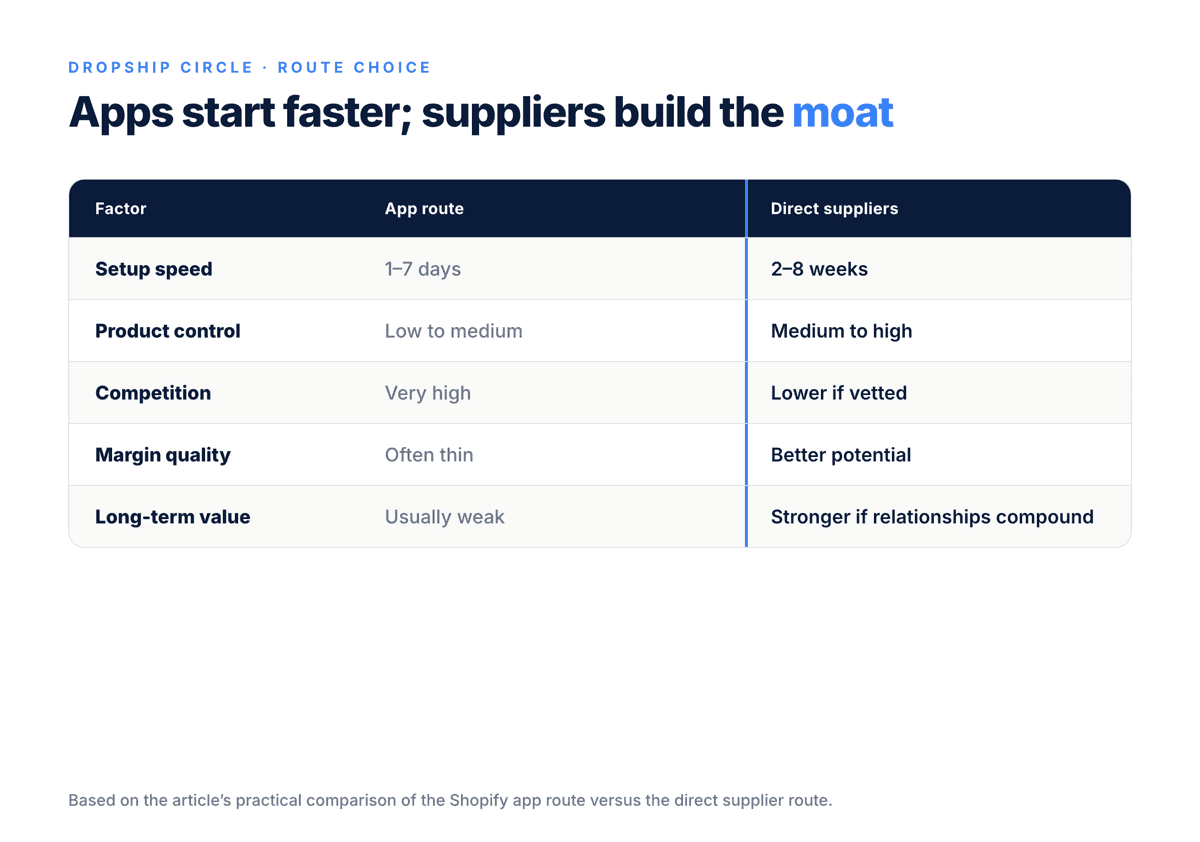
Use apps for speed and learning; use direct suppliers if you want margin, control, and a more defensible store.
I am not anti-app. Shopify apps are useful tools. But too many beginners confuse an app connection with a business model.
A Shopify supplier app can help you:
Import products quickly.
Sync basic stock data.
Send orders automatically.
Test product-page structure.
Understand Shopify operations without warehouse risk.
But the drawbacks are brutal when paid traffic gets involved. If your gross margin is £12 and your customer acquisition cost is £18, you are not “scaling”. You are buying stress.
With direct suppliers, the setup is slower. You might contact 30 companies and get 5 useful replies. You may need a trade account form, a proper website, supplier terms, delivery regions, return instructions, and product data. But that friction is exactly why most screenshot merchants avoid it.
I prefer the model where the supplier relationship itself becomes part of the moat. Dropship Circle teaches a UK and US supplier model, not Chinese import product chasing, because the category changes when you move away from slow-shipping disposable products and into higher-ticket buyer demand.
What does the app route cost compared with the supplier route?
The app route can cost less upfront, but often costs more later through poor margins.
Here is the practical comparison I would make before building anything:
Decision | Shopify app route | Direct supplier route |
|---|---|---|
Setup speed | 1-7 days | 2-8 weeks depending on replies |
Product control | Low to medium | Medium to high |
Typical competition | Very high | Lower if suppliers are vetted well |
Fulfilment visibility | Depends on app | Depends on supplier process |
Margin quality | Often thin on low-ticket products | Better potential on high-ticket products |
Upfront difficulty | Low | Higher |
Long-term value | Usually weak unless branded | Stronger if relationships compound |
If someone tells you the app route is always wrong, they are oversimplifying. If someone tells you the app route is all you need, they probably have not dealt with chargebacks, supplier stock errors, and £100-a-day ad tests that go nowhere.
How do I find dropshipping companies for a Shopify store?
Find suppliers by starting with profitable categories, then contact real UK or US companies with trade intent.
Do not start with “what product is trending?” That is how people end up selling the same LED lamp as 9,000 other stores. Start with categories where buyers already spend serious money and where delivery from a local supplier matters.
Examples of high-ticket categories people often research include:
Garden buildings and outdoor living.
Saunas, ice baths, and wellness equipment.
Home gym equipment.
Commercial furniture.
Pet structures and premium pet products.
Garage storage and workshop equipment.
Home improvement products.
Those are examples, not endorsements. A category still needs supplier availability, search demand, margin, sensible logistics, and supportable returns.
My basic supplier-finding process looks like this:
Pick a category where average order value could realistically be £500+.
Search Google like a buyer, not like a dropshipper.
List brands, importers, distributors, and specialist retailers.
Find companies already holding UK or US stock.
Contact them with a trade-style message, not a beggy “do you dropship?” email.
Ask about stock feeds, delivery terms, damaged goods, warranty, returns, and MAP/RRP policies.
Build a supplier scorecard before adding products to Shopify.
One named mechanism I use mentally is a simple 5-part filter: margin, demand, delivery, support burden, and supplier responsiveness. If one of those is terrible, the Shopify store will feel terrible no matter how clean the branding is.
What should I say when contacting a supplier?
Do not lead with “I am new to dropshipping”. Lead like a retailer.
A simple supplier email can say:
Hi, I run an ecommerce store in the [category] space and I am reviewing UK/US suppliers for a new product range. Could you confirm whether you offer trade accounts, direct-to-customer fulfilment, current product data, delivery pricing, warranty terms, and any RRP/MAP requirements?
That is much stronger than asking for “dropshipping companies Shopify integration”. Serious suppliers care whether you can represent the brand properly, answer customers, and send clean orders.
If a supplier replies with a PDF price list, delivery table, and trade terms, that is more valuable than 10,000 imported app products. If they reply in 11 days with one sentence and no details, that tells you something too.
What should I check before adding a dropshipping company to Shopify?
Check margin, fulfilment, returns, stock accuracy, warranty, and customer support before importing any product.
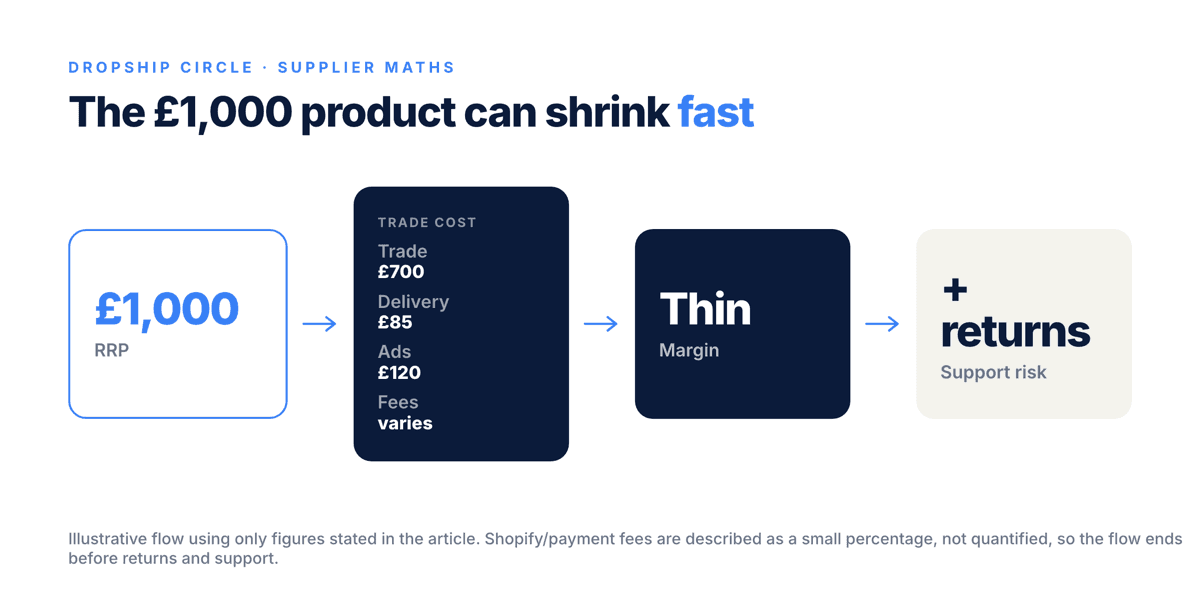
This is where beginners get lazy. They see a product with a £1,499 RRP and assume profit. Then they discover the supplier charges £160 delivery, refunds are painful, spare parts are unclear, and the product is out of stock every other week.
Before I would consider a supplier usable, I want answers to these questions:
What is the trade price versus RRP?
Is VAT included or excluded in the quoted price?
What does delivery cost by region?
Who books the courier?
Is tracking provided automatically?
What happens if the customer is not home?
Who pays for damaged returns?
Is there a warranty process?
Are replacement parts available?
How often is stock updated?
Are there brand rules around pricing or advertising?
Say a supplier gives you a product at £700 trade with £1,000 RRP. That looks like £300 gross margin. But if delivery is £85, Shopify/payment fees are roughly a small percentage, paid ads cost £120, and you need customer support time, the real margin is much tighter.
That does not mean it is a bad product. It means you need the full equation before you build a Shopify collection around it.
What supplier scorecard should I use?
Use a simple 10-point supplier scorecard before you load products.
Check | Pass signal | Fail signal |
|---|---|---|
Margin | Enough room after ads and delivery | Profit only works with perfect ads |
Delivery | Clear cost, timing, regions | Vague courier process |
Stock | Regular updates or feed | Manual guesses and surprises |
Returns | Written policy | “We’ll deal with it case by case” |
Damage process | Photos, claims, replacements defined | Retailer absorbs confusion |
Product data | Images, specs, dimensions | Scraping required |
Warranty | Clear term and owner | Customer left arguing |
Support speed | Replies within 1-2 working days | Slow, unclear answers |
Pricing rules | RRP/MAP understood | Race-to-bottom pricing |
Brand quality | Real reviews and demand | Unknown product with no trust |
If a supplier fails 5 of those 10 checks, I do not care how pretty the product looks on Shopify. The back end will punish you.
Which Shopify setup works best with high-ticket dropshipping companies?
A high-ticket Shopify store needs trust pages, quote handling, supplier rules, and product data control from day one.
A low-ticket impulse store can sometimes get away with a thin product page and a discount timer. A £1,200 item cannot. Buyers want proof, delivery clarity, warranty details, measurements, finance options in some categories, and a way to ask questions before they pay.
For high-ticket ecommerce, I would prioritise:
A clean Shopify theme with fast product pages.
Product specs that are complete, not copied blindly.
Delivery pages by product type or supplier.
Warranty and returns pages written in plain English.
Phone number or strong contact route where appropriate.
Product comparison tables.
FAQs on every important product page.
Abandoned checkout flows via Klaviyo or Shopify Email.
GA4, Google Search Console, and Meta/Google pixels installed properly.
The trade-off is effort. A serious Shopify store with 50 well-built products can beat a lazy store with 5,000 imported products because each page actually answers buyer objections.
When I look at a product page, I am not asking “does this look nice?” I am asking: would I put £1,500 through this page as a normal customer without ringing the bank afterwards?
What apps are useful without turning the store into a mess?
Use fewer apps than you think.
Useful Shopify tools can include:
Klaviyo or Shopify Email for email flows.
Judge.me or similar for reviews if suitable.
Rebuy, Searchanise, or native Shopify Search & Discovery for merchandising.
Gorgias, Zendesk, or Shopify Inbox for support.
Google & YouTube app for Merchant Center connection.
Matrixify for bulk product and data management.
But every app adds cost, load, and potential failure points. A £20/month app seems small until you have 12 of them, weak margins, and no sales consistency.
The boring stack often wins: Shopify, clean product data, good analytics, supplier SOPs, email flows, and properly tracked ads.
Are dropshipping companies on Shopify profitable?
They can be profitable, but only when product margin survives ads, fees, refunds, delivery, and support.
This is the bit gurus avoid because it ruins the fantasy. Revenue is not profit. A Shopify dashboard can show £50,000 in sales while the operator is quietly losing money.
Here is a simplified example:
Item | Example figure |
|---|---|
Retail price | £1,200 |
Supplier cost | £760 |
Delivery cost | £90 |
Payment and platform costs | £35 |
Ad spend to acquire sale | £140 |
Gross contribution before overhead | £175 |
That £175 still has to cover refunds, support, apps, bookkeeping, failed deliveries, and your time. But it is a workable starting point compared with trying to make £6 margin on a novelty product.
Most operators should think in 3-6 month blocks when trying to reach consistent profit, and even that varies heavily. The first phase is usually messy: supplier outreach, store build, first traffic, ugly conversion data, product pruning, and fixing weak pages.
If you need profit in 7 days, this is probably not the model for you. If you can build properly, test properly, and handle boring operational detail, high-ticket Shopify dropshipping is a real commercial model.
What margin should I look for?
Look for enough gross margin to pay for customer acquisition and still leave contribution.
I do not like giving a universal percentage because categories differ. A product with 20% gross margin can work if the ticket is high, demand is strong, delivery is clean, and ad costs are controlled. A product with 45% gross margin can still fail if returns are ugly or nobody trusts the brand.
The better test is this:
Can I spend £50-£200 acquiring a customer and still have contribution left?
Can the supplier deliver without constant manual rescue?
Can the product page justify the price without a discount gimmick?
Can I handle one damaged order without wiping out a week of margin?
That is how operators think. Percentages alone do not protect you.
What are the biggest mistakes when choosing Shopify dropshipping companies?
The biggest mistake is choosing suppliers because they are easy, not because the economics work.
I have seen this pattern too many times. Someone builds a store around products that were convenient to import, then spends weeks trying to force profit from bad unit economics.
The common mistakes are:
Picking products under £50 and expecting paid ads to behave kindly.
Using the same app catalogue as every other beginner.
Ignoring delivery costs until after the store is built.
Not checking supplier stock accuracy.
Copying manufacturer descriptions with no buyer-focused improvements.
Selling bulky products without knowing failed delivery rules.
Assuming a Shopify store equals credibility.
Running ads before product pages answer basic objections.
A named example: garden furniture can look brilliant on paper. High perceived value, seasonal demand, decent basket size. But if the supplier has unclear pallet delivery, no weekend delivery option, and customers keep missing couriers, you can quickly turn a “profitable” product into a support nightmare.
The blunt rule: do not add a product until you understand what happens when the order goes wrong.
How do I avoid picking the same suppliers as everyone else?
Go beyond the first page of app marketplaces and contact category-specific companies directly.
Most beginners search “best dropshipping suppliers for Shopify”, sign up to the first app, import 200 products, and wonder why nobody buys. Better operators search like trade buyers.
Try searches such as:
“[category] UK distributor”
“[category] trade account”
“[category] wholesale supplier”
“[category] manufacturer UK”
“[brand] authorised retailer”
“[category] dropship programme”
In the US, swap in US terms and regions. The aim is not to find a magic hidden supplier. The aim is to build a supplier list that lazy competitors will not bother creating.
How should I choose between Shopify dropshipping companies?
Choose the supplier that gives the best total operating outcome, not just the cheapest product cost.
The cheapest supplier is often expensive in disguise. A £40 cheaper trade price means nothing if they reply slowly, ship late, or leave you fighting warranty claims.
I compare suppliers across 4 areas:
Economics: trade price, delivery, VAT, minimum advertised price, bulk terms.
Operations: stock data, dispatch time, courier reliability, returns process.
Customer experience: brand trust, packaging, warranty, replacement parts.
Growth potential: catalogue depth, exclusivity, content assets, long-term relationship.
If Supplier A gives £300 margin but causes chaos on 1 in 10 orders, and Supplier B gives £240 margin with clean delivery and fast support, I will seriously consider Supplier B. Less theoretical profit, fewer fires.
That is not sexy advice. It is how you stay sane.
What is a practical supplier comparison table?
Use a weighted comparison before signing off a supplier.
Criteria | Supplier A | Supplier B | Supplier C |
|---|---|---|---|
Trade margin | 8/10 | 7/10 | 6/10 |
Delivery clarity | 5/10 | 9/10 | 6/10 |
Stock reliability | 6/10 | 8/10 | 5/10 |
Support speed | 4/10 | 9/10 | 7/10 |
Product demand | 8/10 | 8/10 | 7/10 |
Brand trust | 7/10 | 8/10 | 5/10 |
Total | 38/60 | 49/60 | 36/60 |
This kind of table stops you being seduced by one good number. In ecommerce, the hidden costs usually sit in operations, not the product spreadsheet.
Where does Dropship Circle fit into this?
Dropship Circle teaches the supplier-led UK and US high-ticket model, not cheap product chasing.
I built Dropship Circle because most dropshipping education is either stale, vague, or built by people who are better at selling dreams than running stores. The actual work is more grounded: choosing categories, finding suppliers, building proper Shopify pages, launching traffic, reading numbers, and fixing bottlenecks.
The DSC course was recently rebuilt and kept continuously up to date across all platforms. That matters because ecommerce courses go stale quickly. Supplier routes change, ad platforms change, buyer expectations change, and a serious education product has to keep pace with the market.
DSC students also get an AI tool trained on 128 lessons inside the student system. It is not there to magically build the business for anyone. It is there to help students navigate the material, structure decisions, and get support from the course knowledge rather than being left alone with static videos.
I am careful with this because I hate overpromising. A course does not remove the need to do supplier outreach, build pages, test products, speak to customers, and handle numbers. It should give you a clearer operating system so you are not guessing from random YouTube videos.
Key takeaways
The strongest dropshipping companies for Shopify are often direct UK or US suppliers, not public app catalogues.
Apps are useful for speed, but direct supplier relationships usually offer better control and more defensible margins.
Check margin, delivery, returns, warranty, stock accuracy, and support before adding any supplier to Shopify.
High-ticket products can give more room for ads and operations, but only if the full £-by-£ maths works.
A serious Shopify dropshipping store needs supplier systems, trust pages, clean product data, and realistic timelines.
Related reading
How To Dropshipping On Shopify
The Smartest Online Business Model for 2026 (And Why High-Ticket Wins)
Frequently asked questions
What dropshipping companies work with Shopify?
Shopify works with app-based suppliers like DSers, Zendrop, AutoDS, CJdropshipping, Spocket, and Syncee. For high-ticket ecommerce, I prefer direct UK or US suppliers, distributors, manufacturers, and importers who can fulfil orders under trade terms.
Is Shopify good for high-ticket dropshipping?
Yes, Shopify is a strong platform for high-ticket dropshipping because it gives you control over product pages, checkout, apps, tracking, and customer communication. The platform is not the hard bit; the hard bit is finding suppliers and products where the margin survives ads, delivery, refunds, and support.
How do I find UK dropshipping suppliers for Shopify?
Search by category using terms like “UK distributor”, “trade account”, “wholesale supplier”, “manufacturer UK”, and “authorised retailer”. Then contact companies like a retailer, asking about trade pricing, direct-to-customer fulfilment, delivery rules, warranty, returns, and product data.
Are Shopify dropshipping apps worth it?
They can be worth it for learning the mechanics and testing simple products quickly. But if the same app gives every beginner access to the same catalogue, your edge is weak, and margins can be thin once advertising and refunds are included.
How long does it take to make Shopify dropshipping profitable?
It varies, but most serious operators should think in 3-6 month blocks rather than expecting clean profit in the first week. Supplier outreach, store build, traffic testing, product pruning, and conversion fixes all take time, and results depend on execution and market conditions.
If you want to see how I approach this properly, start with Dropship Circle’s free training. I break down the UK and US high-ticket supplier model, the Shopify side, and the real trade-offs without pretending a product-feed app is a business by itself.
Ready to Build Your Ecommerce Business?
Get started with our free training and discover the exact framework we use to build sustainable high-ticket stores.
Related articles

Building Your Store
How To Dropshipping On Shopify
How to dropshipping on Shopify, step by step: suppliers, store build, shipping rates, margins and what sinks stores.

Building Your Store
Shopify Dropshipping Apps: What a Serious Store Actually Needs
Shopify dropshipping apps ranked by real use case, margin impact, supplier model and fulfilment risk.

Building Your Store
Shopify Dropshipping Platform
A blunt operator guide to using Shopify as a dropshipping platform for high-ticket UK and US ecommerce without guru.