Dropshipping on Shopify means selling through Shopify while a supplier stores and ships the product.
In practice, the model only works when your product economics, supplier terms, traffic costs and customer service can survive real numbers, not TikTok theory.
I’m Lex, founder of Dropship Circle, and I’ve tracked £8.25M in sales across our own and our students’ and clients’ UK high-ticket stores. So I’m not writing this from a SaaS dashboard or a rented Lamborghini course funnel. I’m writing it from the boring bits: payment holds, supplier calls, £92 ad spend days with no sale, customers asking where their £1,400 item is, and the margin maths nobody wants to show.
Shopify is a strong platform for dropshipping, but it is not the business. It’s the till, the shopfront, the checkout, the tracking, the integrations and the order management layer. The money is made or lost in product selection, supplier access, pricing, fulfilment, advertising, sales handling and cash control.
Is dropshipping on Shopify still worth it?
Yes, if you treat it as real ecommerce with supplier relationships, not cheap-product arbitrage.
The blunt answer: dropshipping on Shopify is still worth looking at if you are selling products with genuine buyer demand, enough margin to pay for traffic, and suppliers who can fulfil properly. It is usually not worth it if your plan is to copy a £19.99 gadget from China, add a 3-week shipping time, and pray Facebook ads save you.
The version I teach at Dropship Circle is based around UK and US suppliers, higher-ticket products and real buyer demand, not Chinese import product chasing. That distinction matters. One model is essentially disposable arbitrage; the other is closer to building a lean ecommerce dealership without owning a warehouse.
Here’s the reality most gurus avoid: a £35 product with £12 gross profit gives you almost no room for ads, returns, failed payments, support time or discounting. A £1,200 product with, say, £250 gross margin gives you a completely different game. It still has risk, but at least the numbers have oxygen.
What makes Shopify useful for dropshipping?
Shopify gives you a fast, reliable commerce stack for roughly the cost of a few takeaway meals per month before apps and themes.
The reason operators use Shopify is not because it magically creates sales. It is because it gives you:
A stable checkout customers already recognise
Product pages, collections and navigation without custom development
Payment integrations such as Shopify Payments, PayPal and Klarna-style options where available
App integrations for reviews, email, feeds, live chat, tracking and upsells
Staff accounts, order notes, fulfilment statuses and reporting
A theme system that can look credible without a £10,000 custom build
That matters in high-ticket ecommerce because trust is part of conversion. If someone is considering a £900 garden building, £1,500 massage chair or £2,200 commercial fridge, your site cannot look like it was built between lectures.
Where do people get Shopify dropshipping wrong?
Most beginners fail because they pick products before they understand margin, traffic cost or supplier quality.
I see the same pattern constantly. Someone watches 9 videos, builds a store over a weekend, imports 80 random products, spends £300 on ads, gets no sales, and decides dropshipping is dead.
No. Their store was dead on arrival.
The actual sequence should look more like this:
Pick a market where buyers already spend serious money.
Check supplier availability in your country or target country.
Estimate landed selling price, gross margin and delivery complexity.
Build a small, credible Shopify store around that niche.
Test traffic with strict spend limits.
Speak to customers and suppliers like a real business.
That is slower than “find a winning product in 24 hours”, but it is how you avoid building nonsense.
How much does it cost to start dropshipping on Shopify?
A serious lean launch can start from hundreds, but testing properly often needs £1,000+ in working budget.
You do not need a warehouse, a buying team or £50,000 of stock. That is the appeal. But you do need enough money to build properly, test traffic, handle apps, cover admin, and survive the early period where results are uneven.
If someone says you can start with £0, ignore them. Even if Shopify gave you a trial and suppliers gave you access, you still need a domain, basic branding, email, time, paid testing or organic content, and some room for mistakes.
Here is an illustrative lean budget, not a guarantee or fixed requirement:
What does a realistic Shopify dropshipping budget look like?
Cost area | Lean example | Why it matters |
|---|---|---|
Shopify plan | £25–£100/month | Storefront, checkout, order management |
Domain | £10–£20/year | Basic trust and brand control |
Theme | £0–£300 one-off | A paid theme can save time, but free can work early |
Apps | £30–£150/month | Reviews, feeds, email, tracking, live chat |
Logo/brand basics | £0–£150 | Enough to look credible, not agency theatre |
Paid ad testing | £500–£2,000+ | You need data before making decisions |
Business admin | £50–£300+ | Email, accounting tools, possible company setup, policies |
Cash buffer | £500–£2,000+ | Refunds, payment delays, supplier timing |
The big variable is traffic. Organic SEO and content can reduce cash outlay, but they take time. Paid ads can create faster data, but they punish sloppy stores quickly.
If you spend £700 on ads and make no sale, that does not automatically mean the model is broken. It may mean your offer is weak, your niche is wrong, your pricing is off, your product page does not answer objections, or your ad platform has not had enough clean data. The point is to test with controls, not gamble.
How long does it take to make dropshipping on Shopify work?
Many serious operators need 3–6 months to reach steadier decision-making, but results vary heavily.
I do not like exact timeline promises because they create lazy expectations. If you already understand ecommerce, copywriting, ads and supplier conversations, you can move faster. If you are learning all of that from zero, you are not just “launching a store”; you are learning a commercial skill stack.
A more honest timeline looks like this:
Weeks 1–2: niche research, supplier mapping, product economics
Weeks 3–4: Shopify build, policy pages, product pages, tracking setup
Month 2: supplier outreach, ad tests, offer improvements, first serious data
Months 3–6: refining products, pricing, campaigns, sales process and operations
Some people get traction earlier. Some burn through a niche and need to reposition. Both happen.
What is the best Shopify dropshipping model?
High-ticket local-supplier dropshipping usually has better economics than low-ticket impulse products.
I am biased because I operate and teach high-ticket ecommerce, but the bias comes from numbers. You can be wrong on a few things and still have room to fix them when the gross profit per order is meaningful. With low-ticket products, one bad ad set can wipe the margin from dozens of orders.
This is the comparison most people should study before they build anything:
High-ticket vs low-ticket dropshipping on Shopify
Factor | Low-ticket product chasing | High-ticket supplier model |
|---|---|---|
Example product | £19 phone gadget | £1,200 sauna or garden item |
Supplier route | Often overseas marketplace/import | UK or US supplier relationship |
Shipping expectation | Customer may wait weeks | Customer expects clear delivery windows |
Gross profit per sale | Often £5–£30 | Could be £150–£400+ depending on product |
Order volume needed | High | Lower volume can matter more |
Customer support | Many small queries | Fewer, but higher-stakes queries |
Main risk | Thin margin and copycats | Supplier quality, fulfilment, cash timing |
Store requirement | Fast impulse conversion | Trust, detail, phone/email support, finance options |
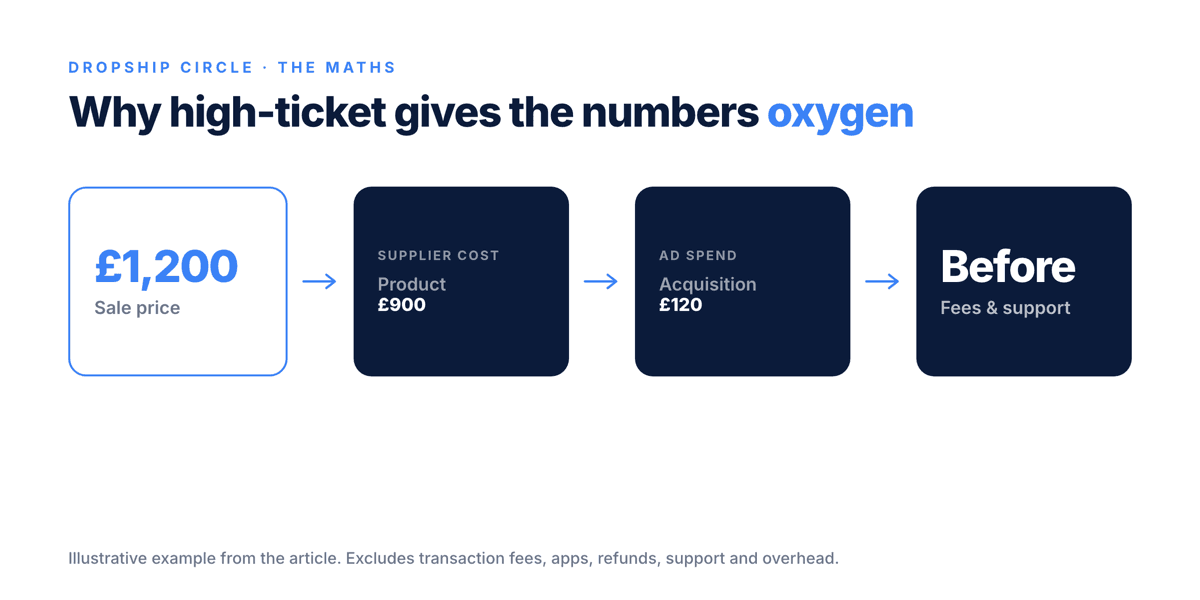
Take an illustrative example. If you sell a £1,200 sauna and your supplier cost is £900, you have £300 gross margin before ads, transaction fees, apps, refunds, support and overhead. If you spend £120 to acquire the customer, the order can still be workable. If your margin is £14 and ads cost £18 per purchase, you are paying to be busy.
That does not mean every expensive product is good. Some high-ticket categories are a nightmare: fragile items, unclear warranties, long lead times, low supplier responsiveness, awkward installations or heavy returns. A £2,000 problem is still a problem.
What products work best for Shopify dropshipping?
Good products are boring, proven, margin-rich and supplied by companies that can actually fulfil.
I like categories where buyers already know the product exists and are comparing options. You do not want to educate the whole market from zero. You want to enter demand that already exists and compete on range, clarity, service, price positioning, delivery information and trust.
Strong product traits often include:
Selling price high enough to support paid acquisition
Gross margin that still works after fees and ad spend
Clear use case, not a gimmick
Supplier based in or near the customer market
Manageable return likelihood
Sensible delivery process
Search demand on Google
Enough competitors to prove demand, but not so many that everyone is identical
Named examples could include saunas, commercial equipment, garden structures, premium furniture, home improvement items or specialist fitness equipment. Those are examples, not instructions to copy blindly.
How do you start dropshipping on Shopify step by step?
Start with niche maths, then supplier access, then build the Shopify store around a narrow offer.
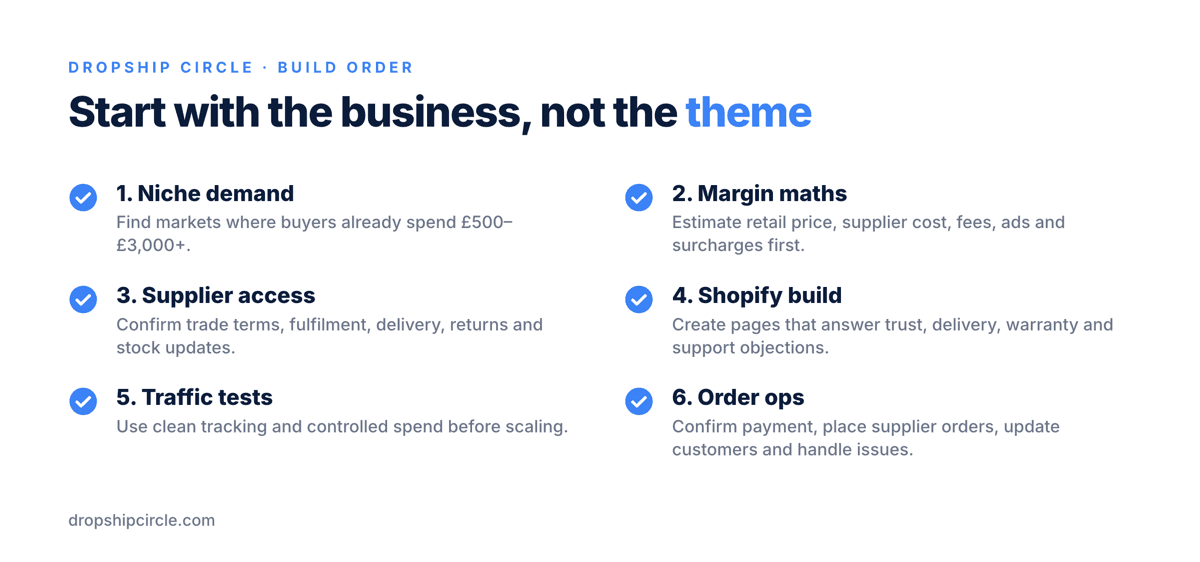
The worst way to start is by choosing a theme first. Your theme is not the strategy. The store should be built around the market, offer, supplier terms and customer questions.
Here is the practical order I would use if I were building from scratch again.
Step 1: Choose a niche with real buyer demand
Pick a niche where people already spend £500–£3,000+ and need trust before buying.
Use Google, Shopping results, competitor stores, supplier sites, Amazon category data where relevant, and search tools such as Ahrefs, Semrush or Google Keyword Planner. You are looking for evidence that buyers already search for these products and competitors are paying to be visible.
I would rather see 10 boring competitors selling a £1,400 product than a “secret winning product” nobody has heard of. Competition is not automatically bad. It often means demand exists.
Step 2: Work out the margin before you touch Shopify
Do not build a store until you can estimate gross margin per product and traffic tolerance.
Use a simple sheet. For each product, list:
Retail price: say £1,200
Supplier cost: say £900
Gross margin: £300
Payment fee estimate: say 2%–3% range depending on processor
Ad cost target: say £80–£180 initially
Delivery surcharge risk: £0–£100 depending on item
Net contribution before overhead: whatever remains
This is not accounting perfection. It is a sanity check. If the maths only works when ads are unrealistically cheap and nothing goes wrong, move on.
Step 3: Contact suppliers before pretending you have a business
Supplier access is the difference between a real store and a dressed-up catalogue.
For a UK or US supplier model, you need trade accounts, approved reseller terms, dropship arrangements, product data, delivery rules, warranty process and stock communication. This means email and phone calls. Yes, actual conversations.
A simple supplier email should cover:
Who you are and the niche store you are building
Which product ranges you want to sell
Whether they support direct-to-customer fulfilment
Trade pricing and minimum advertised price rules
Delivery times and costs
Returns, damages and warranty handling
Stock feed or inventory update process
Some suppliers will ignore you. Some will say no. Some will only work with you after your site looks credible. That is normal.
Step 4: Build a Shopify store that answers buyer objections
Your Shopify store should make a £1,000 buyer feel safe enough to enquire or order.
A high-ticket Shopify store needs more than a logo and 12 product imports. Build pages that remove doubt:
Clear homepage explaining the category and promise
Collection pages by product type, size, brand or use case
Product pages with specifications, delivery, warranty and FAQs
Contact page with email, phone or at least a credible support route
Shipping policy, returns policy, privacy policy and terms
About page that does not sound like AI sludge
Reviews or trust signals where legitimate
Tools vary, but the stack often includes Shopify, a decent theme, Google Analytics 4, Google Search Console, Google Merchant Center, Meta Pixel, an email tool such as Klaviyo or Shopify Email, and a live chat or helpdesk tool as the business matures.
Step 5: Drive traffic without lying to yourself
Traffic is not the goal; profitable demand capture is the goal.
For commercial products, Google Shopping and Search often make sense because the buyer is already looking. Meta can work for discovery and retargeting, but it needs strong creative and enough budget. SEO can become valuable, but it is not a week-one cash machine.
Start with clean tracking and small tests. If you spend £50 a day for 10 days, that is £500 of data. You should be looking at impressions, clicks, cost per click, add-to-carts, checkout starts, enquiries, calls and sales. If nobody even adds to cart, the problem may be offer, price, page trust or traffic quality.
Step 6: Operate the orders properly
A paid order is not the finish line; it is where fulfilment risk begins.
When an order comes in, you need to confirm payment, check fraud risk, place the order with the supplier, communicate delivery expectations, monitor dispatch, handle tracking, and support the customer. On a £1,500 item, a vague “your order is on the way” is not enough.
Have templates for:
Order confirmation
Delivery scheduling
Stock delay updates
Damage claims
Warranty requests
Refund and cancellation handling
This is the part that separates operators from course-watchers.
Which Shopify apps and tools do you actually need?
You need tracking, feeds, email and trust tools before you need gimmicky upsell apps.
Beginners often install 19 apps and wonder why their store is slow, messy and expensive. Apps should solve operational problems, not decorate the dashboard.
A lean stack for dropshipping on Shopify might look like this:
Essential tools for a Shopify dropshipping store
Tool category | Example tools | Why it matters |
|---|---|---|
Ecommerce platform | Shopify | Storefront, checkout, orders |
Analytics | GA4, Shopify Analytics | See what traffic and pages do |
Search visibility | Google Search Console | Track indexing and organic queries |
Shopping ads | Google Merchant Center | Feed products into Google Shopping |
Shopify Email, Klaviyo | Abandoned carts, post-purchase updates | |
Reviews | Judge.me, Loox, Trustpilot where appropriate | Adds proof if used honestly |
Support | Gmail, Gorgias, Zendesk, Tidio | Manage customer questions and issues |
Product feed management | Shopify feed apps or Merchant Center feeds | Keep product data clean |
The mistake is buying tools before you have process. A £60/month review app will not fix weak supplier selection. A fancy page builder will not fix a product with £40 margin and £90 acquisition cost.
Should you use AI for Shopify dropshipping?
AI is useful for drafts and structure, but it does not replace commercial judgement.
I use AI as a tool, not a priest. It can help outline product pages, summarise supplier specs, create FAQ drafts, structure ad angles and produce first-pass email templates. But numerical strategy, supplier claims, warranty wording and product specifications need human verification.
Inside Dropship Circle, students get an AI tool trained on 128 lessons and available inside the student system. It is built as support and structure around the course material, not as a magic shortcut that builds the business for them.
A sensible AI workflow is:
Feed it supplier specs.
Ask for a plain-English product page draft.
Check every number, claim and compatibility point.
Add operator judgement and buyer objections.
Publish only what you can stand behind.
What are the biggest risks with dropshipping on Shopify?
The biggest risks are weak margins, bad suppliers, cash-flow gaps and poor customer communication.
Dropshipping removes stock risk, but it does not remove business risk. Anyone presenting it as simple money without operational downsides is either new, dishonest or both.
The main risks I see are practical, not mysterious.
What can go wrong after you get an order?
Plenty can go wrong after payment, especially on high-ticket products.
Real issues include:
Supplier shows stock, but item is actually unavailable
Customer orders on Monday, supplier cannot dispatch until next week
Courier damages a heavy item in transit
Customer wants to cancel after you have placed the supplier order
Payment processor holds funds for review
Delivery address is remote and costs £85 more than expected
Warranty responsibility is unclear
This is why supplier terms matter before sales volume. If you do not know who pays for damage, returns or failed delivery, you are not ready.
How do you reduce risk without killing growth?
Reduce risk with tighter suppliers, clearer policies, tracked testing and honest customer updates.
You cannot remove risk entirely. You can make it manageable.
My basic rules:
Do not sell products unless you understand delivery and warranty terms.
Do not scale ads from one lucky order.
Do not rely on one supplier for an entire niche if alternatives exist.
Do not hide delivery times to increase conversion.
Do not spend tomorrow’s refund money today.
Do not use fake reviews or fake scarcity.
A store making fewer, cleaner sales with solid communication is healthier than a store creating 40 angry customers from bad fulfilment.
Is Shopify better than WooCommerce, Amazon or eBay for dropshipping?
Shopify is best for brand control; marketplaces bring traffic but limit control and margins.
This is a commercial decision. Shopify is not automatically better in every situation. It depends on whether you want to build your own customer acquisition engine or plug into existing marketplaces with more rules.
Here is the straight comparison:
Shopify vs other dropshipping channels
Channel | Main advantage | Main drawback | Best use case |
|---|---|---|---|
Shopify | Full brand, pricing and customer control | You must generate traffic | Building a niche ecommerce asset |
WooCommerce | Flexible and often cheaper at plugin level | More technical maintenance | Operators comfortable with WordPress |
Amazon | Huge buyer intent | Strict rules, fees, account risk | Approved products with strong fulfilment control |
eBay | Existing bargain-hunting traffic | Price pressure and lower trust control | Clearance, parts, simpler catalogue items |
Etsy | Niche handmade/custom demand | Not ideal for most supplier-led high-ticket goods | Handmade or personalised products |
For high-ticket supplier ecommerce, I prefer Shopify because you control the product page, the phone number, the brand, the email list, the category structure and the post-purchase experience. On marketplaces, you are usually renting attention under someone else’s rules.
That said, marketplaces can be useful for validation. If a product type sells repeatedly on eBay or Amazon at £700–£1,500, that is evidence of demand. It does not mean you should dropship there blindly.
How does Dropship Circle teach dropshipping on Shopify?
Dropship Circle teaches a UK and US supplier model built around high-ticket ecommerce fundamentals.
I built Dropship Circle because I was tired of the low-ticket, fake-scarcity, “winning product” culture that made people think dropshipping meant slow shipping and plastic gadgets. That objection is valid if you are talking about AliExpress-style arbitrage. It is not the model I teach.
DSC focuses on local suppliers, higher-ticket products, fewer sales with better margins, and the operating skills needed to build a real ecommerce store. The course was recently rebuilt and kept continuously up to date across all platforms because ecommerce education goes stale quickly if the operator behind it stops paying attention.
The rebuilt programme reflects the current high-ticket ecommerce model, supplier route and student needs. That matters because Shopify, ad platforms, supplier expectations and buyer behaviour do not sit still.
What should you expect from a serious ecommerce education product?
A serious programme should give structure, current thinking and operator judgement, not fantasy screenshots.
Any education product in this space should help you understand:
Niche selection
Supplier outreach
Shopify setup
Product page structure
Offer positioning
Paid traffic basics
Customer service
Cash-flow management
Testing and decision-making
It should also keep pace with the market. That is why DSC was recently rebuilt and is kept continuously up to date, with the in-system AI support tool kept current alongside it. Again, the tool does not do the work for them. It helps them navigate and apply the material with more structure.
Key takeaways
Dropshipping on Shopify needs supplier control, margin discipline and real ecommerce operations.
Dropshipping on Shopify works best when treated as real ecommerce, not a quick product-flipping trick.
The supplier model matters: UK and US supplier relationships can change shipping, trust and margin dynamics.
High-ticket products can offer more room for ads and support, but they also create higher-stakes fulfilment issues.
Budget for Shopify, apps, admin, traffic testing and a cash buffer; £0-start claims are not serious.
Most beginners should expect months of learning, testing and refinement, not instant consistency.
AI can support drafts and structure, but supplier terms, product claims and financial decisions need human verification.
Related reading
Frequently asked questions
Shopify dropshipping is legal and possible, but the hard part is suppliers, margins and fulfilment.
Can you really dropship on Shopify?
Yes, Shopify supports dropshipping because you can take orders through your store and have suppliers fulfil them directly to customers. The hard part is not the Shopify setup; it is finding products, suppliers and margins that work after ads, fees, delivery issues and support.
Is dropshipping on Shopify legal in the UK?
Yes, dropshipping is legal in the UK when you sell honestly, follow consumer law, provide accurate delivery and returns information, and handle taxes and business obligations properly. The fact that a supplier ships the item does not remove your responsibility to the customer.
How much money do I need to start Shopify dropshipping?
A lean launch can begin with hundreds, but serious testing often needs £1,000+ available for tools, setup, ads and cash buffer. The exact amount depends on your niche, traffic method, app stack and how quickly you want data.
Is high-ticket dropshipping better than normal dropshipping?
High-ticket dropshipping can be better because each sale may carry more gross margin, which gives you more room for ads and support. It is not easier by default; customers expect more trust, clearer delivery, stronger supplier handling and better communication.
Do I need a course to start dropshipping on Shopify?
No, you can learn from free resources, testing and direct operator experience. A good course can shorten the learning curve if it is current, practical and based on a real model rather than hype.
If you want to see the high-ticket supplier model explained properly, start with Dropship Circle’s free training. I’ll show you how I think about niches, suppliers, Shopify stores and the numbers behind the model: without pretending every beginner is one product away from an easy win.
Ready to Build Your Ecommerce Business?
Get started with our free training and discover the exact framework we use to build sustainable high-ticket stores.
Related articles

Building Your Store
How To Dropshipping On Shopify
How to dropshipping on Shopify, step by step: suppliers, store build, shipping rates, margins and what sinks stores.

Building Your Store
Shopify Dropshipping Apps: What a Serious Store Actually Needs
Shopify dropshipping apps ranked by real use case, margin impact, supplier model and fulfilment risk.

Building Your Store
Shopify Dropshipping Platform
A blunt operator guide to using Shopify as a dropshipping platform for high-ticket UK and US ecommerce without guru.